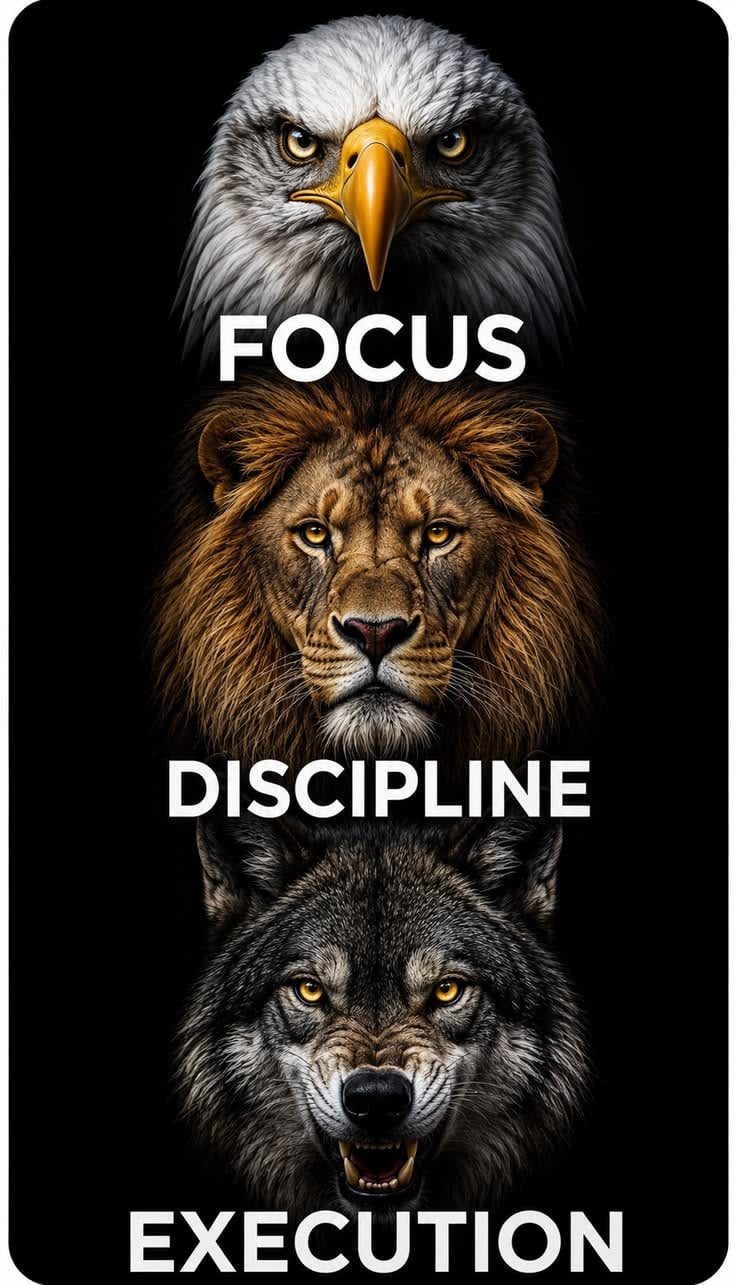
Focus, Discipline, Execution… See More
Success is rarely the result of luck alone. More often, it comes from three simple qualities that almost anyone can develop: focus, discipline, and execution.
You can have a brilliant idea, an ambitious dream, or a clear vision for your future. But an idea without action remains only an idea. A dream without discipline remains only a dream. And effort without focus can leave you exhausted without moving you any closer to your destination.
Focus gives you direction. Discipline keeps you moving. Execution turns your plans into reality.
The first step is learning how to focus.
Modern life constantly competes for your attention. Your phone vibrates. Social media offers endless entertainment. Other people’s opinions demand your attention. New opportunities appear every day. Before you realize it, hours have passed and you have accomplished very little that actually matters to you.
Focus means deciding what deserves your attention and deliberately ignoring what does not.
You cannot build everything at once. You cannot chase every opportunity. You cannot become excellent at ten different things simultaneously. At some point, you have to choose a direction and commit to it.
Ask yourself a simple question: What is the most important thing I need to accomplish right now?
Then work on it.
Not tomorrow.
Not when you feel motivated.
Now.
Focus does not mean working every minute of the day. It means giving your most important work your best attention. Even one uninterrupted hour of meaningful work can accomplish more than several hours of distracted activity.
When you focus, you stop measuring progress by how busy you look and start measuring it by what you actually accomplish.
The second quality is discipline.
Motivation is powerful, but it is unreliable. Some mornings you will feel inspired. Other mornings you will feel tired, frustrated, or completely uninterested in working toward your goals.
If your success depends entirely on motivation, you will constantly stop and start.
Discipline is different.
Discipline means doing what needs to be done even when you do not feel like doing it.
It means keeping promises you make to yourself.
If you decide to study for an hour, you study.
If you decide to exercise, you exercise.
If you decide to save money, you avoid unnecessary spending.
If you decide to build a business, you continue learning and improving even after the excitement disappears.
This does not mean being perfect. Everyone has bad days. Everyone makes mistakes. Everyone sometimes loses focus.
Discipline means returning to the path.
You do not have to be perfect to succeed. You have to be consistent.
Small actions repeated over time can produce extraordinary results.
Imagine someone who reads ten pages every day. Ten pages may seem insignificant, but after a year, that person will have read thousands of pages. Imagine someone who saves a small amount of money every week. The individual contribution may look small, but consistent saving can eventually create meaningful financial security.
The same principle applies to skills.
One hour of practice may not transform your life. But one hour every day for months and years can completely change your abilities.
Consistency turns ordinary actions into extraordinary results.
Then comes the third quality: execution.
This is where many people fail.
They plan.
They research.
They watch videos.
They buy books.
They create schedules.
They talk about their goals.
But they never actually begin.
Execution means taking the plan out of your head and putting it into the real world.
You do not need to know everything before you start. You need to start learning through action.
Your first attempt may be imperfect.
Your first business idea may fail.
Your first video may receive almost no attention.
Your first investment decision may teach you an uncomfortable lesson.
Your first project may contain mistakes.
That is normal.
Execution creates feedback.
Feedback creates learning.
Learning creates improvement.
Improvement creates progress.
You cannot think your way into experience. You have to act.
This is why successful people often appear different from people who constantly talk about success. They do not necessarily have better ideas. They simply turn their ideas into action more consistently.
They understand that progress requires movement.
You can spend months designing the perfect plan, or you can begin with a simple version and improve it along the way.
Action creates information that thinking alone cannot provide.
Once you execute, reality tells you what works and what does not.
Maybe your strategy needs adjustment.
Maybe your goal was unrealistic.
Maybe your timeline was too short.
Maybe you discovered a better opportunity.
That is valuable information.
Failure is not always evidence that you should quit. Sometimes failure is evidence that you need to change your approach.
Focus tells you where to go.
Discipline tells you to keep going.
Execution actually moves you forward.
These three qualities work together.
Without focus, discipline can become wasted effort because you may work extremely hard on the wrong thing.
Without discipline, focus can disappear whenever distractions or difficulties appear.
Without execution, focus and discipline remain theoretical.
You need all three.
Think about an athlete preparing for a major competition.
They need focus to understand their objective. They need discipline to train consistently. And they need execution to perform when the moment arrives.
The same applies to business, education, personal development, finances, and almost every other meaningful goal.
Your future is built through repeated decisions.
Every day gives you another opportunity to decide what deserves your attention.
You can spend another hour scrolling.
Or you can learn something.
You can complain about your circumstances.
Or you can improve one part of your situation.
You can wait for someone to rescue you.
Or you can begin building your own solution.
You cannot control everything that happens around you, but you can control many of your daily actions.
That is where your power begins.
Protect your focus.
Be careful about what you consume mentally. If you spend hours comparing your life with strangers online, your confidence can suffer. If you constantly listen to people who tell you that your goals are impossible, eventually their doubts may become your doubts.
Choose your environment carefully.
Spend time with people who encourage growth. Learn from people who have already achieved something you want to accomplish. Read information that expands your understanding. Give yourself periods of quiet where you can think without constant interruption.
Your attention is valuable.
Treat it like an investment.
Discipline also becomes easier when you create systems.
Do not depend entirely on willpower.
Make good habits easier.
Prepare your workspace.
Remove unnecessary distractions.
Create a schedule.
Set realistic targets.
Track your progress.
Build routines that make productive behavior normal rather than exceptional.
You do not need to wake up at an extreme hour or work twelve hours every day to prove that you are disciplined. Discipline is not about destroying yourself.
It is about becoming dependable.
You should be able to depend on yourself to take the next necessary step.
And execution becomes easier when you stop waiting for perfection.
Perfection can become procrastination disguised as preparation.
You tell yourself you need more knowledge.
More money.
More equipment.
More confidence.
More time.
Sometimes you simply need to begin.
Start with what you have.
Improve as you go.
Your first version does not have to be your final version.
The important thing is movement.
One day, you will look back and realize that the small decisions you made repeatedly were shaping your entire life.
The hour you spent learning.
The money you saved.
The workout you completed.
The project you started.
The distraction you ignored.
The difficult task you finished.
None of those moments may have felt life-changing at the time.
But together, they create your direction.
That is why you should stop underestimating small progress.
You do not need to change your entire life in one day.
You need to make better decisions consistently.
Focus on what matters.
Discipline yourself to continue.
Execute instead of endlessly planning.
Then repeat.
Again.
And again.
And again.
Eventually, what once seemed impossible may become normal.
Your confidence will grow because you will have evidence that you can trust yourself.
Your skills will grow because you practiced them.
Your opportunities will grow because you became more capable.
Your results will grow because you kept showing up.
The formula is simple, but it is not easy.
Focus. Discipline. Execution.
Focus on the destination.
Discipline yourself through the difficult days.
Execute even when the conditions are not perfect.
You do not need everyone’s approval.
You do not need to have everything figured out.
You do not need to move as fast as everyone else.
You simply need to keep moving in the right direction.
One focused day becomes a productive week.
One disciplined week becomes a strong month.
One strong month becomes a powerful year.
And one year of consistent execution can change the trajectory of your life.
So stop waiting for the perfect moment.
Choose your goal.
Clear away the distractions.
Build the discipline to stay committed.
Then take action.
Because dreams do not become reality through wishing.
They become reality through focus, discipline, and execution.
See more.