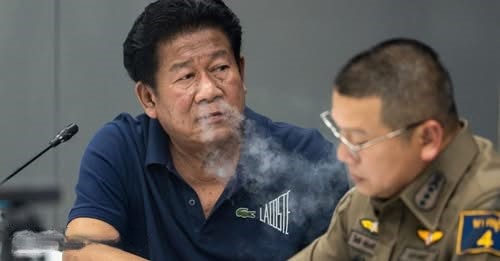
Thailand’s Gun Ownership Crisis: More Than 10 Million Civilian Firearms in Circulation… See More
Thailand is facing renewed debate over gun ownership and firearms regulation after a series of deadly shootings brought national attention to the number of weapons circulating among civilians.
Estimates cited by international researchers put the number of civilian-held firearms in Thailand at around 10.3 million. Of those, roughly 6 million were registered, while more than 4 million were estimated to be unregistered or unlicensed. These figures come from older Small Arms Survey estimates, so they should not be interpreted as a current official government count.
Even with that qualification, the numbers are striking.
Thailand has one of the highest rates of civilian firearm possession in Asia. The 2017 Small Arms Survey estimate works out to approximately 15 firearms for every 100 residents, placing Thailand behind only Pakistan in Asia at the time of that estimate.
The issue has become especially urgent following several violent shootings in recent years. In August 2026, a deadly shooting in Nonthaburi involving a 14-year-old suspect triggered another national discussion about how firearms are obtained, stored, licensed, and controlled.
The teenager reportedly used his grandfather’s handgun during the attack, illustrating one of the central concerns surrounding firearms: a weapon does not necessarily have to be purchased illegally to end up in the wrong hands.
Safe storage, supervision, licensing, and accountability can all play important roles in preventing access to firearms by people who should not have them.
The Thai government has responded to recent shootings by proposing stronger controls. Authorities have moved toward suspending new firearm licences and tightening enforcement surrounding possession and carrying. Prime Minister Anutin Charnvirakul has also called for tougher action against people carrying firearms in public.
The debate, however, is complicated.
Thailand already has laws governing firearm ownership. Supporters of stronger restrictions argue that the problem is not simply the existence of laws but enforcement, illegal weapons, licensing practices, storage, and the ability of firearms to remain in circulation outside official systems.
The millions of estimated unregistered weapons make the challenge particularly difficult.
An unregistered firearm can be harder for authorities to trace. It may have been inherited, acquired through informal channels, smuggled across borders, or circulated for years without being properly recorded. Experts have previously pointed to several possible sources for illegal weapons, including smuggling and firearms left over from earlier conflicts.
At the same time, legal gun owners argue that responsible citizens should not automatically be treated as criminals because of the actions of individuals who misuse weapons.
That disagreement is at the heart of Thailand’s gun-control debate.
Some legal firearm owners believe the government should concentrate on illegal weapons and people who use guns irresponsibly rather than imposing restrictions that affect everyone. Others argue that stronger rules are necessary because preventing dangerous access requires examining the entire system.
The recent shootings have intensified those arguments.
For many ordinary people, the question is no longer theoretical. When shootings happen in schools, government offices, shopping areas, or homes, communities are forced to confront the possibility that firearms can be accessible in places where people expect to be safe.
Schools are particularly sensitive environments.
Parents send children to school expecting them to learn, make friends, and return home safely. When a firearm enters that environment, the consequences can be devastating.
Following the recent violence, Thai authorities have discussed additional school security measures, including improved weapons detection, emergency procedures, and other safety protocols.
But experts and officials face a much larger problem than school security alone.
If millions of firearms remain in civilian circulation, reducing gun violence requires looking at what happens before a weapon reaches a dangerous situation.
Who can legally purchase a firearm?
Who can obtain a licence?
How are applicants checked?
How are firearms stored?
Are licences reassessed over time?
What happens when a firearm is inherited?
How are stolen or lost weapons reported?
And perhaps most importantly, how can illegal weapons already circulating in the country be identified and removed from circulation?
These questions are difficult, but they are central to the debate.
Another issue is the difference between gun ownership and gun carrying.
A person may legally own a firearm but still face restrictions on carrying it in public. Thai officials have recently emphasized that distinction, with the prime minister saying that carrying firearms in public should face stronger enforcement.
That distinction matters because a firearm kept securely at home presents a different risk from a firearm carried into a crowded public location.
There is also a cultural dimension to the issue.
Firearms have been present in parts of Thai society for generations, including among civilians, security personnel, police, and military members. Some people view firearms as tools for protection or security. Others see widespread civilian access as a major public-safety concern.
Neither side is likely to disappear from the debate.
Instead, Thailand is likely to continue searching for a balance between individual ownership, public safety, and effective enforcement.
The estimated 4 million unregistered firearms make that task especially difficult. If the estimate is even approximately correct, bringing those weapons into a regulated system would be an enormous undertaking.
Authorities would need to determine where the weapons are, who possesses them, whether they can legally be registered, and what should happen to weapons that cannot legally remain in civilian hands.
Governments in other countries have used different approaches, including voluntary surrender programs, amnesties, stricter licensing systems, buybacks, registration campaigns, and tougher penalties for illegal possession.
Each approach has advantages and limitations.
A surrender program, for example, may encourage people to hand over weapons they inherited or possess illegally without fear of immediate prosecution. But such programs only work if people trust authorities and believe participation is safe.
Stronger enforcement can remove illegal firearms from circulation, but enforcement alone may not solve the problem if new weapons continue entering illegal markets.
Better licensing can improve oversight, but it cannot automatically account for weapons that were never registered in the first place.
That is why Thailand’s challenge is larger than a single new law.
It is a long-term problem involving regulation, enforcement, education, storage, illegal markets, and public attitudes toward firearms.
The numbers also demonstrate why simple solutions are unlikely to be enough.
More than 10 million civilian firearms represent a huge existing stock of weapons. Even if new purchases were dramatically restricted, the firearms already in circulation would remain an issue for years.
This means that policymakers must consider both the future supply of firearms and the weapons already present in homes and communities.
For families, safe storage can be particularly important. A firearm that is legally owned can still become dangerous if children or other unauthorized people can access it.
The recent case involving a grandfather’s firearm has made that concern especially visible in Thailand. The tragedy has renewed questions about whether existing safeguards are sufficient to prevent unauthorized access to guns kept inside homes.
Ultimately, the debate is about more than statistics.
Behind every number is a real person, a family, and a community.
When a shooting occurs, the consequences can last for years. Families lose loved ones, survivors may carry emotional and physical scars, and communities can lose their sense of security.
At the same time, millions of responsible firearm owners do not want to be portrayed as criminals simply because they own a weapon legally.
Finding policies that address both realities will be difficult.
Thailand now faces pressure to strengthen its firearm regulations while also dealing with the large number of weapons already circulating outside formal registration systems.
The figure of more than 10 million civilian firearms—and more than 4 million estimated to be unregistered—is therefore more than a statistic. It represents the scale of the challenge facing authorities.
The exact numbers may change as better data becomes available, and the widely cited estimates are not a current official census. But the broader issue is clear: Thailand has a substantial civilian firearm stock and a significant gap between registered and estimated total weapons.
As the country continues debating stronger gun controls, the most important question may not simply be how many firearms exist.
It may be how effectively Thailand can ensure that the firearms that remain in civilian hands are legally owned, responsibly stored, properly monitored, and kept away from people who could use them to cause harm.
The coming years will show whether new restrictions and enforcement measures can reduce the risks associated with illegal and improperly controlled firearms.
For Thailand, the challenge is enormous—but so is the potential benefit of creating a system that protects communities while treating responsible ownership fairly.
The debate is far from over.
And with millions of firearms already in circulation, it is a debate that Thailand can no longer afford to ignore.