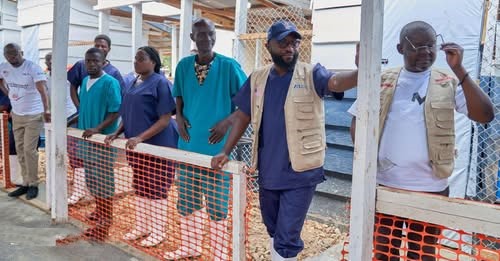
The Fastest-Growing Ebola Outbreak on Record Is Raising Global Alarm… See More
The Democratic Republic of the Congo is facing an extraordinary public-health crisis as an Ebola outbreak driven by the rare Bundibugyo virus continues to spread at an alarming rate.
The outbreak has become the fastest-growing Ebola outbreak recorded in history, according to recent reports, with thousands of confirmed cases and more than 2,300 deaths reported by August 17, 2026. Health officials are warning that the epidemic could become the largest Ebola outbreak ever recorded if transmission is not brought under control.
What makes the situation particularly concerning is the virus responsible for the outbreak.
The outbreak is being caused by Bundibugyo ebolavirus, one of the rarer species of Ebola known to infect humans. Before the current crisis, there had been only two documented outbreaks involving this strain, in 2007 and 2012.
Unlike the Zaire species of Ebola, for which approved vaccines and treatments exist, there is currently no approved vaccine or virus-specific treatment specifically licensed for Bundibugyo virus. Researchers are therefore working urgently to evaluate experimental vaccines and treatments while health workers rely heavily on supportive medical care and infection-control measures.
The outbreak was officially declared in the Democratic Republic of the Congo in May 2026, but genetic sequencing suggests the virus had already been circulating for months before authorities recognized the outbreak.
That delay is extremely important.
Ebola outbreaks are much easier to contain when health officials can quickly identify infected people, trace their contacts, isolate patients, and monitor anyone who may have been exposed. When transmission continues unnoticed, infected people can travel to other communities before anyone realizes that an outbreak is underway.
According to recent reporting, the earliest infections may have occurred as early as February. By the time the outbreak was officially recognized, the virus had already established transmission chains that were much harder to track.
This helps explain why the numbers have risen so quickly.
By August 17, authorities were reporting approximately 4,945 confirmed cases and 2,325 deaths. The outbreak had spread beyond its initial location in Ituri province into additional areas, creating an enormous challenge for health workers and emergency teams.
The numbers are especially striking when compared with previous Ebola outbreaks.
The devastating West African epidemic of 2014–2016 eventually killed more than 11,000 people, but it took considerably longer to reach major death milestones. The current outbreak has reached more than 2,000 deaths in a fraction of the time, making its speed of growth unprecedented.
However, the current outbreak should not be misunderstood as an airborne pandemic spreading like influenza or COVID-19.
Ebola is primarily transmitted through direct contact with the blood or other bodily fluids of an infected person, including during care of sick patients or handling of bodies after death. That means ordinary casual contact does not carry the same risk as direct exposure to infectious material.
This difference is important because fear and misinformation can make an outbreak harder to control.
When communities become frightened, people may avoid treatment centers or hide sick relatives. Misinformation can also create distrust toward health workers, making it more difficult for medical teams to identify cases and trace contacts.
That is already proving to be a major challenge in parts of the Democratic Republic of the Congo.
The affected areas have experienced years of conflict and insecurity. Armed groups operate in parts of the region, while millions of people have been displaced from their homes. Health facilities can be difficult to reach, and medical workers may face serious security risks.
Infrastructure is another problem.
Some communities are located far from major medical centers. Roads may be poor or unsafe, and transporting patients can take valuable time. When Ebola patients arrive for treatment late in the illness, their chances of survival can be reduced and the opportunity for further transmission increases.
Recent reports have also highlighted shortages of resources and disputes involving health workers who have not been paid.
That creates a dangerous cycle.
An outbreak requires more medical workers, laboratory staff, contact tracers, ambulance teams, community educators, and burial specialists. But if the health system itself is struggling, there may not be enough people or resources to respond at the speed required.
The international response is therefore focused on expanding treatment capacity, improving surveillance, identifying contacts, and developing medical tools specifically for Bundibugyo virus.
Experimental vaccines are now being studied in affected communities. Researchers are also evaluating potential treatments. These efforts are taking place under enormous pressure because scientists are trying to develop evidence about products that have never previously been widely used against this particular strain.
There is also an important scientific question about how the outbreak began.
Genetic research indicates that the virus likely originated through a zoonotic spillover event, meaning transmission from an animal into a human population. Once the virus entered humans, however, subsequent transmission occurred between people.
That distinction matters.
The animal origin does not mean the virus is automatically more dangerous. The major concern comes from what happens after human infection and how efficiently the virus spreads through communities.
The current outbreak also demonstrates why early detection is so important.
If the first cases had been recognized earlier, health authorities might have had more opportunities to interrupt transmission before the virus spread into multiple provinces.
Once an outbreak becomes geographically widespread, every additional infected person creates more potential contacts to investigate.
That is why contact tracing is one of the most important tools in an Ebola response.
Health workers identify people who may have been exposed, monitor them for symptoms, and quickly isolate anyone who becomes ill. The goal is to stop each transmission chain before it creates another generation of infections.
But this approach depends on cooperation.
Communities need to trust medical teams and understand why isolation, testing, safe burials, and contact monitoring are necessary. Without that cooperation, even well-equipped health systems can struggle.
The humanitarian situation makes the problem even more complicated.
Families are not simply dealing with a dangerous disease. Many are also living with poverty, displacement, insecurity, damaged infrastructure, and limited access to healthcare.
For some communities, the Ebola outbreak is another crisis added on top of several existing crises.
That reality means that controlling the outbreak requires more than medicine.
It requires security, transportation, trained health workers, laboratories, communication, funding, and cooperation with local communities.
The international community is therefore facing a difficult race against time.
The longer the virus continues spreading, the more difficult containment becomes.
Experts have warned that the outbreak could continue for many months. Recent assessments suggest that even under a moderate scenario, the epidemic may not peak immediately and could potentially last six to twelve months if major challenges remain unresolved.
Despite the alarming situation, there are reasons for hope.
Ebola can be controlled when effective surveillance, isolation, treatment, contact tracing, safe burial practices, and community cooperation are combined quickly.
The world has learned important lessons from previous Ebola outbreaks.
The experience of West Africa demonstrated how devastating delayed responses can be, but it also showed that international cooperation can eventually bring even large outbreaks under control.
The current crisis requires that those lessons be applied quickly.
For the people living in affected communities, the statistics are not abstract.
Every confirmed case represents a person.
Every death represents a family.
Every healthcare worker represents someone putting their own safety at risk to help others.
That human dimension can sometimes disappear beneath large numbers in news reports.
But behind the thousands of cases are communities trying to continue daily life while facing an extraordinary threat.
The Bundibugyo outbreak is also a reminder that infectious diseases can emerge in unexpected ways. Even after decades of progress against Ebola, rare viral species can still create new challenges.
This is why investment in disease surveillance, research, vaccines, medical infrastructure, and local healthcare systems remains so important.
The world cannot predict exactly where the next outbreak will begin.
But it can prepare to respond faster.
For now, the Democratic Republic of the Congo remains at the center of the crisis. Health workers are racing to identify infections, treat patients, protect families, and prevent further spread.
The numbers are already devastating.
And the speed at which they have risen is what has made this outbreak so extraordinary.
The rare Bundibugyo virus has turned a regional health emergency into a major international concern. With no approved vaccine or specific licensed treatment for the strain, researchers and health workers are facing an especially difficult battle.
The coming months will be critical.
If surveillance improves, communities cooperate, treatment capacity expands, and experimental vaccines and therapies prove useful, the trajectory could eventually change.
But until then, the outbreak remains a serious warning.
The fastest-growing Ebola outbreak on record is not simply a story about a virus.
It is a story about how quickly an infectious disease can spread when detection is delayed, healthcare systems are under pressure, conflict restricts access, and communities lose trust.
And it is a reminder that when an outbreak begins, every day matters.