Major Jason Watson Speaks Out Over Iran War… Read More
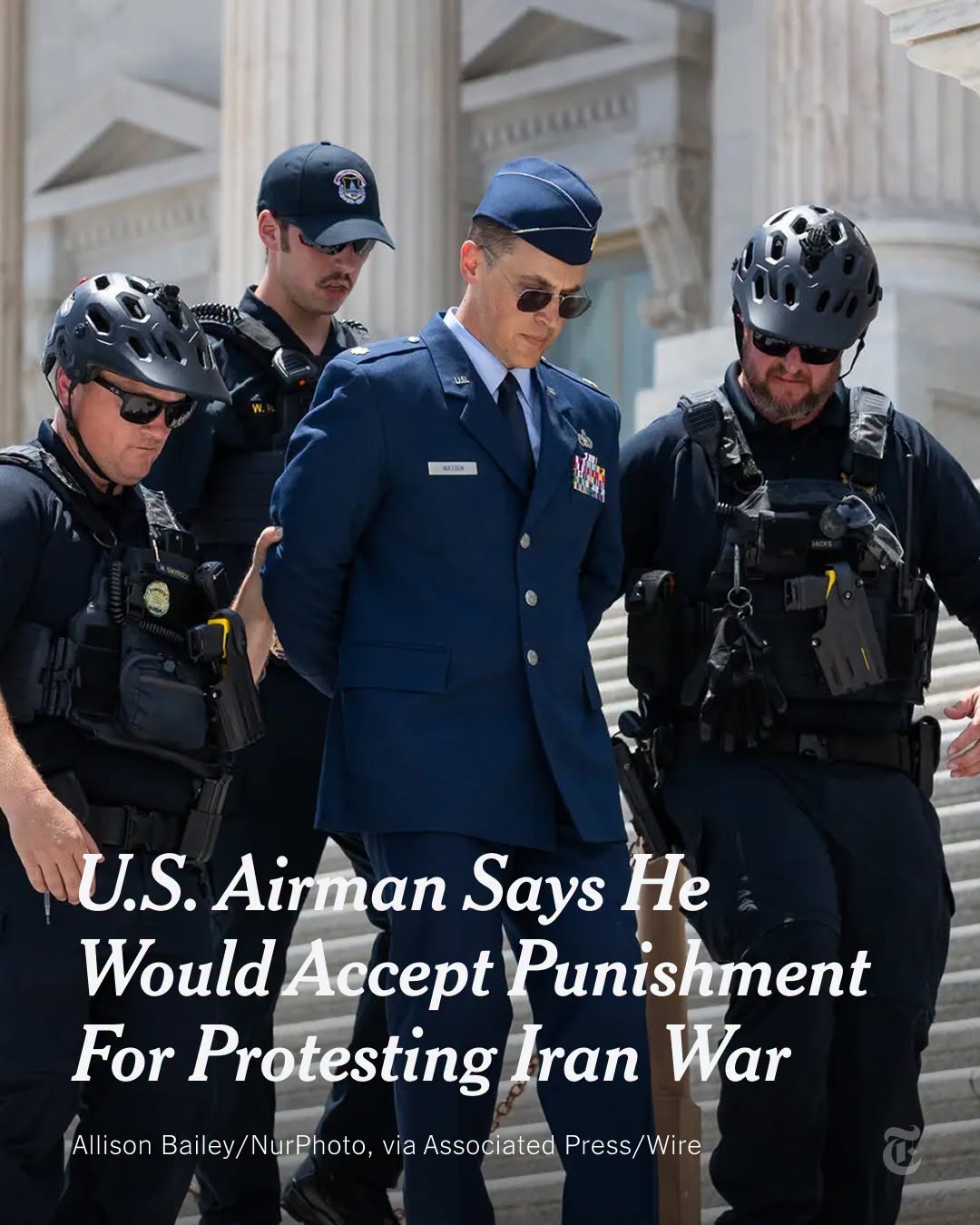
Major Jason Watson, a U.S. Air Force officer, has drawn national attention after publicly criticizing the Trump administration’s approach to the war with Iran and calling for President Donald Trump to be removed from office.
Watson’s comments have sparked a wider debate about military dissent, freedom of expression, and the responsibilities of members of the armed forces when they strongly disagree with government policy.
According to the account provided, Watson characterized the U.S. military campaign against Iran as an act of American aggression and compared the situation with Russia’s invasion of Ukraine. He also indicated that he understood his decision to speak publicly could carry consequences and said he was willing to accept punishment for his dissent.
That position raises an important question: How much freedom should military personnel have to publicly criticize the government they serve?
For ordinary citizens, political disagreement is a normal part of democratic life. People can criticize presidents, protest government decisions, write articles, organize demonstrations, and argue passionately about foreign policy.
Military personnel, however, operate under a different set of rules.
The armed forces depend on discipline, hierarchy, and lawful orders. Service members take an oath and accept restrictions that do not apply to civilians in the same way. Those restrictions exist because military organizations must be able to function effectively, particularly during wartime.
At the same time, members of the military remain citizens with constitutional rights.
That creates a difficult balance.
Watson’s case has therefore attracted attention beyond the specific controversy surrounding Iran. His actions raise broader questions about where military discipline ends and political expression begins.
His willingness to accept punishment is particularly significant.
Rather than claiming that consequences should not apply to him, Watson reportedly acknowledged that his public dissent could result in disciplinary action. His position appears to be that expressing his conscience was important enough for him to accept whatever consequences followed.
For supporters, that can look like an act of principle.
For critics, it can raise concerns about military discipline and whether active-duty personnel should publicly challenge the elected commander in chief during an ongoing conflict.
Both perspectives reflect a genuine tension within democratic societies.
Military members are expected to follow lawful orders, but democratic governments also depend on citizens who are willing to question government decisions.
The debate becomes even more complicated when the issue is war.
War involves enormous consequences. Military operations can result in deaths, injuries, displacement, economic disruption, and long-term political instability. Decisions made by government leaders can affect not only soldiers but also civilians thousands of miles away.
That is why disagreement over military action can become deeply emotional.
Watson’s comparison between American military actions in Iran and Russia’s invasion of Ukraine is especially provocative. Such comparisons are politically and morally charged, because Russia’s invasion of Ukraine has been widely condemned as an unlawful use of force by much of the international community.
By drawing a comparison, Watson appears to be challenging the justification for American military action and asking people to consider whether the United States should be applying the same standards to itself that it applies to other countries.
Supporters of U.S. policy would likely reject that comparison, arguing that American military actions may have different legal and strategic justifications.
The underlying disagreement, therefore, is not simply about one officer.
It is about how a country decides when military force is justified.
Who determines whether a war is necessary?
What legal authority supports it?
What objectives are being pursued?
What happens if those objectives fail?
And what responsibility does an individual service member have when they believe the government’s policy is fundamentally wrong?
These are difficult questions without easy answers.
History shows that military personnel have sometimes spoken out against wars and government policies. Some were praised for courage, while others faced disciplinary consequences. In many cases, the controversy continued long after the original conflict had ended.
Watson’s case is therefore part of a much larger American tradition of debate over war and dissent.
But there is another side that cannot be ignored.
Military organizations cannot operate if every individual decides whether an order is politically acceptable before carrying it out. The distinction between lawful and unlawful orders is therefore critical. Service members are expected to obey lawful orders, while unlawful orders must not be followed.
That framework exists precisely because military power is extraordinarily consequential.
The public also has a responsibility in discussions like this.
It is easy for a controversial military statement to become a viral political argument. One side may portray the officer as a hero standing up against government aggression. Another may portray him as undermining military discipline.
The reality can be more complicated.
A person can sincerely believe they are acting according to conscience while still violating military regulations. Conversely, a government can have legitimate authority to discipline a service member while the public still has a legitimate interest in hearing that person’s criticism.
Those ideas are not necessarily contradictory.
The most important question is ultimately whether democratic institutions can withstand disagreement without turning dissent into something that must automatically be silenced.
At the same time, dissent does not mean immunity from consequences.
Watson’s reported willingness to accept punishment acknowledges that reality.
His message appears to be that he believes speaking out was worth the personal cost.
Whether people agree with his position or strongly disagree with it, that decision has opened a conversation about military service, political responsibility, and the limits of dissent during wartime.
The Iran conflict has already generated difficult questions about American foreign policy. Watson’s public criticism adds another dimension by bringing those questions inside the military itself.
His case will likely continue to attract attention because it touches on issues larger than one individual.
It is about war.
It is about power.
It is about obedience.
It is about conscience.
And it is about the difficult balance between maintaining military discipline and preserving a democratic culture in which people can challenge the decisions of their government.
Ultimately, the debate should not be reduced to whether someone is simply “for” or “against” America.
Citizens can disagree about war while still caring deeply about their country.
Service members can disagree with government policy while still believing in the institutions they swore to defend.
And governments can enforce military rules while still allowing broader public debate about the wisdom of their decisions.
That is what makes cases like Watson’s so complicated.
His statement has forced attention onto a question that democracies have confronted for centuries:
When a person believes their government is making a grave mistake, how far should they go to speak against it—and what consequences should they be prepared to accept?
For Major Jason Watson, the answer appears to have been clear: he was willing to speak, even knowing that dissent could come with a price.
What happens next will depend on the facts of the case, the applicable military rules, and the decisions of the authorities responsible for reviewing his conduct.
But regardless of where people stand politically, his story has become part of a larger national conversation about war, military duty, freedom of expression, and the meaning of dissent in a democracy.