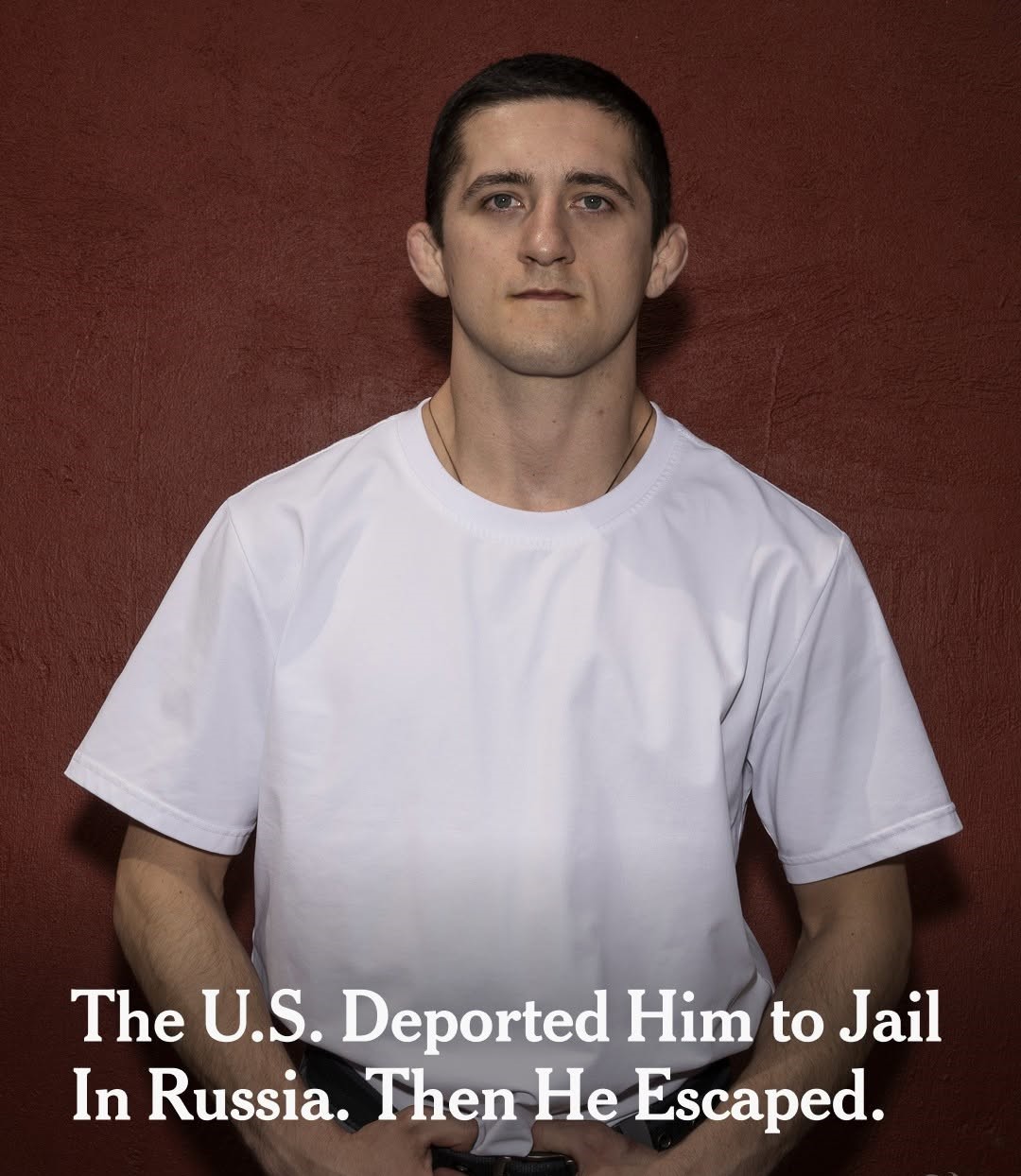
He Was Deported Back to Russia—Then He Escaped Again… Read More
Artyom Vovchenko’s story is one of those extraordinary journeys shaped by war, fear, detention, deportation, and an extraordinary determination to escape.
According to the account provided, Vovchenko had served in the Russian military before deciding that he could no longer support the war in Ukraine. He deserted and eventually fled Russia, hoping to find protection in the United States.
Instead, his journey through the American immigration system left him detained for more than a year.
By the time his deportation flight arrived in Moscow, he had reportedly spent 13 months in three different U.S. detention centers. His request for asylum had been denied, and he was returned to the country he had fled.
The stakes were enormous.
Returning to Russia meant potentially facing criminal prosecution for desertion and opposition to the war. According to the account, he faced the possibility of a prison sentence of up to 10 years.
For someone who had already risked everything to leave Russia, being forced back must have been devastating.
But the story did not end when he landed in Moscow.
It was only the beginning of another escape.
Vovchenko reportedly managed to escape again after returning to Russia, despite the danger surrounding him.
His story illustrates the complicated reality faced by some Russian citizens who have opposed the war in Ukraine, particularly those with connections to the country’s military.
Since Russia launched its full-scale invasion of Ukraine in February 2022, thousands of people have attempted to leave the country for different reasons. Some feared military mobilization. Others opposed the war politically or morally. Some simply wanted to avoid being sent to the battlefield.
For military personnel, the consequences can be particularly serious.
Desertion during wartime can carry severe criminal penalties, making the decision to leave the military an extraordinarily risky one.
For someone like Vovchenko, the choice was reportedly not simply about finding a better life somewhere else.
It was about avoiding participation in a war he opposed.
That distinction is important.
People fleeing conflict are often described in statistics—numbers of migrants, asylum seekers, detainees, or deportees. But behind each number is an individual story.
There is a person who made a decision.
There is a family that may have been left behind.
There are fears about what might happen next.
And there is often uncertainty about whether another country will provide protection.
Vovchenko’s experience also highlights the complexity of the U.S. asylum system.
Seeking asylum does not automatically guarantee protection. Applicants must meet legal requirements and convince immigration authorities or courts that they qualify under the applicable rules.
Some applicants spend long periods in detention while their cases move through the system.
For someone fleeing a government they fear, being detained for months or years can be psychologically exhausting.
The uncertainty can be overwhelming.
Every hearing can feel like a decision about the future.
Every delay can create additional anxiety.
And when an asylum application is ultimately denied, the consequences can be enormous.
For Vovchenko, deportation reportedly meant being sent directly back into the environment from which he had escaped.
That is why his eventual escape from Russia is such a striking part of the story.
After surviving detention in the United States and being transported back to Russia, he apparently found another opportunity to leave.
The details surrounding his escape are crucial, but they also need to be understood carefully. Stories involving immigration, military desertion, and international deportation can contain sensitive information, and early reports may not include every detail.
What is clear from the account is that his determination did not disappear after deportation.
He had already left once.
When he was forced back, he tried again.
His story also raises broader questions about the responsibilities of countries when dealing with people who claim they are fleeing persecution or punishment for political reasons.
How should governments evaluate the claims of people who deserted an opposing military?
What happens when immigration law conflicts with concerns about possible persecution after deportation?
How should authorities determine whether someone is genuinely at risk?
These questions are difficult because every case is different.
There are legitimate immigration laws that governments enforce, but there are also international principles concerning refugees and people who face serious danger if returned to their home countries.
The tension between those principles can become especially complicated during wartime.
Russia’s war in Ukraine has created one of the largest geopolitical crises in Europe in decades. Millions of Ukrainians have been displaced, while Russian citizens have also faced major consequences from the conflict, including military mobilization and restrictions connected to dissent.
For opponents of the war, speaking publicly can carry significant risks.
For soldiers, refusing military service or deserting can create additional legal problems.
Vovchenko’s journey therefore reflects a much larger story about individuals caught between governments, wars, borders, and legal systems.
But there is another important element: resilience.
When someone loses their freedom, spends months in detention, and is then returned to a country where they fear imprisonment, it would be understandable for them to feel defeated.
Yet Vovchenko reportedly escaped again.
That does not mean the danger disappeared.
An escape is not necessarily the end of a crisis. It can create another series of challenges—finding a safe location, securing legal status, reconnecting with loved ones, and figuring out what happens next.
For people following his story, the most important thing is to remember that this is not simply a dramatic tale of escape.
It is a story involving real legal and human consequences.
Every stage—from military service to desertion, asylum, detention, deportation, and escape—can profoundly affect a person’s future.
It also demonstrates why the treatment of asylum seekers and military deserters remains such an important international issue.
People fleeing wars do not all have the same reasons for leaving.
Some are escaping bombs.
Some are escaping persecution.
Some are escaping military service.
Some are fleeing political repression.
And some are facing several of these dangers at once.
Understanding those differences matters.
Vovchenko’s reported experience is ultimately a reminder of how complicated life can become when an individual decides to oppose a war and leave the country demanding their loyalty.
He left Russia because he did not want to participate in the war.
He sought protection in America.
He spent more than a year in detention.
His asylum claim was denied.
He was deported back to Russia.
And then, despite everything, he escaped again.
Whatever happens next, his journey illustrates the extraordinary risks that individuals can face when personal conscience collides with military obligation and international politics.
His story is not simply about crossing borders.
It is about what a person is willing to risk when returning home may mean losing their freedom.
And it leaves behind a powerful question:
How far would someone go to escape a war they believe they cannot morally participate in?
For Vovchenko, the answer appears to have been extraordinarily far.