Trump Attacks CNN Reporter After Heated Exchange — See More
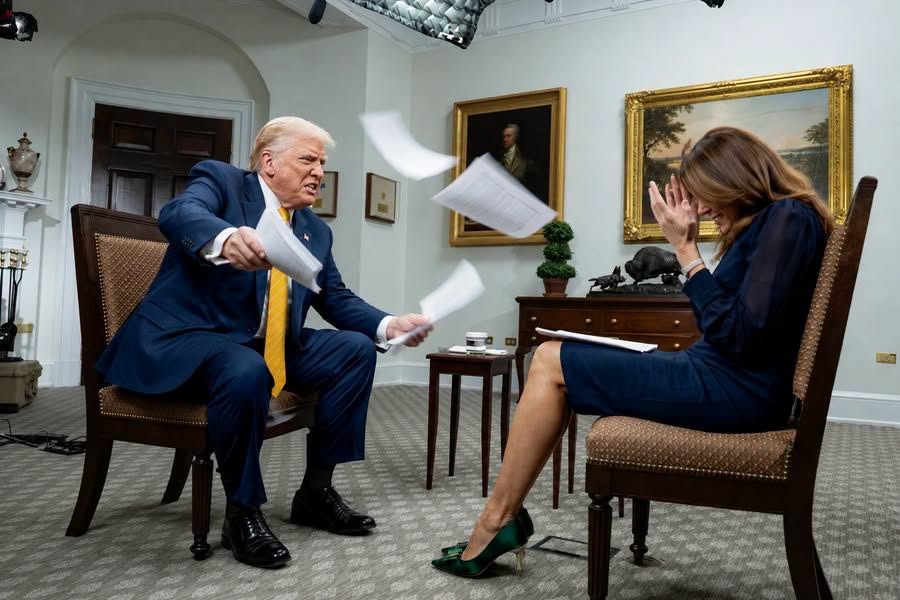
A tense confrontation between President Donald Trump and CNN correspondent Kristen Holmes has once again drawn national attention to the increasingly combative relationship between the White House and the press.
The exchange took place during an Oval Office event when Holmes asked Trump a pointed question concerning remarks made by Democratic Senator Jon Ossoff about the president and his close aide, Natalie Harp.
Trump did not respond quietly.
Instead, he interrupted the reporter and criticized both her question and CNN, calling her “fake news” and “disrespectful” and telling her to be quiet. The confrontation quickly became a major subject of discussion across news organizations and social media.
But the story did not end when the exchange inside the Oval Office was over.
The White House’s Rapid Response account subsequently posted criticism of Holmes online, escalating the dispute beyond the original exchange. The posts became particularly controversial because they went beyond criticism of Holmes’s reporting and made personal references involving her family.
CNN responded by defending Holmes and arguing that she was doing the job journalists are expected to do: asking difficult questions of people in positions of power.
The confrontation therefore became about more than one reporter and one president.
It became part of a much larger debate about the relationship between political leaders and the press.
Presidents have always faced difficult questions from journalists. Reporters are expected to challenge officials, request explanations, and ask about controversial statements or decisions.
Presidents, meanwhile, have the right to criticize coverage they believe is unfair.
But the disagreement becomes more controversial when criticism turns personal.
That is precisely what attracted attention to the Holmes incident.
The original question concerned Natalie Harp, a Trump aide who has recently received increased media attention. Holmes referenced Ossoff’s criticism of Trump’s priorities and asked the president for his response. Trump rejected the premise and attacked the reporter’s manner and credibility.
The exchange was captured on video, allowing viewers to watch the confrontation for themselves.
That has made the incident particularly easy to share online.
Short clips can be removed from their original context, reposted with dramatic captions, and interpreted very differently depending on the political viewpoint of the person sharing them.
This is where headlines can become misleading.
A headline claiming that Trump “attacked a CNN reporter after she accused him of killing…” suggests an entirely different confrontation from the one documented by credible reporting.
There is no reliable evidence in the sources reviewed that Holmes accused Trump of killing someone.
The actual dispute centered on her questions about Ossoff’s remarks and Trump’s relationship with Harp.
That distinction is important.
Political journalism already operates in an environment filled with competing narratives. When an inaccurate phrase is added to a genuine event, readers can easily come away believing something that never happened.
The controversy surrounding Holmes also reflects a broader pattern.
Trump has frequently clashed with journalists whose questions he considers hostile. His relationship with CNN has been particularly contentious, with the president repeatedly criticizing the network and its reporting.
CNN, for its part, has defended its reporters and argued that journalists must be able to question government officials without being subjected to personal intimidation.
The Holmes episode therefore became another chapter in a long-running battle over the boundaries of presidential criticism.
How should a president respond when confronted with an aggressive question?
How should journalists challenge a president who refuses to answer?
When does criticism of the press become a personal attack?
And how should news organizations respond when one of their reporters becomes the target of criticism from the White House?
These are difficult questions.
A healthy democracy requires both accountable government and a press that is free to ask uncomfortable questions.
Journalists cannot perform that role if they are expected to ask only friendly questions.
At the same time, reporters have a responsibility to be accurate, fair, and prepared to support their claims.
The relationship therefore involves tension by design.
The press is supposed to challenge power.
Political leaders are supposed to answer to the public.
That does not mean every exchange will be polite.
But it does mean the public benefits when disagreements remain focused on facts and policy rather than personal attacks.
The reaction to the Holmes confrontation demonstrated how divided American politics remains.
Supporters of Trump praised his willingness to push back against a reporter they viewed as hostile.
Critics argued that the president’s response was inappropriate and that journalists should not be personally targeted for asking difficult questions.
CNN strongly defended Holmes, describing her as a respected journalist doing her job. Other journalists also expressed concern about the White House’s subsequent attacks.
Meanwhile, the story surrounding Natalie Harp has continued to attract attention.
Recent reporting has examined her unusually close role around Trump and her history working alongside him. A CNN report also brought renewed attention to an incident in which Harp reportedly rode in the trunk of an SUV to accompany Trump to a New York court appearance in 2023.
That reporting has added another layer to the controversy.
But again, it is important to separate established reporting from speculation.
A public disagreement between a president and a journalist is newsworthy.
A viral claim that changes the substance of what was actually said is something else entirely.
Readers should therefore be cautious with shortened clips and sensational captions.
Watch the full exchange when possible.
Read multiple accounts.
Look for the reporter’s actual question.
And distinguish what was said from what someone later claimed was said.
The incident involving Trump and Holmes is significant because it illustrates the continuing tension between the administration and parts of the American news media.
It also demonstrates how quickly a few seconds of confrontation can dominate political discussion.
One question becomes a headline.
The headline becomes a social-media clip.
The clip becomes a political argument.
And before long, the original context can disappear.
That is why accuracy matters.
Trump did confront CNN reporter Kristen Holmes.
He did criticize her question and CNN.
He did tell her to be quiet.
And the White House subsequently escalated its criticism of her online.
But the claim that she accused Trump of killing someone is not supported by the reporting reviewed here.
The real story is already dramatic enough.
It is a story about presidential power, press freedom, political polarization, and the increasingly aggressive relationship between the White House and journalists.
And as the political environment becomes even more intense, these confrontations are likely to continue.
For citizens, the best response is not simply to choose whichever headline confirms their existing beliefs.
It is to look at what actually happened.
Because in an era when a few words can turn a real event into a completely different story, the truth is often found not in the most dramatic headline—but in the full exchange.