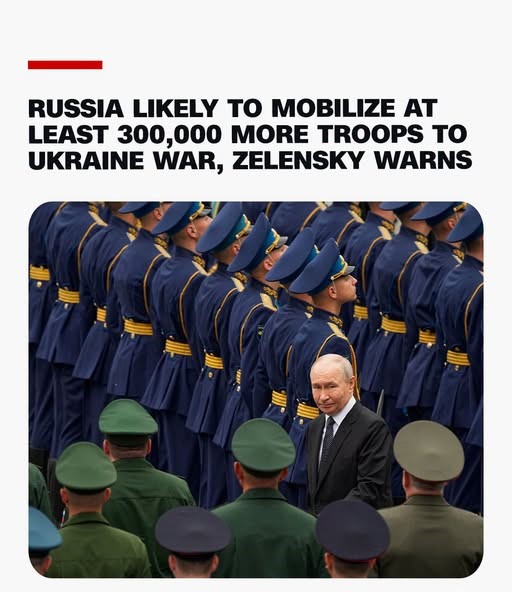
Russia Could Mobilize Another 300,000 Troops Later This Year, Zelensky Says… See More
A new warning from Ukrainian President Volodymyr Zelensky has put the spotlight back on Russia’s military manpower and the possibility of another major recruitment drive.
According to Zelensky, Russia could seek to mobilize approximately 300,000 additional troops after its September parliamentary elections. Reuters reported the claim on August 23, 2026, noting that Zelensky believes Moscow could ultimately seek to bring as many as 500,000 additional personnel into the military by 2027.
That is an enormous number.
But there is an important distinction: this is Zelensky’s assessment, not a confirmed Russian announcement that 300,000 people will definitely be mobilized.
The difference matters.
Russia has not publicly confirmed such a new mass mobilization. In fact, recent reporting indicates that Moscow has been trying to avoid repeating the large-scale mobilization announced in 2022, instead relying heavily on voluntary recruitment through military contracts and financial incentives.
Still, the possibility of another mobilization is being watched closely.
The reason is simple.
The war in Ukraine has continued for years, and maintaining a large military force requires a constant flow of personnel. Russia has suffered significant battlefield losses while attempting to maintain pressure along the front.
Zelensky says Moscow is preparing for the possibility of sending significantly more troops into the war.
According to his assessment, the additional manpower would support Russia’s continuing efforts to seize territory in eastern Ukraine, particularly in the Donbas.
The Donbas remains strategically important because Russia has repeatedly identified control of the region as one of its central war objectives.
The fighting has been particularly intense around cities and defensive positions in eastern Ukraine.
For Ukraine, the possibility of another Russian recruitment campaign creates another major challenge.
Ukraine is already dealing with its own manpower difficulties.
A prolonged war requires soldiers to remain on the battlefield for extended periods, while wounded personnel need treatment and experienced troops eventually need rest and replacement.
Adding hundreds of thousands of Russian personnel could therefore change the military calculations, even if those recruits were not immediately ready for combat.
New recruits need training.
They need equipment.
They need commanders.
They need transportation, logistics, ammunition, medical support, and organizational structures.
Simply increasing the number of people in uniform does not automatically create an effective fighting force.
That is an important point when considering the 300,000 figure.
Numbers alone do not determine the outcome of a war.
Training, leadership, morale, equipment, intelligence, air defense, artillery, drones, logistics, and industrial capacity all matter.
Nevertheless, a large recruitment campaign could give Russia greater manpower reserves and potentially allow commanders to rotate troops more frequently or sustain offensive operations for longer periods.
That is one reason Ukrainian officials are watching Russian recruitment patterns so closely.
Russia’s experience in 2022 also explains why the word “mobilization” carries enormous political weight.
In September 2022, Russian authorities announced a partial mobilization of reservists for the war in Ukraine. The announcement triggered widespread concern inside Russia, including significant public anxiety and an exodus of people attempting to leave the country. The government subsequently sought to rely more heavily on other recruitment methods.
A second large-scale mobilization could therefore carry substantial political and economic consequences.
Russia would need to take people away from civilian employment.
Businesses could lose workers.
Families could face uncertainty.
Regional governments would have to manage recruitment.
And the Kremlin would need to explain why another major call-up was necessary.
That may help explain why Russia has increasingly emphasized voluntary enlistment.
Recent reporting indicates that the Kremlin has been offering substantial financial incentives for military contracts, particularly in poorer regions, while regional authorities have been given recruitment targets.
This approach allows Moscow to add personnel without announcing another highly visible nationwide mobilization.
But there are limits.
If battlefield losses continue to exceed the number of new recruits, the pressure on the Russian military could increase.
That is where Zelensky’s warning becomes significant.
He argues that Russia may eventually decide that voluntary recruitment is insufficient and that a larger mobilization is necessary.
According to Reuters, Zelensky believes Russia could pursue a new recruitment effort following the September parliamentary elections.
The timing is notable.
Holding such a mobilization before an important political event could create domestic problems. Waiting until afterward could potentially make the decision politically easier.
But again, this is an assessment of Russian intentions, not confirmation that the Kremlin has already made the decision.
That distinction should remain clear.
In wartime, both sides have strong incentives to emphasize the other’s weaknesses.
Military leaders may make public statements to influence allies, adversaries, and their own populations.
That does not mean the claims are automatically false.
It means they should be evaluated carefully.
Independent reporting is particularly important.
And there is evidence that Russia is preparing for the possibility of increased military recruitment. The Wall Street Journal reported today that Russia has been conducting nationwide readiness exercises related to potential military mobilization, although no final decision had reportedly been made.
That development makes the broader discussion more serious.
At the same time, analysts have pointed out that a new mass mobilization would create problems for Russia as well.
Training hundreds of thousands of people takes time.
Equipping them is expensive.
Housing and feeding them requires resources.
Sending poorly trained troops into combat can produce devastating losses.
And removing large numbers of working-age men from the civilian economy can create additional pressure.
So the question is not simply:
“Can Russia find 300,000 people?”
It is:
“Can Russia recruit, train, equip, organize, and sustain 300,000 additional troops effectively?”
That is a much more complicated question.
The answer could have major consequences for the war.
For Ukraine, another Russian manpower surge could mean increased pressure along already contested sections of the front.
For Russia, it could provide additional reserves but also create significant domestic costs.
For Europe and the United States, another mobilization could signal that Moscow expects the conflict to continue rather than end quickly.
And for civilians on both sides, it would mean more families facing the consequences of a war that has already lasted far longer than many expected.
There is also the question of what Russia actually wants to accomplish with additional manpower.
Zelensky has argued that Moscow continues to seek control over the remaining Ukrainian territory it does not currently hold in the Donbas. Reuters reported that he believes Russia’s military objectives remain ambitious despite the enormous losses associated with its offensive operations.
If that assessment is correct, additional troops could be intended not simply for defense but to sustain offensive pressure.
Yet more troops do not guarantee territorial gains.
Ukraine has repeatedly demonstrated that defensive positions, drones, artillery, mines, intelligence, and fortifications can make advances extremely costly.
Russia could therefore face another difficult calculation.
More personnel might allow it to keep attacking.
But if the attacks continue producing heavy casualties for limited territorial gains, the cost of mobilization could become increasingly difficult to justify.
This is why the next several months could be important.
The September parliamentary elections will be closely watched.
Russian recruitment numbers will be examined.
Regional military quotas will attract attention.
And analysts will look for evidence of whether Moscow is actually preparing a nationwide mobilization or simply expanding its existing recruitment system.
For now, the safest conclusion is this:
Zelensky has warned that Russia may seek another 300,000 troops later this year, but that number should be understood as a Ukrainian assessment rather than a confirmed Russian mobilization order.
The possibility is serious enough to monitor, particularly because reporting indicates that Russia is already taking steps associated with military mobilization readiness.
But until the Kremlin officially announces a new call-up, nobody can say with certainty that 300,000 additional troops will actually be mobilized.
The war remains unpredictable.
Military strategies can change.
Diplomatic efforts can alter calculations.
Recruitment numbers can rise or fall.
And decisions made in Moscow, Kyiv, Washington, and European capitals could dramatically change the situation.
One thing is certain, however: the prospect of another large Russian recruitment campaign would represent a significant development in a war already marked by enormous human and economic costs.
For millions of people watching from outside the conflict, the hope remains the same—that the fighting eventually ends through a durable agreement rather than another cycle of mobilization, escalation, and loss.
Until then, every claim about hundreds of thousands of additional troops deserves careful attention, reliable sourcing, and a clear distinction between what has been confirmed and what is being predicted.
See More…