U.S. Cancels Major Joint Amphibious Exercise With South Korea Amid Iran War — See More
A significant change in U.S.-South Korean military planning has drawn attention across Asia after Washington canceled a major joint amphibious exercise that had been scheduled for next month, citing limits on the availability of American forces because of the ongoing war in Iran.
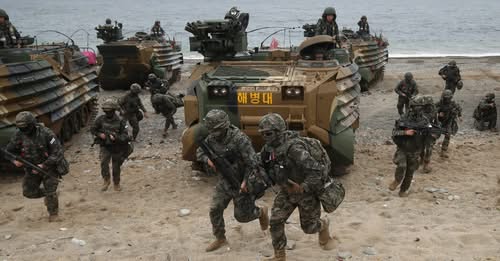
South Korea’s Marine Corps confirmed the cancellation on Monday, August 24, saying the United States had informed its South Korean counterpart that American force availability would be constrained. The exercise, known as Ssangyong, is a major combined training event involving U.S. and South Korean Marines.
The decision is significant because Ssangyong is designed to strengthen the two countries’ ability to conduct large-scale joint operations. The exercise normally involves amphibious forces, naval assets, aircraft and ground troops practicing coordinated operations.
Instead of moving forward in September, the exercise has now been canceled.
The U.S. Marine Corps reportedly notified its South Korean counterpart in June that American forces would not be sufficiently available for the division-level exercise. South Korean officials have indicated that the decision was connected to the demands created by the conflict in Iran.
For South Korea, the development comes at a sensitive moment.
The country relies heavily on its military alliance with the United States as a central part of its defense strategy against North Korea. Approximately 28,500 U.S. troops are stationed in South Korea, and combined exercises are considered an important component of maintaining readiness and interoperability between the two militaries.
The cancellation of Ssangyong also follows another major adjustment.
Earlier this month, the United States and South Korea significantly reduced the annual Ulchi Freedom Shield exercise. The drill, which began on August 17, was shortened from 11 days to five, while some field-training activities were reduced, canceled or converted into simulations.
The changes have generated questions about the future direction of the U.S.-South Korean alliance.
President Donald Trump has criticized the cost of large military exercises and has also pointed to his relationship with North Korean leader Kim Jong Un. He has argued that some exercises can send an unnecessarily hostile message toward Pyongyang.
At the same time, the Iran conflict has placed additional demands on U.S. military resources.
American forces and equipment have been deployed or redirected toward the Middle East, creating difficult decisions about where troops, ships and aircraft should be positioned. The cancellation of Ssangyong demonstrates how developments thousands of miles away can directly affect military planning on the Korean Peninsula.
For military planners, exercises are more than symbolic demonstrations.
They provide opportunities for troops from different countries to practice communications, logistics, command structures and coordinated operations. Large amphibious exercises are particularly complex because they require naval forces, aircraft, Marines and ground units to operate together.
Canceling such an exercise therefore means losing a training opportunity.
However, officials have not indicated that the cancellation represents the end of U.S.-South Korean military cooperation.
The two countries continue to maintain their alliance, and the cancellation is being described as a consequence of current force-availability constraints rather than a permanent abandonment of combined military training. Seoul and Washington remain in discussions about their future plans.
Still, the timing has attracted considerable attention.
North Korea has consistently criticized U.S.-South Korean military exercises, describing them as preparations for an invasion. Pyongyang has reacted negatively even when the exercises have been reduced. Following the recent scaling back of Ulchi Freedom Shield, North Korea reportedly launched 10 short-range ballistic missiles and condemned the exercises.
That creates a complicated strategic environment.
If the United States reduces exercises, North Korea may interpret the decision as a sign that Washington is less willing to maintain a large military presence in the region.
But if Washington and Seoul conduct large exercises, North Korea may use them as justification for additional weapons testing or military provocations.
The allies therefore face a difficult balancing act.
They must maintain military readiness without unnecessarily escalating tensions.
The latest cancellation also raises broader questions about America’s commitments to its allies in Asia.
Japan, South Korea and other regional partners closely watch changes in U.S. military deployments because their security strategies are closely connected to American power.
Recent reports have noted concerns among U.S. allies about whether Washington’s focus on the Iran conflict could reduce its ability to deter threats elsewhere.
For South Korea, the concern is particularly immediate because North Korea continues to maintain a substantial nuclear and missile program.
Military readiness therefore remains a national priority.
At the same time, South Korea has its own increasingly capable armed forces and has repeatedly discussed strengthening its ability to take greater responsibility for national defense.
The cancellation of Ssangyong could consequently become part of a larger discussion about how much responsibility each ally should carry.
The United States has long encouraged its allies to contribute more to regional security and defense. South Korea, meanwhile, has continued investing heavily in modernizing its military.
But alliance relationships are built not only on weapons and troop numbers.
They also depend on confidence.
Regular joint exercises demonstrate that two militaries can operate together when necessary. When those exercises are reduced or canceled, analysts naturally ask whether the changes are temporary responses to circumstances or indications of a broader strategic shift.
That question is particularly important now because the cancellation comes alongside reductions to another major U.S.-South Korean exercise.
For the moment, officials continue to emphasize the practical explanation: American forces are constrained because of the war in Iran.
That explanation does not necessarily mean Washington is abandoning South Korea.
Military resources are finite, and a major conflict can force governments to prioritize immediate requirements.
Nevertheless, the decision will be watched carefully in Seoul, Washington, Tokyo and Pyongyang.
The Korean Peninsula remains one of the world’s most heavily militarized regions.
Any change in the pattern of military exercises can therefore carry political and strategic significance far beyond the training ground.
The next few months could provide more clues about whether the cancellation is simply a temporary consequence of the Iran conflict or part of a longer-term adjustment in U.S. military strategy.
For now, one thing is clear.
A major exercise that was supposed to demonstrate U.S.-South Korean amphibious readiness will not take place as planned.
The cancellation is a reminder that modern military alliances do not operate in isolation. A conflict in one part of the world can quickly affect deployments, exercises and strategic calculations in another.
As Washington continues dealing with the demands of the Iran war, Seoul will be watching closely.
And across the border, North Korea will almost certainly be watching too.
The big question now is whether the cancellation is a temporary pause—or the beginning of a much broader change in America’s military posture in East Asia.
See more 👇