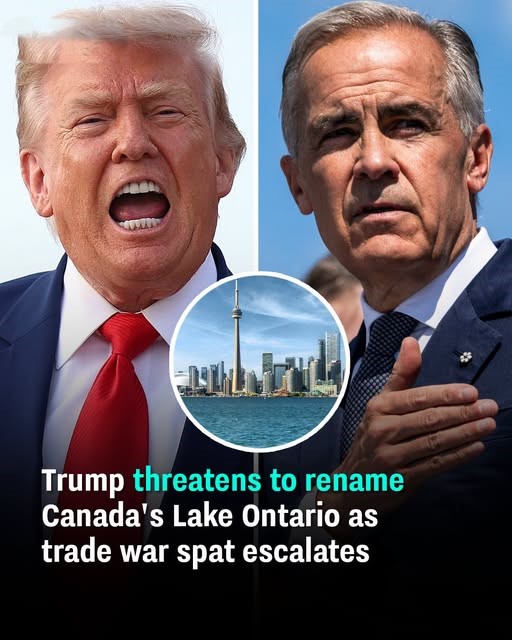
Trump Gives “Serious Consideration” to Renaming Lake Ontario “Lake America” as Canada Trade War Escalates… See more
President Donald Trump has once again stunned observers with an extraordinary proposal, saying the United States is giving “serious consideration” to changing the name of Lake Ontario to “Lake America.”
Trump made the statement Tuesday morning on his social-media platform as tensions between Washington and Ottawa continued to rise. He linked the possible renaming directly to the deteriorating economic relationship between the United States and Ontario, saying the U.S. does not expect to be doing much business with the Canadian province any longer.
The announcement immediately generated headlines across North America because Lake Ontario is not simply an American lake. It is a shared international waterway, with Ontario on its northern shore and New York State on its southern shore.
That makes the proposal considerably more complicated than changing a name on a U.S. map.
A Remarkable Announcement
The wording “serious consideration” immediately caught people’s attention.
Trump did not announce that the lake had already been renamed. Instead, he said his administration was considering the change.
The proposal follows Trump’s earlier effort to rename the Gulf of Mexico as the Gulf of America. That previous decision demonstrated that the administration is willing to use federal authority to change geographic terminology used by the U.S. government.
But Lake Ontario presents a different challenge.
The lake is shared by two countries, meaning the United States cannot simply determine what Canada or international organizations call it.
Why Bring Lake Ontario Into a Trade War?
The timing is particularly significant.
The United States and Canada are currently involved in a rapidly escalating trade confrontation.
Washington has imposed new tariffs on Canadian goods, while Canada has responded with retaliatory tariffs against American products. The dispute has already affected billions of dollars in trade and raised concerns among businesses on both sides of the border.
Ontario is especially important because it is Canada’s most populous province and home to a major portion of the country’s automobile manufacturing industry.
Trump’s comments therefore appear to be as much a political message as a geographic proposal.
The name “Lake America” would emphasize the president’s argument that the United States should put American economic interests first.
Canada Is Not Taking the Idea as a Simple Name Change
Lake Ontario is deeply connected to Canadian geography and identity.
The province itself takes its name from the lake.
Toronto, Canada’s largest city, sits on its northern shore.
The lake is also part of a larger system of waterways jointly managed by the United States and Canada.
The two nations cooperate through institutions such as the International Joint Commission and agreements dealing with Great Lakes water quality and management.
That means a unilateral American naming decision would not automatically change what Canadians call the lake.
Canada could continue using “Lake Ontario,” while U.S. federal agencies could potentially adopt “Lake America.”
The result could be an unusual situation in which the same body of water has different official terminology depending on which country is referring to it.
What Does “Serious Consideration” Actually Mean?
The phrase sounds dramatic, but it is important to distinguish between considering a name change and actually completing one.
As of Tuesday, Trump has proposed the idea.
There has not been an international agreement changing the lake’s name.
And the proposal does not give the United States authority to force Canada to abandon the name Lake Ontario.
ABC News noted that Trump could potentially change the terminology used by U.S. federal agencies, much as his administration did with the Gulf of Mexico, but he cannot dictate what Canada or international bodies call a shared waterway.
That distinction is crucial when reading sensational headlines about the announcement.
The Trade Dispute Is the Bigger Story
Although the proposed name change is generating enormous attention, the underlying trade conflict has much more serious economic consequences.
Canada has announced retaliatory tariffs covering more than 700 American products, including items such as dairy products, seafood, clothing, cosmetics and other consumer goods.
Some of those tariffs are as high as 50 percent.
The United States has also imposed significant tariffs on Canadian products.
Because the two countries have deeply integrated supply chains, businesses can face higher costs even when the final product is assembled far from the border.
The automobile industry is one of the clearest examples.
A vehicle can contain parts manufactured in multiple countries, with components crossing the border several times before final assembly.
Tariffs can therefore create additional costs at multiple stages of production.
Ontario Is at the Center of the Conflict
Ontario plays an enormous role in the Canadian economy.
Its manufacturing sector, particularly automobile production, has strong ties to American companies and consumers.
That makes the province especially vulnerable to a prolonged trade dispute.
Ontario Premier Doug Ford has been vocal about the need for Washington and Ottawa to return to negotiations.
Following Trump’s comments about Lake Ontario, Ford characterized the proposal as largely rhetorical and argued that the two countries should reduce the hostility and return to the negotiating table.
Ford has also emphasized how closely connected the two economies remain.
That reality makes a prolonged trade war difficult for both countries.
Can Trump Actually Rename the Lake?
This is perhaps the biggest practical question.
The answer is complicated.
A U.S. president can direct federal agencies to use particular geographic terminology in official American documents.
But that does not automatically change international usage.
Lake Ontario is shared by the United States and Canada.
Canada controls its own official terminology, and international organizations have their own procedures.
Therefore, even if U.S. federal agencies begin using “Lake America,” millions of Canadians could continue calling it Lake Ontario.
Maps produced in different countries could potentially use different names.
Digital mapping services could also face difficult decisions about how to display the lake depending on the user’s location.
That is similar to what happened with the Gulf of Mexico after the Trump administration introduced the “Gulf of America” designation for U.S. government use.
Why Names Matter
Geographic names are not merely labels.
They can carry historical, cultural and political meaning.
Lake Ontario’s name has existed for centuries and is deeply connected to the identity of the region.
The name is also connected to the Indigenous history of the area, making the question of renaming more complicated than simply choosing a different word.
Changing a geographic name can therefore become a debate about history, identity and political power.
That is one reason Trump’s proposal has generated such strong reactions.
The Politics Behind the Proposal
Trump has repeatedly demonstrated that he views geographic naming as a way to make political statements.
His push to rename the Gulf of Mexico was closely connected to his broader political agenda.
The Lake Ontario proposal follows a similar pattern.
The president is using the name of a major geographic feature to emphasize his dissatisfaction with Canadian trade policies and the province of Ontario.
In that sense, “Lake America” may be less about geography than about political symbolism.
It sends a message to both Canadian and American audiences.
What Canadians Are Saying
Canadian reaction has been mixed, but officials have generally treated the proposal as rhetoric rather than an immediate practical change.
Ontario’s premier has emphasized the need to lower the temperature between the two countries.
Other Canadian voices have pointed out that the lake is shared and cannot simply be renamed by one government for everyone.
For many Canadians, the name “Lake Ontario” is so familiar that changing it may seem almost impossible to imagine.
The lake is part of the country’s geography, history and identity.
A Strange Moment in North American Politics
The episode illustrates just how unusual the current relationship between the United States and Canada has become.
These are two neighboring countries with enormous economic and cultural ties.
Millions of people cross the border every year.
Businesses operate on both sides.
Families live in communities separated only by an international boundary.
Yet the relationship has become increasingly confrontational.
Tariffs are rising.
Political rhetoric is becoming harsher.
And now the name of one of the Great Lakes has been pulled directly into the dispute.
What Happens Next?
For now, Lake Ontario remains Lake Ontario in ordinary Canadian and international usage.
Trump has said the United States is seriously considering “Lake America,” but that is not the same thing as an internationally recognized renaming.
The immediate focus will likely remain on trade negotiations and retaliatory tariffs.
If the United States and Canada eventually reach a new agreement, the name-change proposal could fade away as quickly as it appeared.
If tensions continue escalating, however, “Lake America” could become another symbol of the deteriorating relationship.
The Bottom Line
Trump’s statement is real, but the headline should be understood carefully.
He has not announced that Lake Ontario has officially been renamed.
He has said that the United States is giving serious consideration to calling it “Lake America,” tying the proposal to the worsening trade relationship with Ontario and Canada.
Because Lake Ontario is a shared U.S.-Canadian waterway, the situation is far more complicated than simply changing a name on an American map.
Whether the proposal goes anywhere remains uncertain.
But it has already accomplished one thing: it has turned a familiar Great Lake into an unexpected symbol of the latest chapter in the U.S.-Canada trade war.
For now, people on both sides of the border will continue watching the negotiations, the tariffs and the increasingly heated political rhetoric.
And somewhere in the middle of it all sits the same enormous body of water that has been known for generations as Lake Ontario.
See more…