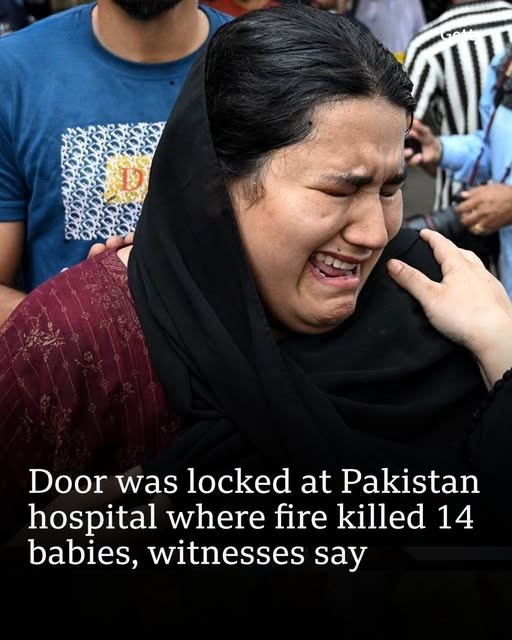
HORRIFIC BLAZE AT PAKISTAN MATERNITY WARD KILLS 14 NEWBORNS — FAMILIES DEMAND ANSWERS
A devastating fire at a maternity ward in Islamabad has left families mourning the deaths of 14 newborn babies, after flames and thick smoke engulfed a critical-care nursery at one of Pakistan’s largest public hospitals.
The tragedy occurred on August 26 at the Pakistan Institute of Medical Sciences, commonly known as PIMS, in the Pakistani capital. Authorities said the fire broke out in the Mother and Child Health Ward, where critically ill newborns were being treated. Fourteen babies died, while one newborn was rescued.
For the families gathered outside the hospital, the tragedy quickly turned from fear into unimaginable grief.
Parents had arrived at the hospital expecting their babies to be receiving care.
Instead, they found themselves desperately searching for answers.
A MORNING THAT TURNED INTO A NIGHTMARE
The fire began shortly after dawn.
According to reports, the blaze broke out on the third floor of the maternity facility. The nursery contained babies who were particularly vulnerable, including infants requiring incubators and oxygen support.
The fire and smoke spread rapidly.
Witnesses described corridors becoming dark and difficult to breathe through as smoke filled the ward.
One father said he rushed toward the maternity unit after hearing people screaming. Another relative described seeing mothers desperately calling for help and trying to find their children.
The scenes outside the hospital were heartbreaking.
Families gathered in shock while rescue workers attempted to reach the affected ward.
PARENTS SAY THEY WAITED FOR HELP
Some of the most painful accounts have come from parents and relatives who said they struggled to get assistance during the emergency.
One mother who lost her newborn reportedly described crying and pleading for help for hours.
“Give me my child back,” she said, expressing the devastating reality facing families who had come to the hospital expecting their children to be safe.
Other witnesses said there appeared to be too few staff members immediately available in parts of the maternity ward.
Accounts about the exact timing of the emergency response differ.
The Islamabad district administration said an emergency call was made around 6:45 a.m. and that rescue teams arrived within minutes. But an official with Rescue 1122 gave a somewhat different account, saying his station received the alert later and reached the hospital shortly afterward.
Those conflicting accounts are now part of the investigation.
RESCUERS HAD TO BREAK THROUGH WINDOWS
The conditions inside the ward made the rescue extremely difficult.
Firefighters reportedly encountered smoke and blocked access as they attempted to enter the affected area.
Rescuers eventually had to break through concrete grilles and windows to gain access to the nursery and other parts of the building.
That meant precious time was spent finding alternative ways into the ward.
The tragedy has raised questions about whether the hospital had adequate emergency exits, fire-safety equipment and evacuation procedures for a nursery filled with critically ill newborns.
Those questions will now be investigated.
ONLY ONE BABY WAS RESCUED
Fifteen newborns were reportedly inside the nursery when the fire occurred.
Only one survived.
The other 14 babies died.
The number is particularly devastating because newborns in intensive care are among the least capable patients of escaping an emergency on their own.
Many depend on medical equipment, oxygen and incubators.
They cannot simply be carried out by themselves.
That makes rapid evacuation procedures and trained emergency personnel especially important.
The loss of so many infants has therefore generated anger as well as grief.
WHAT CAUSED THE FIRE?
Authorities have offered differing preliminary explanations as investigators work to establish the exact cause.
Early reports blamed a malfunction or explosion involving an air-conditioning unit in the nursery. Other reporting has pointed to an electrical fault and the presence of high oxygen levels as factors that may have accelerated the fire.
However, the formal investigation is still important.
It must determine exactly how the fire started, why it spread so quickly and whether safety procedures were followed.
Those answers could help determine whether the tragedy was caused by an equipment failure, inadequate maintenance, failures in fire protection, human error or a combination of factors.
QUESTIONS ABOUT THE NURSERY DOOR
Another troubling allegation has emerged from witnesses.
Some families said the nursery door was locked or difficult to access during the emergency, forcing rescuers to break windows to reach the babies.
However, the circumstances surrounding access to the nursery require investigation before responsibility can be assigned.
Hospital officials and authorities will need to establish whether the door was actually locked, why access was restricted and whether those procedures were consistent with hospital safety requirements.
Access restrictions can sometimes exist for legitimate reasons, including protecting vulnerable newborns from unauthorized removal.
But in an emergency, hospitals must also have effective evacuation procedures.
That balance is now under intense scrutiny.
FAMILIES ARE DEMANDING ANSWERS
For grieving parents, explanations may never feel sufficient.
They entrusted the hospital with their children.
They expected doctors and nurses to protect them.
Instead, many families were left waiting outside while rescuers fought their way into the burning building.
The emotional aftermath has been overwhelming.
Parents have reportedly provided DNA samples as authorities work to identify the deceased infants and complete the process of returning remains to their families.
For families who had been celebrating the arrival of a new child only days earlier, the loss is almost impossible to comprehend.
THE GOVERNMENT ORDERS AN INVESTIGATION
Pakistan’s government has responded by ordering an immediate investigation.
Prime Minister Shehbaz Sharif called for those responsible to be identified and for action to be taken if negligence is established.
The federal health secretary, Aslam Ghauri, was suspended following the tragedy, while investigation committees were established to examine what happened.
The investigation is expected to examine both the cause of the fire and the hospital’s emergency response.
That distinction matters.
Finding the source of the flames is only one part of understanding the disaster.
Officials must also determine whether the hospital had functioning alarms, sprinklers, extinguishers, emergency lighting, accessible exits and sufficient trained personnel.
A TRAGEDY THAT HAS REOPENED OLD CONCERNS
The disaster has also revived broader concerns about safety standards in Pakistani hospitals.
Pakistan has experienced other serious hospital fires in recent years.
In 2024, a fire at Sahiwal Teaching Hospital in Punjab killed 11 babies. The recurrence of fatal fires involving vulnerable children has raised questions about whether lessons from previous tragedies were adequately implemented.
For critics, the Islamabad tragedy demonstrates that fire safety cannot be treated as a secondary concern in healthcare facilities.
Hospitals must be prepared for emergencies precisely because their patients often cannot protect themselves.
THE HUMAN COST
Statistics can describe the scale of a tragedy.
Fourteen newborns.
One survivor.
One hospital.
One morning.
But behind every number is a family.
There was a mother waiting to hold her child.
A father imagining the future.
Grandparents preparing to welcome a new member of the family.
Brothers and sisters waiting to meet a baby.
And then, suddenly, those futures disappeared.
That is why the grief surrounding the tragedy extends far beyond the hospital.
THE QUESTIONS THAT REMAIN
As investigators examine the incident, families will want answers to difficult questions.
Why did the fire spread so rapidly?
Was the electrical and air-conditioning equipment properly maintained?
Were fire alarms functioning?
Were sprinklers available and operational?
Were emergency exits accessible?
Was there enough staff in the nursery?
Why did rescuers have difficulty entering?
Were evacuation procedures properly designed for critically ill newborns?
And most importantly, could some or all of these deaths have been prevented?
Those questions cannot be answered through social-media speculation.
They require a careful, independent investigation.
A CALL FOR ACCOUNTABILITY
The families do not simply need condolences.
They need the truth.
If safety systems failed, they need to know why.
If equipment was improperly maintained, they deserve to know who was responsible.
If emergency procedures were inadequate, they need assurances that they will be changed.
And if negligence contributed to the deaths, accountability must follow.
At the same time, the investigation should be based on evidence rather than assumptions.
The people responsible for determining what happened must carefully reconstruct the sequence of events.
REMEMBERING THE BABIES
Amid the investigation and political debate, the most important people in this story remain the babies who died.
They were among the most vulnerable patients in the hospital.
They had barely begun their lives.
Their families will carry their loss forever.
The tragedy is a painful reminder that hospitals are places where people place extraordinary trust in medical professionals, equipment and safety systems.
When that trust fails, the consequences can be devastating.
THE BOTTOM LINE
The Islamabad hospital fire has become one of Pakistan’s most heartbreaking recent tragedies.
Fourteen newborn babies died after a fire swept through a critical-care nursery at the Pakistan Institute of Medical Sciences. One infant survived, while families outside the hospital described scenes of panic, confusion and desperate attempts to reach their children.
Authorities have launched investigations into the fire, its cause and the emergency response.
For now, many questions remain unanswered.
But one thing is certain: fourteen families have suffered a loss that can never be measured by a statistic.
Their children were supposed to be coming home.
Instead, families are now demanding answers—and hoping that the truth will prevent another hospital nursery from ever becoming the scene of such unimaginable grief.
See more