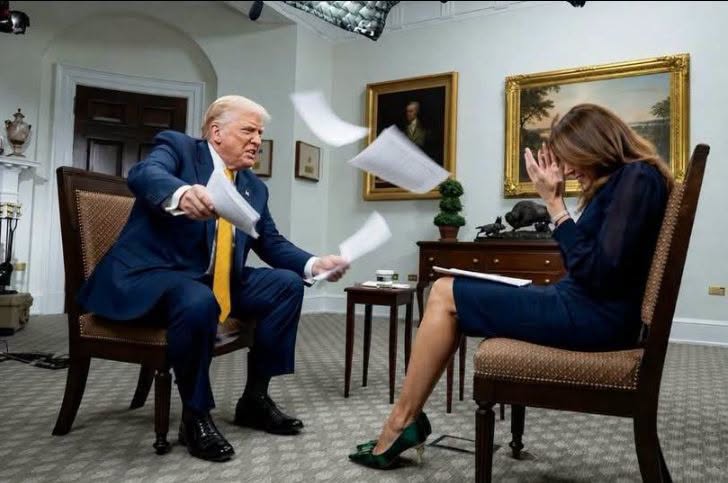
Trump Attacks CNN Reporter After Heated Exchange Over His Presidency — See More
A tense confrontation between President Donald Trump and CNN White House correspondent Kristen Holmes has once again drawn attention to the increasingly combative relationship between the White House and the press.
The dispute began when Holmes asked Trump about comments made by Democratic Sen. Jon Ossoff concerning the president’s relationship with his executive assistant, Natalie Harp. Rather than simply answering the question, Trump sharply criticized the reporter, telling her that she was being disrespectful and accusing her of reporting what he characterized as false information.
The confrontation quickly became larger than the original question. The White House later issued a personal attack against Holmes on social media, referring to her children and describing her question as “disgusting and inhumane.” CNN responded by defending its correspondent and condemning the administration’s treatment of her.
For many observers, the incident represented another chapter in Trump’s long-running clashes with journalists who ask him difficult or uncomfortable questions.
The Question That Triggered the Clash
Holmes was covering an Oval Office event when she asked Trump about comments attributed to Ossoff. According to reports, the senator had criticized Trump’s relationship with Harp and questioned the president’s priorities.
Holmes asked Trump for his response.
The question immediately changed the tone of the event.
Trump pushed back forcefully, accusing Holmes of being disrespectful and later telling her to be quiet. Reports said he also described her as a “fake reporter” and accused CNN of producing “fake news.”
Such exchanges have become increasingly familiar during Trump’s presidency. His relationship with major news organizations, particularly CNN, has frequently been confrontational. Trump has repeatedly argued that certain media outlets treat him unfairly, while journalists and press-freedom advocates argue that aggressive questioning is an essential part of holding a president accountable.
The latest confrontation therefore became symbolic of a much larger argument over the role of the press.
The White House Takes the Fight Further
What made the episode particularly notable was what happened after the exchange.
Instead of allowing the disagreement to remain between the president and the journalist, a White House social-media account targeted Holmes personally. The post invoked her children and suggested that they would be embarrassed by the question she had asked.
That move generated additional criticism.
Attacking a reporter’s professional work is one thing. Bringing the reporter’s family into a political dispute is considerably more personal, and critics argued that the White House had crossed an important line.
CNN defended Holmes “in the strongest possible terms,” saying that the attacks directed at its correspondent were inappropriate.
The controversy therefore expanded from a disagreement over a political question into a broader debate about press freedom, presidential power and the boundaries of political rhetoric.
A Familiar Pattern
The confrontation did not happen in isolation.
Trump has a long history of tense interactions with journalists, particularly female reporters who challenge him during public events. His clashes with CNN reporters have occurred throughout his political career.
One of the most famous earlier examples involved CNN correspondent Jim Acosta during Trump’s first presidency. Trump called Acosta a “rude” and “terrible” person during a contentious White House news conference, leading to a major dispute over Acosta’s press credentials and access to the White House.
Trump has also had repeated confrontations with CNN’s Kaitlan Collins. Those encounters have sometimes become major news stories in their own right because they demonstrate how quickly a presidential press conference can turn into a personal confrontation.
The latest incident with Holmes fits into that broader history.
Why Female Journalists Have Become a Particular Focus
Another aspect of the controversy is the treatment of female reporters.
The White House’s confrontation with Holmes came amid criticism over what observers described as repeated attacks against women journalists. Reports characterized the incident as part of a broader pattern in which female reporters have faced particularly personal criticism when questioning the president.
Supporters of Trump argue that the president has every right to push back against reporters whom he believes are unfair or hostile.
Critics counter that there is an important difference between challenging a journalist’s reporting and attempting to intimidate the journalist personally.
That distinction is at the heart of the debate.
A president possesses an enormous public platform. When the president attacks a reporter, millions of people can hear the criticism, and the journalist may subsequently face intense online harassment.
For that reason, press organizations often pay close attention to presidential rhetoric directed at individual journalists.
CNN Stands Behind Holmes
CNN’s response was significant because the network did not distance itself from Holmes.
Instead, it publicly defended her.
The network said the attacks against its correspondent were unacceptable and defended her right to ask difficult questions of the president.
That response reflects a basic principle of journalism: reporters covering political leaders are expected to ask questions that may be uncomfortable.
Presidents are not required to like those questions.
Journalists are not required to make presidents comfortable.
The tension between those two realities is an unavoidable part of political reporting.
In a healthy democracy, that tension can be productive. Journalists question leaders, leaders respond, and citizens hear competing arguments before forming their own conclusions.
The danger comes when disagreement becomes personal intimidation rather than substantive debate.
The Bigger Political Context
The controversy surrounding Holmes also comes at a time when Trump’s administration has maintained an unusually combative relationship with the traditional news media.
The White House has embraced social media as a powerful weapon for responding to criticism. Rather than relying solely on formal press briefings, administration officials frequently respond directly to journalists and critics online.
This approach has advantages for a political administration. It allows officials to communicate directly with supporters without relying on television networks or newspapers to frame their message.
But it also creates risks.
Personal attacks can dominate the news cycle and distract from the original issue. A question about presidential priorities can quickly become a story about the reporter who asked it.
That appears to have happened here.
Instead of focusing entirely on the substance of Ossoff’s criticism, much of the public discussion shifted toward Trump’s treatment of Holmes and the White House’s decision to mention her children.
Supporters and Critics See the Incident Differently
Trump’s supporters are likely to view the confrontation as another example of a president refusing to allow journalists to control the narrative.
They argue that reporters should be challenged when their questions contain assumptions or political framing. From this perspective, Trump’s response represents a willingness to fight back against media organizations he believes have been hostile toward him.
Critics see something very different.
They argue that questioning the president is precisely what journalists are supposed to do. They contend that calling reporters fake, telling them to be quiet and involving their families in political disputes can have a chilling effect on journalism.
Both sides therefore see the incident through very different political lenses.
But beyond those partisan arguments is a broader question:
How should a president respond when confronted with an aggressive question?
The Importance of Presidential Accountability
Presidential press conferences can sometimes appear chaotic, but they serve an important democratic purpose.
A reporter may ask a question that millions of Americans would never have the opportunity to ask themselves.
The president can answer—or refuse to answer.
The exchange becomes part of the public record.
That process allows citizens to evaluate not only what politicians say but also how they react under pressure.
A calm response can demonstrate confidence.
A detailed response can clarify policy.
An angry response can reveal something else entirely.
That is why tense exchanges between presidents and journalists attract so much attention. They are not merely television moments. They can reveal the relationship between political power and independent scrutiny.
What Happens Next?
It is unlikely that this will be the last confrontation between Trump and the news media.
His relationship with CNN has been contentious for years, and both Trump and the network understand that their conflicts attract enormous public attention.
For Holmes, the incident is likely to become another chapter in her work covering one of the most closely watched administrations in modern American politics.
For CNN, defending its correspondent reinforces its position that journalists must be able to question powerful officials without becoming targets of personal retaliation.
And for the White House, the controversy represents another opportunity to communicate directly with its supporters and challenge what it considers hostile coverage.
Ultimately, the most important issue may not be who won the verbal exchange.
The more important question is whether journalists can continue asking difficult questions without fear of personal attacks—and whether political leaders can respond to those questions without turning every disagreement into a personal battle.
The confrontation between Trump and Holmes has once again placed that question directly in the spotlight.
And as the political environment becomes increasingly polarized, the relationship between presidents and the press will remain one of the most closely watched battles in American public life.
For now, the message from both sides is clear: Trump remains determined to fight what he considers unfair media coverage, while CNN and its journalists insist that asking difficult questions is part of their responsibility.
The argument is far from over.
See more.