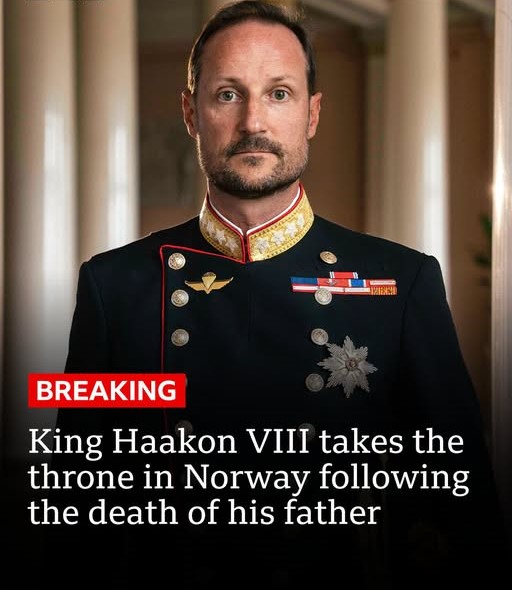
King Haakon VIII Takes the Throne in Norway Following the Death of His Father… See More
Norway has entered a new royal era.
Crown Prince Haakon has become King Haakon VIII following the death of his father, King Harald V, on Friday at the age of 89. The succession happened immediately, in accordance with Norway’s constitutional system, bringing an end to Harald’s more than three decades on the throne and beginning a new chapter for the Norwegian monarchy.
For many Norwegians, the transition is both deeply emotional and historic.
King Harald had been one of the country’s most familiar public figures since becoming monarch in 1991. His reign lasted 35 years and was marked by a reputation for warmth, humility and a close connection with ordinary Norwegians.
Now his son, 53-year-old Haakon, faces the enormous responsibility of following him.
A New King for a New Era
Haakon formally informed the Norwegian government of his father’s death during an extraordinary Council of State at the Royal Palace in Oslo.
During the meeting, he confirmed that he had assumed the responsibilities of king and announced that he would reign as Haakon VIII.
He also chose to continue the royal motto associated with his father, grandfather and great-grandfather:
“Alt for Norge” — “All for Norway.”
The words carry considerable historical meaning.
They express the central idea of Norway’s modern monarchy: that the sovereign’s role is fundamentally one of service to the country.
Unlike some European monarchies, Norway does not hold a traditional coronation. The new monarch takes the throne automatically when the previous monarch dies, while formal constitutional and ceremonial events follow afterward.
The End of King Harald’s Long Reign
Harald V became king following the death of his father, Olav V, in 1991.
Over the following decades, he became a symbol of stability during periods of enormous social and political change.
He witnessed Norway’s transformation into one of the world’s wealthiest and most influential democracies. He also became known for emphasizing inclusion and national unity.
His speeches often avoided the formality associated with traditional royalty.
Instead, Harald frequently spoke about ordinary people, community and the importance of accepting differences.
His response following Norway’s 2011 terrorist attacks became particularly significant. At a time of national grief, the king emphasized solidarity and democratic values.
For many citizens, that helped strengthen his reputation as a unifying figure.
His death therefore represents more than a change in royal titles.
For an entire generation, Norway had only known Harald as king.
Haakon Has Been Preparing for This Moment
Although the transition may feel sudden to the public, Haakon has been preparing for his eventual role for decades.
He became crown prince when his father ascended the throne in 1991.
Over the years, he gradually assumed more responsibilities and represented Norway at home and abroad.
As his father’s health became more fragile, Haakon also served as regent on several occasions.
That experience means he enters the throne with a detailed understanding of the responsibilities involved.
He is not an unknown figure suddenly stepping into public life.
He has spent much of his adult life preparing for exactly this moment.
Haakon also has a background that reflects the relatively modern character of Norway’s monarchy.
He served in the Royal Norwegian Navy and later studied political science at the University of California, Berkeley. He subsequently earned a master’s degree in development studies from the London School of Economics.
His public work has included international development and humanitarian issues.
A Family Moves Into New Roles
The change also affects the rest of the royal family.
Haakon’s wife, Mette-Marit, is now Queen Mette-Marit.
Their eldest child, Princess Ingrid Alexandra, becomes Crown Princess and the heir to the Norwegian throne.
That makes Ingrid Alexandra particularly important to the monarchy’s future.
Born in 2004, she represents a younger generation of Norwegian royalty and is expected to become the country’s next monarch after Haakon.
Norway’s succession rules changed in 1990 to give boys and girls equal rights among those born under the new rules. As a result, Ingrid Alexandra stands to inherit the throne ahead of her younger brother, Prince Sverre Magnus.
The significance of that change will become even clearer in the future if Ingrid Alexandra eventually becomes queen.
Challenges Await the New King
Haakon inherits not only his father’s crown but also the difficulties facing the modern Norwegian monarchy.
Royal families across Europe have struggled with a changing public relationship with monarchy.
Younger generations often expect greater transparency, accountability and relevance from royal institutions.
Norway is no exception.
The Norwegian royal family has faced several controversies in recent years, including scrutiny surrounding members of Haakon’s immediate family. Those issues have created difficult headlines and placed additional pressure on the institution.
Haakon will therefore have to balance tradition with modern expectations.
He must preserve the aspects of the monarchy that Norwegians value while ensuring that the institution remains credible and relevant.
That may prove to be one of the defining challenges of his reign.
A Different Kind of Monarchy
Norway’s monarchy is constitutional and largely ceremonial.
The king does not govern the country in the way an absolute monarch would.
Instead, the elected government holds political power while the monarch serves as head of state.
That means Haakon’s greatest influence may come not through political decisions but through symbolism, diplomacy and national representation.
He will welcome foreign leaders.
He will represent Norway abroad.
He will participate in national ceremonies.
And perhaps most importantly, he will be expected to provide continuity during moments of national difficulty.
That role was performed exceptionally visibly by his father.
Now Haakon must establish his own relationship with the Norwegian people.
Saying Goodbye to Harald
As Haakon begins his reign, Norway is simultaneously mourning Harald.
The country has entered a period of national mourning, with funeral ceremonies and other official events planned in the days ahead.
Harald is expected to be laid to rest in the royal mausoleum at Akershus Fortress alongside members of the Norwegian royal family.
For many citizens, the coming days will therefore contain two very different emotions.
There will be grief for a beloved king.
And there will be curiosity and hope surrounding his successor.
The old reign has ended.
The new one has begun.
A Historic Moment
Every succession is significant, but this one carries a particularly strong emotional weight because Harald remained on the throne for so long.
Many Norwegians were born, grew up, married and raised families during his reign.
They never knew another king.
Now they have a new monarch.
King Haakon VIII has inherited a country where the monarchy remains an important part of national identity, but where its future cannot be taken for granted.
His task will be to make the institution his own.
He has the benefit of experience, years of preparation and a familiar name.
But he also faces expectations that are uniquely his.
The Norwegian people will watch carefully as he develops his own style of leadership.
Will he resemble his father?
Will he create a more modern royal image?
Will he emphasize environmental issues, international development, national unity or other causes?
Those questions will be answered gradually.
For now, however, the moment is about transition.
King Harald V’s long chapter has come to an end.
His son has stepped forward.
And with the words “All for Norway,” King Haakon VIII has begun a reign that will define the next generation of the Norwegian monarchy.
For the people of Norway, it is a moment of farewell, remembrance and new beginnings.
The crown has passed from father to son.
A new king now stands at the center of Norway’s constitutional monarchy.
And history has begun writing the first page of the reign of Haakon VIII.