NASA’s $4.3 Billion Roman Space Telescope Has Finally Blasted Off—And It Could Change What We Know About the Universe
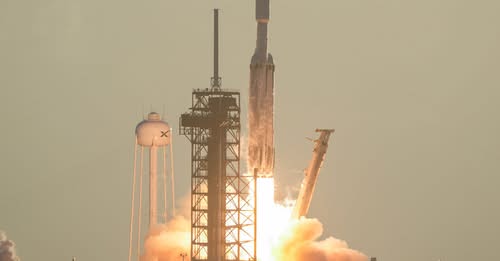
At 7:26 a.m. Eastern time on Sunday, the Florida coastline became the starting point for one of NASA’s most ambitious scientific journeys yet.
The Nancy Grace Roman Space Telescope thundered away from Kennedy Space Center aboard a SpaceX Falcon Heavy, beginning a mission designed to investigate some of the biggest unanswered questions in modern astronomy. NASA confirmed the successful liftoff from Launch Complex 39A, with the observatory now beginning its journey toward its final operating location roughly one million miles from Earth.
The launch represented years of engineering, testing and scientific planning—and a mission cost of approximately $4.3 billion.
But the telescope’s real value isn’t measured simply in dollars.
Scientists hope Roman will transform our understanding of dark energy, dark matter, distant galaxies and planets beyond our solar system.
And it is designed to do something particularly important: see an enormous amount of the universe at once.
A Different Kind of Space Telescope
When people think of powerful space telescopes, the Hubble and James Webb Space Telescopes usually come to mind.
Roman isn’t designed to replace either of them.
Instead, it will complement them.
Hubble has provided extraordinarily detailed images of individual cosmic objects for decades. Webb, meanwhile, has opened a remarkable window into the infrared universe, allowing astronomers to study some of the earliest galaxies and distant cosmic structures.
Roman takes a different approach.
Its powerful infrared instrument has a field of view more than 100 times larger than Hubble’s, allowing it to survey enormous portions of the sky rapidly. That combination of wide coverage and high sensitivity could give scientists a much broader picture of how the universe is structured and how it has changed over time.
In other words, Roman isn’t simply looking at one distant galaxy.
It’s designed to map huge cosmic neighborhoods.
The Mystery of Dark Energy
One of Roman’s most important goals is investigating dark energy.
Scientists know that the universe is expanding. More than that, observations indicate that the expansion is accelerating.
The mysterious phenomenon believed to be responsible is called dark energy.
Yet scientists still don’t know exactly what dark energy is.
Is it a property of space itself?
Is our understanding of gravity incomplete?
Or is something else influencing the expansion of the universe?
Roman will conduct large-scale surveys that could provide crucial evidence for answering those questions.
The telescope will measure enormous numbers of galaxies and cosmic structures, helping scientists understand how the universe has evolved across billions of years.
Those observations could ultimately challenge or strengthen some of the most fundamental theories in physics.
Dark Matter Is Another Major Target
Dark energy isn’t the only cosmic mystery Roman will investigate.
There’s also dark matter.
Although scientists cannot see dark matter directly, evidence suggests that it makes up a substantial portion of the universe’s mass.
It doesn’t appear to interact with light in the ordinary way, making it invisible to conventional telescopes.
But its gravitational influence can be observed.
Scientists can study how galaxies and other structures are affected by unseen mass and use those observations to investigate the distribution and behavior of dark matter.
Roman’s enormous surveys could therefore help researchers create a much clearer picture of the invisible architecture underlying the visible universe.
Thousands of New Worlds
Roman will also search for exoplanets—worlds orbiting stars beyond our solar system.
Astronomers have already discovered thousands of exoplanets, but scientists believe there are vastly more waiting to be found.
Roman’s wide-ranging surveys will allow researchers to search enormous areas of the sky for tiny changes in starlight that can reveal the presence of planets.
The telescope is expected to find thousands of new worlds and provide valuable information about the population of planets throughout our galaxy.
Some of those discoveries could eventually become targets for other telescopes.
Roman may therefore function as a cosmic scout, identifying intriguing worlds for more detailed investigation by observatories such as Webb.
A Telescope Named for a Pioneer
The telescope carries the name Nancy Grace Roman, a pioneering astronomer who played a major role in establishing NASA’s space astronomy program.
Roman became NASA’s first chief astronomer and was instrumental in developing the agency’s space-based astronomy efforts.
Her contributions helped lay the groundwork for what eventually became the Hubble Space Telescope.
Naming this next-generation observatory after her is therefore more than symbolic.
It recognizes a scientist whose work helped make space telescopes an essential part of modern astronomy.
The mission has also been described as a landmark because Roman is NASA’s first major space telescope named after a woman.
The Journey Is Just Beginning
Although the launch was spectacular, the most important part of Roman’s mission is still ahead.
The spacecraft will spend approximately three months traveling toward its destination near the Sun-Earth L2 point, roughly one million miles from our planet.
Once there, engineers will begin the lengthy process of deploying, checking and calibrating the observatory.
Space telescopes cannot simply be switched on immediately after reaching their destination.
Every system has to be carefully tested.
The instruments must be precisely calibrated.
The telescope must be pointed accurately.
Scientists must verify that everything is performing as expected.
Only then can the scientific observations begin in earnest.
A Massive Scientific Survey
Roman’s mission is expected to last at least five years, although the spacecraft is designed to operate longer if its resources allow.
During that time, it could collect enormous quantities of astronomical data.
NASA says Roman will map billions of galaxies, search for planets outside our solar system and investigate black holes and other cosmic phenomena. Its wide field of view means scientists will be able to survey the sky at a pace that would be impossible for narrower-field observatories.
That creates another exciting possibility.
Roman’s discoveries won’t belong only to one research team.
Its enormous datasets could become a resource for astronomers around the world, allowing researchers to ask questions that haven’t even been imagined yet.
Every new survey can produce unexpected discoveries.
A telescope designed to study dark energy might find a previously unknown class of star.
A planet survey might reveal unusual planetary systems.
A galaxy map could uncover strange structures that challenge existing theories.
That’s one of the most exciting things about astronomy.
Scientists build an instrument to answer specific questions—and the universe often gives them completely different surprises.
A New Era Begins
The successful launch of the Nancy Grace Roman Space Telescope represents far more than another rocket flight.
It marks the beginning of a new chapter in humanity’s attempt to understand the cosmos.
Hubble taught us to see the universe in extraordinary detail.
Webb has pushed our view deeper into infrared space and cosmic history.
Now Roman is preparing to give scientists something different: an enormous panoramic survey of the universe.
Its mission will investigate invisible matter, mysterious energy, distant planets and the evolution of galaxies on a scale never before possible.
And perhaps somewhere inside all that data will be an answer to a question scientists haven’t yet learned how to ask.
The rocket has left Florida.
Roman is now on its way.
The next great discoveries may already be waiting in the darkness.