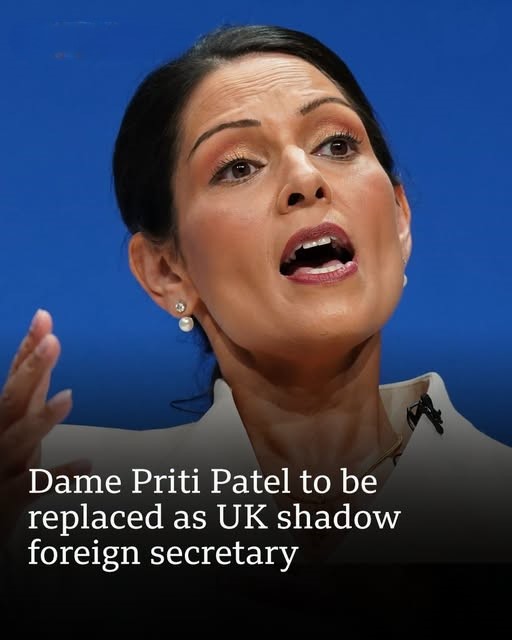
Dame Priti Patel to Be Replaced as UK Shadow Foreign Secretary — What the Conservative Reshuffle Means… See more
Dame Priti Patel is set to leave her position as the UK Conservative Party’s shadow foreign secretary as leader Kemi Badenoch carries out a major reshuffle of her senior opposition team.
The move represents one of the most significant changes to the Conservative front bench since Badenoch became party leader and comes at a politically important moment for the opposition. Patel is expected to be replaced by Tom Tugendhat, a former security minister and prominent Conservative voice on international affairs and defence.
Patel’s departure does not mean she is leaving Parliament or the Conservative Party. Instead, she is expected to return to the back benches while taking on a new international role for the party, focused on strengthening relationships with conservative and centre-right political parties around the world.
A Major Change for the Conservative Front Bench
The announcement comes as Badenoch reshapes her shadow cabinet in an attempt to give the Conservative Party a renewed political direction.
Several senior figures have been affected by the changes. Shadow chancellor Sir Mel Stride has been replaced by Andrew Griffith, while other senior Conservatives have also left or changed responsibilities. Former shadow housing secretary Sir James Cleverly has separately announced plans to run for mayor of London, while shadow health secretary Stuart Andrew is also leaving the top team.
Against that backdrop, Patel’s departure is part of a much wider political reset rather than an isolated personnel decision.
Badenoch is attempting to build a team capable of presenting the Conservatives as a credible alternative government while responding to pressure from both Labour and Reform UK.
Patel’s New Role
Patel has made clear that she remains committed to the Conservative Party despite leaving the shadow cabinet.
In announcing her move, she said she was pleased to continue supporting Badenoch and the party through an international role designed to strengthen relationships with conservative and centre-right parties overseas. She also pointed to what she described as a period of profound global uncertainty and argued that conservatives should work more closely together.
The new position could allow Patel to draw on her previous experience in government and international affairs while giving her greater freedom to develop relationships outside Westminster.
Patel has held several senior government positions. She served as international development secretary under Theresa May and later became home secretary under Boris Johnson, a role she held from 2019 until 2022. She has represented Witham in Parliament continuously since 2010.
Her experience therefore means that her departure from the shadow cabinet does not necessarily mark the end of her influence within Conservative politics.
Tom Tugendhat Emerges as the Successor
The person expected to take Patel’s place is Tom Tugendhat.
Tugendhat is a particularly significant choice because of his background in foreign affairs, defence and national security. He has previously served as a security minister and has developed a reputation for taking a firm position on international threats.
Reports say he will return to the shadow cabinet as shadow foreign secretary, potentially with an expanded foreign affairs and defence brief.
His appointment would also bring a different political style to one of the Conservative Party’s most important opposition roles.
Tugendhat has often been associated with the party’s more centrist One Nation tradition, although his positions on foreign policy have frequently been strongly expressed. His views on countries including China and Iran have made him a prominent voice within Conservative debates about Britain’s international role.
Why the Change Matters
The shadow foreign secretary is one of the most important positions in an opposition party.
The role involves scrutinising the government’s foreign policy, challenging ministers in Parliament and presenting an alternative Conservative approach to Britain’s relationship with allies and international organisations.
At a time when national security, defence spending, geopolitical tensions and Britain’s relationship with major powers are major political issues, the Conservatives need a prominent figure capable of communicating their position clearly.
Tugendhat’s background makes him a natural fit for that responsibility.
His return could also signal that Badenoch wants foreign affairs and national security to play a larger role in the party’s political strategy.
A Party Under Pressure
The reshuffle comes as the Conservative Party faces a difficult political environment.
The party is attempting to recover from its historic defeat at the 2024 general election and faces competition from Reform UK for voters on the political right.
That creates a complicated challenge for Badenoch.
The Conservatives need to appeal to voters who have moved toward Reform while also maintaining support among traditional Conservative voters who may be uncomfortable with a further shift to the right.
The appointment of Tugendhat could therefore be interpreted as an effort to balance competing political priorities.
His views on defence and international security are firmly Conservative, but his political background is different from some of the party’s more populist figures.
More Than Just a Personnel Change
Although reshuffles are often presented as routine changes of personnel, they can reveal a party leader’s priorities.
Badenoch’s decision to make several changes at once suggests she wants a different political approach from her senior team.
Andrew Griffith’s appointment as shadow chancellor, for example, is being presented as part of a renewed emphasis on economic growth, while Tugendhat’s expected promotion places considerable weight on foreign affairs and security.
The Conservative leadership will now hope that its new team can communicate a clearer message to voters.
For Patel, meanwhile, the move could provide an opportunity to concentrate on international political relationships rather than daily Westminster battles.
What Happens Next?
The immediate focus will be on how Tugendhat performs in the shadow foreign secretary role and whether Badenoch’s wider reshuffle succeeds in giving the Conservative Party a stronger public profile.
Patel will remain an influential Conservative MP and will continue representing Witham in Parliament. Her new international responsibilities could also give her a distinctive role within the party, particularly if the Conservatives seek stronger relationships with like-minded political movements abroad.
For Tugendhat, the challenge is different.
He will need to establish himself quickly as the principal Conservative voice on foreign policy and demonstrate that the party has a coherent alternative to the government’s approach to Britain’s international position.
Ultimately, the change is about more than one politician replacing another.
It is part of a broader attempt by Kemi Badenoch to reshape the Conservative Party, strengthen her senior team and prepare the opposition for the political battles ahead.
With Britain facing continuing international uncertainty and the Conservatives fighting to rebuild public trust, the shadow foreign secretary will have a highly visible role.
Priti Patel leaves the position with considerable experience behind her, while Tom Tugendhat appears ready to take on the responsibility.
The coming months will show whether the change becomes a successful part of Badenoch’s wider strategy — or simply another chapter in the Conservative Party’s continuing struggle to redefine itself.