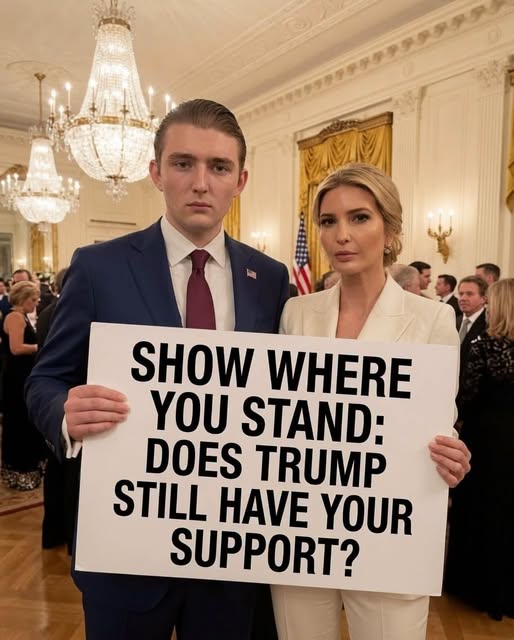
Show Where You Stand: Does Trump Still Have Your Support?
Politics has never been short on strong opinions, but few political figures have generated as much loyalty, criticism and debate as Donald Trump.
For years, Americans have argued passionately over his leadership, his policies, his personality and his vision for the country. Supporters see him as a fighter who challenges Washington and refuses to back down. Critics see his approach as divisive and believe his leadership has created serious problems for the country.
Now, with the 2026 midterm elections approaching, the question is once again being placed directly before voters:
Does Donald Trump still have your support?
It is a simple question, but the answer can be complicated.
For some Americans, the answer remains an enthusiastic yes.
Trump’s supporters continue to point to issues including immigration, trade, national security, government spending and his willingness to confront political opponents. Many believe he represents a political movement that existed before him but became significantly stronger during his presidency.
They argue that Trump speaks directly to Americans who feel ignored by traditional political institutions.
For these voters, supporting Trump is not necessarily about agreeing with every statement he makes or every decision he takes. Instead, it can be about believing that his overall direction for the country is preferable to the alternatives.
But there is another side.
Many Americans have become increasingly critical of Trump’s presidency, particularly over economic pressures and foreign policy. Recent polling illustrates just how difficult the political environment has become for him.
A Reuters/Ipsos poll conducted in late August found that only 33% of Americans approved of Trump’s performance, while 64% disapproved. The survey described the approval figure as a low point for his presidency.
Other polling trackers also show Trump facing a difficult national environment. Silver Bulletin reported a net approval rating of -19.5 on September 3, while another polling tracker placed approval at roughly 36% and disapproval near 60%.
Those numbers do not mean that every American has changed their mind.
Far from it.
Trump remains a powerful figure within the Republican Party, and his ability to motivate his political base continues to make him central to Republican electoral strategy.
That was evident when Trump announced plans to campaign aggressively for Republican candidates ahead of the November midterms. Reuters reported that he planned to make numerous appearances in key races as Republicans seek to maintain control of Congress.
For his supporters, that involvement could be an advantage.
For his opponents, it could be an opportunity to turn the midterm elections into a referendum on his administration.
And that is where the question becomes particularly important.
What do voters actually think?
Some voters may support Trump because they believe he has delivered on promises they consider important.
Others may oppose him because they believe his policies have harmed the country.
Still others may be undecided.
There are also Americans who dislike both major political parties and do not feel represented by either side.
That means a question such as “Does Trump still have your support?” cannot be reduced to a simple political argument.
For one voter, the most important issue may be the economy.
For another, immigration may be the deciding factor.
Someone else may care primarily about foreign policy.
Another voter may focus on government spending, inflation, energy prices, civil liberties or the courts.
And some people may simply believe that changing leadership is necessary.
The political conversation becomes more meaningful when voters explain why they hold their positions.
That is especially important during an era when social media can turn political disagreements into personal battles.
A person can disagree with Trump’s policies without hating his supporters.
A person can support Trump without agreeing with every action he takes.
Political disagreement does not have to mean personal hostility.
Unfortunately, modern political discussions often become exactly that.
Friends stop speaking.
Families argue.
Neighbors become divided.
People block one another online.
And instead of discussing policies, they begin attacking each other’s character.
But democracy depends on disagreement.
The United States has always contained competing political visions. Elections provide a mechanism for citizens to decide which vision they prefer.
That makes voting—and understanding the issues behind voting—more important than simply repeating slogans.
Trump’s supporters believe the country needs a leader willing to challenge established political norms.
His critics believe the country needs a different direction.
Neither position should be dismissed simply because it comes from the other side of the political divide.
The real question for voters is what they believe will make their communities and country better.
That could mean supporting Trump.
It could mean opposing him.
It could mean remaining undecided until more information becomes available.
And it could mean changing one’s mind.
Changing your political opinion is not necessarily a weakness. Sometimes it means that a voter has listened, considered new information and decided that a different conclusion makes more sense.
Likewise, continuing to support a politician despite criticism does not automatically mean someone is uninformed.
People prioritize different issues.
That is the reality of democracy.
As the 2026 midterm elections approach, Trump’s political standing will continue to receive enormous attention. Polls will rise and fall. Campaigns will intensify. Candidates will make promises. Political advertisements will fill television screens and social-media feeds.
But ultimately, polling numbers are not votes.
The voters decide.
That is why the question deserves to be asked directly:
Does Trump still have your support?
If your answer is yes, what has convinced you to remain supportive?
If your answer is no, what changed your mind?
Was it the economy?
Foreign policy?
Immigration?
The cost of living?
His leadership style?
A specific policy?
Or simply the belief that it is time for a different direction?
And if you are undecided, what would you need to see before making your decision?
These questions are more valuable than simply asking people to choose a political team.
Because elections are ultimately about choices.
Americans have the right to support the candidate they believe will best represent their interests and values. They also have the right to criticize their government and demand accountability from elected officials.
That right belongs to supporters and opponents alike.
So rather than turning the conversation into another political shouting match, perhaps the better approach is to ask people to explain their position.
Show where you stand.
Support Trump if you believe his leadership is moving the country in the right direction.
Oppose him if you believe the country needs a different path.
Remain undecided if you are still weighing the evidence.
But whatever position you take, understand why you take it.
The future of the country should not be determined by the loudest person online. It should be determined by citizens who pay attention, ask questions, examine competing arguments and ultimately make their own decisions.
Trump’s political future remains a subject of intense debate.
But the larger question is bigger than one politician.
It is about what Americans want their government to look like, what priorities they believe should come first and what kind of leadership they believe the country needs.
So, America, the question is yours:
Does Donald Trump still have your support?
Show where you stand—and, more importantly, explain why.