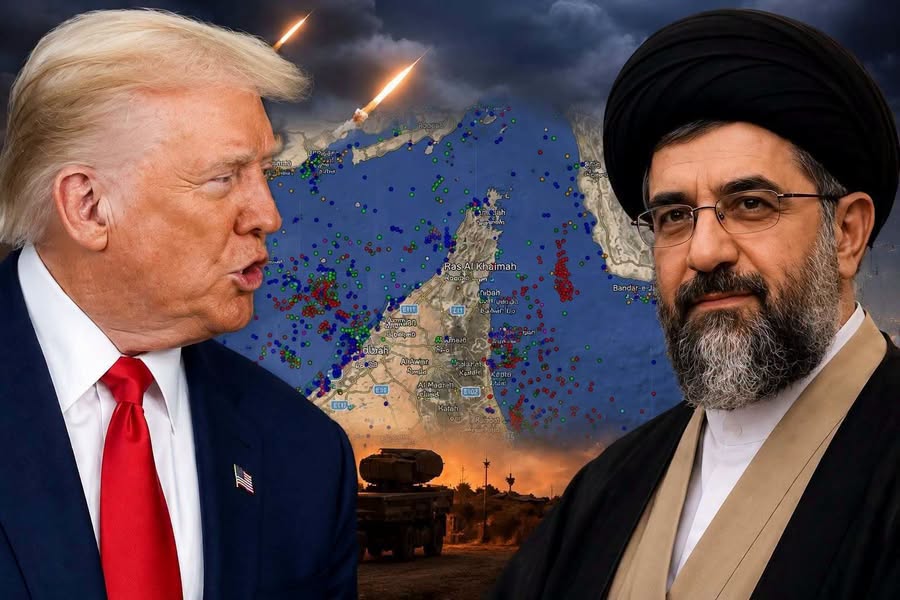
US Officials Report Russia Is Providing Iran With Intelligence Support
U.S. officials are reporting that Russia has been providing Iran with intelligence and other forms of support during the ongoing conflict, raising new concerns in Washington about the growing cooperation between Moscow and Tehran.
The reported assistance is particularly significant because the conflict has increasingly involved sophisticated surveillance, missile strikes and attacks against U.S. military positions across the Middle East. According to reporting cited by U.S. officials, Russian intelligence information may be helping Iranian forces identify the locations and movements of American military assets.
The development highlights how the war is becoming more complicated as outside powers become involved.
For years, Russia and Iran have developed increasingly close military and political ties. Their cooperation has expanded through weapons, technology, intelligence and diplomatic coordination. The current conflict appears to be creating another opportunity for the two countries to work together against shared American interests.
U.S. officials have reportedly expressed concern that Iranian forces have experienced difficulties independently locating some American military assets. Intelligence supplied by Russia could potentially help close that gap by providing information that Iran’s own surveillance systems cannot easily obtain.
The potential significance of such assistance is enormous.
Modern warfare depends heavily on information. Knowing where an opposing force is located can be just as important as having missiles or aircraft capable of striking the target. Satellite imagery, electronic intelligence, signals intelligence and other forms of surveillance can help military commanders identify targets and determine when and where an attack might be possible.
If Russian intelligence is being provided to Iran, it could therefore give Iranian forces an additional source of information at a critical moment.
The reports come as the broader Middle East conflict continues to place enormous pressure on the United States and its allies.
U.S. forces have faced repeated threats from Iranian forces and Iran-aligned groups. The situation has also expanded beyond the immediate battlefield, with attacks and threats affecting major shipping routes.
The Strait of Hormuz has already been severely disrupted, while Iran-aligned Houthi forces in Yemen have advanced toward the strategically important Bab el-Mandeb Strait. Reuters reported on September 12 that the Houthis had reached Perim Island, potentially giving Iran-aligned forces greater leverage over another major international shipping corridor.
That development means Washington is confronting pressure in several different locations at the same time.
The possibility of Russian assistance adds another layer to the crisis.
Moscow has its own strategic reasons for supporting Tehran. Russia has been under heavy pressure from the United States and its allies because of the war in Ukraine. Strengthening cooperation with Iran could allow Moscow to challenge American influence in another region while also expanding its strategic partnership with a country that has long opposed Washington.
For Iran, Russian assistance could provide valuable capabilities at a moment when its military is under intense pressure.
The exact nature and scale of Russia’s support remain important questions.
Intelligence assistance does not necessarily mean that Russian forces are directly participating in attacks against American troops. Providing information, however, can still have major consequences if that information is used to identify targets.
This distinction could become politically important in Washington.
If American officials conclude that Russian intelligence directly contributed to attacks against U.S. personnel, pressure could grow for the Trump administration to respond to Moscow.
That could complicate already difficult diplomatic efforts involving Russia and Ukraine.
The United States has simultaneously been attempting to engage Moscow over the war in Ukraine. Recent reporting indicates that CIA Director John Ratcliffe may take a larger role in U.S. negotiations involving Russia and Ukraine, although the CIA has disputed reports that such a decision has been finalized.
The possibility of Russian assistance to Iran therefore creates an uncomfortable contradiction for Washington.
On one side, the United States wants to maintain diplomatic channels with Moscow in hopes of ending the war in Ukraine. On the other, Washington has a direct interest in preventing Russia from helping Iran threaten American forces.
The situation could force U.S. officials to balance military, diplomatic and economic considerations simultaneously.
For Russia, meanwhile, cooperation with Iran may represent an opportunity to increase pressure on the United States without directly entering another major conventional war.
The Kremlin has not necessarily needed to send Russian troops into the Middle East to influence the conflict. Intelligence, technology and other forms of assistance can provide strategic benefits while keeping Russia’s direct military involvement limited.
That is one reason intelligence sharing is so closely watched by governments.
A single piece of accurate information can potentially save enormous amounts of time and resources. It can also reveal weaknesses that an opposing military might otherwise struggle to discover.
For U.S. commanders, the possibility that Russia is helping Iran means that American military movements may need to be planned with an additional intelligence threat in mind.
It could also encourage the United States to change how it operates bases, aircraft, ships and temporary installations.
Greater reliance on deception, movement and communications security could become necessary if officials believe foreign intelligence services are helping Iran track American forces.
The concern extends beyond the immediate battlefield.
Russia’s growing relationship with Iran is part of a broader shift in international alliances. Moscow and Tehran have increasingly found common ground in opposition to American influence, while China has also developed extensive economic and diplomatic ties with Iran.
Recent reporting has separately raised concerns about Chinese entities providing Iran with satellite imagery connected to a U.S. military base in Jordan before and after a July missile attack that killed three American service members. U.S. officials have linked the imagery to the attack but have not accused the Chinese government itself of directly providing the information.
Taken together, these developments illustrate the increasingly international nature of the conflict.
Iran is not operating in isolation.
It has relationships with governments and groups that can provide technology, intelligence, economic assistance or political support. At the same time, the United States is relying on its own network of allies and regional partners.
The result is a conflict in which information may travel across borders long before weapons do.
For American officials, determining exactly what Russia is providing Iran will therefore be crucial.
If the assistance consists primarily of general intelligence, the response may be diplomatic or economic. If evidence shows that Russian information is directly supporting attacks against U.S. personnel, the consequences could be much more serious.
The stakes are already high.
The United States is dealing with threats to its military forces, rising energy prices and disruptions to international shipping. The possibility of Russian intelligence support for Iran introduces another potential source of escalation.
It also demonstrates how quickly regional conflicts can develop into broader international confrontations.
What began as a confrontation centered on Iran and the United States now involves multiple countries, armed groups and strategic interests.
Russia’s reported assistance to Iran could become one of the most closely watched aspects of that wider struggle.
For Washington, the central question will be whether Moscow’s support remains limited or becomes more direct.
For Moscow, the challenge will be avoiding a confrontation with the United States while continuing to strengthen its relationship with Tehran.
And for Iran, Russian intelligence assistance could provide an important advantage at a time when the country’s military is under enormous pressure.
As the conflict continues, intelligence may prove to be one of the most important weapons of all.
The reports of Russian assistance are therefore not simply another diplomatic disagreement.
They could signal a deeper alignment between Moscow and Tehran—and potentially reshape the strategic balance of the conflict in ways that Washington and its allies will be watching very closely.