Nobody Made the Ground Zero Cross. It Was Found in the Rubble on September 13th ✝️
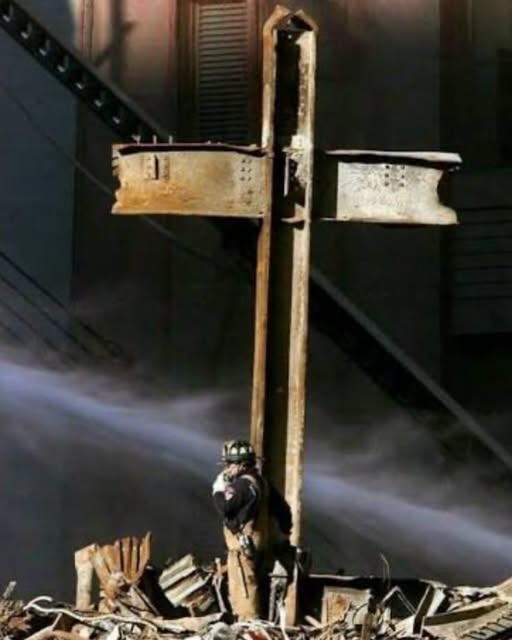
In the aftermath of September 11, 2001, Ground Zero became a place unlike any other in American history. It was a landscape of destruction, grief, courage, and unimaginable loss. Amid the twisted steel, dust, concrete, and debris left behind by the collapse of the World Trade Center towers, workers discovered something that would eventually become one of the most recognizable symbols associated with the tragedy: a large steel structure resembling a Christian cross.
The discovery became known as the Ground Zero Cross.
For many people, the significance of the object was deeply personal. To others, it represented an extraordinary coincidence in the middle of an otherwise devastating scene. Either way, its story became intertwined with the history of September 11 and the years of remembrance that followed.
According to accounts from the recovery operation, the structure was not deliberately constructed as a memorial immediately after the attacks. Instead, workers found intersecting steel beams within the enormous pile of debris at Ground Zero. Their arrangement created a shape that strongly resembled a cross.
The discovery reportedly occurred during the difficult cleanup operation just days after the attacks, when workers were still searching through the ruins and beginning the enormous task of removing debris.
The image of the cross carried powerful symbolism.
For firefighters, police officers, construction workers, volunteers, survivors, and families of victims, Ground Zero was a place filled with overwhelming grief. Nearly 3,000 people had died in the attacks, and thousands more were dealing with injuries, trauma, and the loss of loved ones.
In that environment, the unexpected appearance of a familiar religious symbol offered comfort to some people.
Workers eventually positioned the cross-shaped beams in a way that made the shape more visible. It became a quiet landmark within the ruins, standing among the remains of buildings that had once dominated the New York City skyline.
Photographs of the structure spread widely, and the Ground Zero Cross became a symbol of hope for many Christians.
However, the story is sometimes simplified online. Claims that the cross was “made” or deliberately planted immediately after the attacks can obscure the historical details surrounding its discovery. The steel beams were part of the World Trade Center’s structural remains, and their cross-like configuration became meaningful because of what people saw in the wreckage.
For believers, the symbolism went beyond the physical object.
The Christian cross has traditionally represented sacrifice, suffering, faith, and hope after tragedy. Seeing a cross emerging from the ruins therefore carried an emotional meaning that was particularly powerful in the days following September 11.
But the symbol was also part of a complicated public conversation.
Ground Zero was not simply a religious site. It was a place where people of many faiths, backgrounds, and nationalities had suffered. The attacks affected Christians, Muslims, Jews, people of other religions, and people who followed no religion at all.
For that reason, the Ground Zero Cross has often been discussed as a symbol of individual faith rather than as a statement about everyone who experienced the tragedy.
As cleanup and recovery continued, the cross became increasingly recognizable. It was eventually moved from its temporary position and preserved.
Years later, the object became part of the September 11 Memorial & Museum’s collection and interpretation of the events surrounding the attacks.
Its preservation reflects the importance of physical objects in remembering history. Photographs can show us what happened, but objects can provide a tangible connection to the past.
The Ground Zero Cross is one such object.
Its steel beams were once simply part of a massive architectural structure. After the towers collapsed, their meaning changed. They became evidence of the destruction and, for many people, a representation of survival and faith.
There is also an important human element to the story.
Ground Zero workers were surrounded by uncertainty. They were searching for survivors and victims while dealing with dangerous conditions and enormous amounts of debris. Many workers would later describe the experience as physically and emotionally exhausting.
In such circumstances, discovering something recognizable and meaningful could have an extraordinary psychological effect.
The cross became a gathering point for some workers and visitors. People prayed near it. Others photographed it. Some left flowers or personal messages.
The object therefore became more than steel.
It became part of the emotional landscape of Ground Zero.
For families who lost loved ones, however, September 11 remained primarily about the people who never came home. No symbol could replace them. No monument could erase the pain of losing a parent, spouse, child, sibling, friend, or colleague.
The cross was meaningful precisely because it existed alongside that grief.
It did not erase the tragedy. Instead, for those who found comfort in it, it provided a way to express hope while confronting an unbearable loss.
Over time, the Ground Zero Cross became part of a larger story about how societies remember catastrophic events.
After disasters, people often search for symbols. They preserve pieces of damaged buildings, photographs, personal belongings, handwritten notes, uniforms, and other objects connected to those who were lost.
These objects can help transform an overwhelming event into something that can be remembered and understood.
The Ground Zero Cross became one of those objects.
Its story continues to attract attention because of the circumstances surrounding its discovery. The idea that a recognizable cross-like shape emerged from the wreckage only days after the attacks is emotionally powerful, particularly for people who interpret the event through their religious beliefs.
At the same time, remembering history responsibly means separating documented facts from later retellings.
The important point is that the cross-shaped steel beams were part of the rubble and became an enduring symbol because of how people interpreted and preserved them. Its significance ultimately comes not only from the physical shape of the metal but from the meaning people attached to it.
For some, it represents God and faith during suffering.
For others, it represents resilience.
For still others, it is simply a remarkable artifact from one of the most consequential moments in modern American history.
More than two decades after September 11, the Ground Zero Cross remains a reminder that history is often preserved through unexpected objects.
A piece of steel that once served an ordinary structural purpose became connected forever to a day that changed the world.
The cross cannot tell us why the attacks happened, nor can it explain the suffering that followed. But it can remind us of something human beings repeatedly demonstrate after tragedy: the desire to find meaning, remember the dead, support one another, and search for hope in places where hope seems impossible.
On September 11, the world witnessed extraordinary destruction.
In the days afterward, amid the rubble, people also witnessed extraordinary courage.
And for millions who continue to remember that terrible time, the Ground Zero Cross remains one of the most enduring symbols of the complicated emotions that followed—grief, sacrifice, faith, remembrance, and hope. ✝️