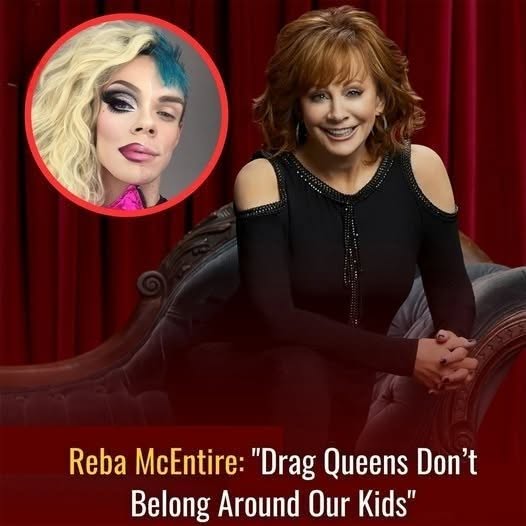
Reba McEntire and the Viral “Drag Queens Don’t Belong Around Our Kids” Claim: What the Record Shows
A provocative headline recently circulated online claiming that country music star Reba McEntire had declared, “Drag queens don’t belong around our kids.” The statement appeared designed to provoke a strong reaction, especially amid America’s continuing debates over drag performances, LGBTQ+ rights, and questions about what kinds of entertainment should be accessible to children.
But there is a major problem with the claim: there is no credible evidence that Reba McEntire actually made that statement.
Fact-checkers investigated the viral attribution and found that the quote originated from a satirical article published in 2024. Searches for reliable reports of McEntire making the alleged statement turned up fact-checks rather than evidence that she had actually said it.
The distinction matters because the claim portrays McEntire as taking a position that is very different from statements she has actually made publicly.
In March 2023, McEntire spoke to the Los Angeles Times about Tennessee legislation restricting certain drag performances. Rather than expressing support for the restrictions, she said she was disappointed that the bill had passed.
Her comments focused on what she believed lawmakers should be prioritizing. She questioned why so much attention, energy, and money was being devoted to the issue when other problems—including children experiencing poverty—needed attention.
That interview provides important context for understanding the viral claim.
McEntire also emphasized that she generally tries to stay away from politics. She explained that her job is to entertain rather than tell people how to vote. But when asked about the Tennessee law, she nevertheless made clear that she did not understand why lawmakers were concentrating so heavily on drag performers.
That position is almost the opposite of the viral headline.
The controversy surrounding drag performances has become one of the most emotionally charged cultural debates in the United States. Supporters of restrictions often argue that children should be protected from adult-oriented entertainment and that parents should have greater control over what their children see.
Opponents argue that broad restrictions can unfairly target LGBTQ+ people and drag performers and can turn a debate about age-appropriate entertainment into discrimination.
Those disagreements are real.
But attaching a statement to a celebrity that the celebrity never made changes the conversation entirely.
A person reading only the viral headline could reasonably believe McEntire had publicly attacked drag queens or demanded that they be kept away from children. That belief could then influence how the reader thinks about her, her music, and her political views.
The problem is that the headline creates a conclusion before the facts are examined.
McEntire’s actual history also makes the alleged statement particularly questionable.
In a 2015 interview with The Advocate, McEntire discussed her LGBTQ+ fan base and said she had always embraced her gay and lesbian fans. She also spoke about being supportive of same-sex marriage and emphasized the importance of an open mind and a loving heart.
Her connection with drag culture has also been documented for years. A 2018 Washington Post profile noted that McEntire was popular with drag queens and described her as someone with many gay friends.
That does not mean every person must agree with McEntire’s views.
Celebrities are allowed to change their opinions. People can evolve. Public figures can also have complicated positions on controversial issues.
But when a dramatic quote is attributed to someone, there should be evidence showing that the person actually said it.
That is especially important in the social-media era.
A sensational headline can travel much faster than a correction. Thousands of people may share a claim because it confirms something they already believe. By the time fact-checkers investigate the statement, the original post may already have reached an enormous audience.
Some readers may never encounter the correction.
This is one reason fabricated celebrity quotes can be so effective.
They often sound believable because they are built around issues the celebrity could plausibly be discussing. A person sees a famous name, a controversial subject, and a short quotation that sounds dramatic. The natural reaction is to assume the statement is authentic.
But plausibility is not proof.
The Reba McEntire example demonstrates why checking the original source matters.
If someone claims that a celebrity made a controversial statement, the first question should be simple: Where and when did the celebrity say it?
Was there an interview?
Was there a video?
Was there an official statement?
Did reputable news organizations report the quote?
Is there a transcript?
In this case, the evidence points in the opposite direction from the viral claim.
Fact-checkers found that the headline had been published as satire and later circulated as though it were a genuine news report.
That transformation—from satire into supposed fact—is particularly dangerous because readers who encounter the statement later may have no idea that it began as satire.
The words can be copied from one page to another until the original context disappears.
Eventually, a fabricated statement can begin to look like established history.
That is why this story should not simply be viewed as another celebrity controversy.
It is also a lesson in how misinformation spreads.
The debate over drag performances and children is legitimate and emotionally important to many Americans. Parents, performers, LGBTQ+ advocates, lawmakers, religious communities, and civil-rights organizations have different perspectives on the subject.
Those perspectives deserve to be debated using real statements and verifiable facts.
Inventing a quote does not strengthen either side of the debate.
It only makes it harder to determine what anyone actually believes.
For Reba McEntire, the available record tells a much more nuanced story than the viral headline suggests.
She has described herself as someone who prefers to entertain rather than engage in political battles. Yet when asked directly about Tennessee’s anti-drag legislation, she expressed disappointment and questioned whether lawmakers were focusing on the issues that most urgently needed attention.
She has also spoken positively about her LGBTQ+ fans and emphasized acceptance and an open heart in previous interviews.
None of that means every aspect of McEntire’s personal beliefs can be reduced to a single political label.
And that may be the broader lesson.
People are more complicated than viral headlines.
A celebrity can be politically independent, personally religious, supportive of LGBTQ+ friends, uncomfortable with certain forms of entertainment, and still hold views that do not fit neatly into an internet argument.
The public deserves to know what famous people actually say—not what someone wants them to have said.
So the next time a shocking celebrity quote appears in your feed, take a moment before sharing it.
Look for the original interview.
Search for the exact words.
Check reputable reporting.
And ask whether the statement has been independently verified.
In the case of the claim that Reba McEntire said, “Drag queens don’t belong around our kids,” the evidence does not support it.
The controversy may be real.
The cultural debate may be real.
The disagreement over children and entertainment may be real.
But the quote attributed to McEntire is not supported by the available evidence.
And sometimes, the most important part of a viral story is not the shocking statement everyone is sharing.
It is discovering whether the statement was ever made at all.