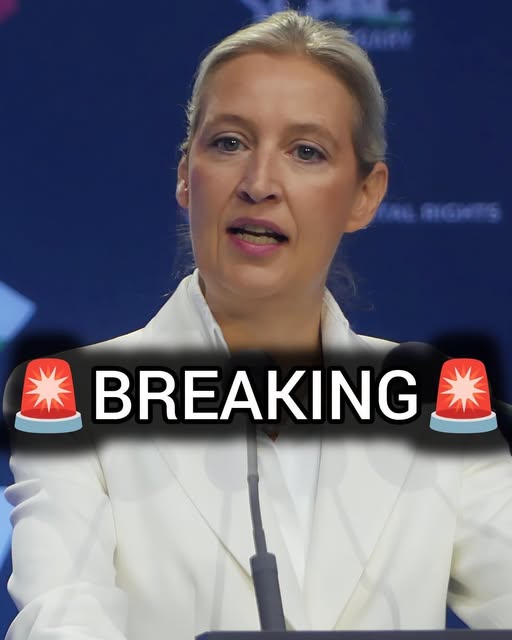
Alice Weidel Signals a New Direction for Germany’s AfD
A major political debate is unfolding in Germany after AfD co-leader Alice Weidel highlighted what she sees as a new opportunity for her party following its historic success in Saxony-Anhalt.
The Alternative for Germany, or AfD, secured about 43.8% of the vote in the September 6 state election, winning 39 of the 83 seats in the state parliament. The result put the party just short of an outright majority and created the possibility of Germany’s first state government led by the AfD.
For Weidel, the result represents far more than a successful regional election.
She described the outcome as a historic result and said it gave the AfD a clear mandate to take responsibility in the state government. She has acknowledged, however, that the precise form of participation remains uncertain, with possibilities including a minority government or some form of cooperation.
The result has immediately intensified Germany’s political debate.
For years, mainstream German parties have maintained a political firewall around the AfD, refusing to cooperate with it. Chancellor Friedrich Merz and the CDU have continued to reject cooperation with the party, despite the AfD’s growing electoral strength.
That makes the Saxony-Anhalt result especially significant.
The AfD’s success demonstrates that its support is no longer limited to a small protest movement. The party has become a major force in German politics, particularly in parts of eastern Germany.
The reasons for that growth are complex.
Economic dissatisfaction, concerns about immigration, frustration with bureaucracy, worries about the cost of living, and disappointment with established political parties have all contributed to the AfD’s appeal. Recent reporting has also highlighted dissatisfaction with the federal government’s economic performance and the political establishment’s inability to convince many voters that existing policies are working.
Weidel has repeatedly presented her party as an alternative to the political establishment.
The AfD’s national platform calls for major changes in migration, energy, economic, and European policy. The party has also criticized what it describes as excessive European Union bureaucracy and argued for policies focused more strongly on German national interests.
Migration is one of the central issues.
The AfD advocates substantially stricter immigration policies and has promoted the concept of “remigration,” a term that has become one of the most controversial elements of its political message. Critics argue that some of the party’s proposals threaten Germany’s liberal democratic values, while AfD supporters argue that tougher immigration policies are necessary to strengthen national security and social cohesion.
Weidel and her party also emphasize economic concerns.
In recent statements, she has criticized the federal government’s approach to taxation, bureaucracy, and public-sector employment. The AfD has argued that Germany needs a major reduction in bureaucracy and a different economic strategy to restore competitiveness.
Those arguments are gaining attention at a difficult time for the German government.
Chancellor Friedrich Merz is facing political pressure over the economy, pensions, and his government’s broader reform agenda. The AfD’s rise adds another challenge because voters dissatisfied with the governing coalition increasingly have an alternative that is polling and performing strongly at the state level.
But the AfD’s electoral gains do not automatically mean that it can govern.
Winning the largest share of votes is different from forming a stable government. In Saxony-Anhalt, the party fell short of an outright majority, meaning that questions about parliamentary cooperation remain crucial.
Other parties have traditionally refused to cooperate with the AfD.
That political isolation has been one of the most important barriers preventing the party from entering government. Even after the election victory, mainstream politicians have indicated that they do not intend to abandon that position.
Merz has argued that the AfD’s policies are too divisive and has specifically criticized its positions on Ukraine and migration.
This creates a difficult political situation.
The AfD can claim a strong electoral mandate, while other parties can still refuse to work with it. The result could therefore lead to negotiations, political pressure, or a minority administration rather than an immediate AfD government.
Nevertheless, the symbolism of the election is enormous.
The party came close to securing enough seats to govern a German state on its own. That would represent a historic development for a political movement that has never previously led a state or federal government in modern Germany.
The result is also being watched outside Germany.
European governments and political parties are paying attention to the AfD’s growth because Germany is Europe’s largest economy and one of the European Union’s most influential members.
Changes in German politics can therefore have consequences far beyond German borders.
Foreign policy is another area of disagreement.
The AfD has taken positions sharply different from those of Merz’s government, particularly concerning Ukraine and relations with Russia. Merz has maintained strong support for Ukraine and warned about the consequences of a Russian victory, while the AfD has criticized Germany’s current approach.
That difference could become increasingly important if the AfD continues gaining support.
The upcoming elections in Berlin and Mecklenburg-Western Pomerania will provide additional tests of the party’s momentum. Its performance in those elections could help determine whether Saxony-Anhalt was an isolated breakthrough or part of a broader political transformation.
For Weidel, however, the message is already clear.
She believes voters are increasingly rejecting the established political order and turning toward the AfD because they want a different direction.
Critics see something very different.
They warn that the party’s increasingly hardline positions on immigration, national identity, and Europe could deepen social divisions and challenge Germany’s postwar political consensus. Reporting on the party’s rise has highlighted concerns from opponents about extremist tendencies within parts of the movement.
That disagreement is unlikely to disappear soon.
Germany is entering a period in which the traditional political balance is being tested. The AfD’s electoral strength means other parties can no longer treat it simply as a marginal force.
At the same time, the party’s critics are determined to prevent it from becoming part of the governing establishment.
The coming months will therefore be closely watched.
Will other parties maintain their refusal to cooperate with the AfD? Will the party succeed in turning its electoral victories into actual governing power? Can Weidel and her colleagues broaden their support beyond the voters who already strongly identify with their platform?
Those questions remain unanswered.
What is already clear is that the AfD has reached a new level of political influence.
The Saxony-Anhalt election has changed the conversation in Germany. A party once treated primarily as an opposition force is now discussing the possibility of governing, while its opponents are being forced to confront a political reality they had hoped to contain.
Alice Weidel’s message is therefore part of a much larger transformation.
Whether that transformation ultimately leads to government power or produces a stronger reaction from Germany’s established parties remains to be seen.
But one thing is certain: the AfD’s rise has made German politics more unpredictable, and the country’s voters will have a major role in determining what happens next.