Thailand’s King Maha Vajiralongkorn and Queen Suthida Arrive in Hanoi for a Historic State Visit
Thailand’s King Maha Vajiralongkorn and Queen Suthida have arrived in Hanoi, Vietnam, for a historic state visit that has attracted considerable attention across both countries. The visit, taking place from September 14 to 16, 2026, marks an important moment in the long relationship between Thailand and Vietnam and coincides with the 50th anniversary of diplomatic relations between the two nations.
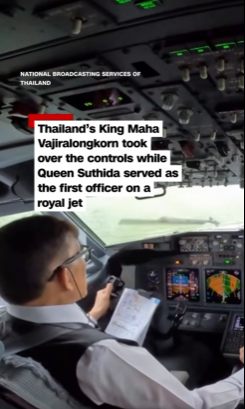
The journey has also drawn attention because of the King’s well-known aviation background. King Maha Vajiralongkorn is a certified military and civilian pilot, while Queen Suthida is also an experienced aviator who has received flight training and holds a commercial pilot license. Thailand’s Government Public Relations Department has previously documented occasions when the King piloted a royal aircraft with Queen Suthida serving as co-pilot.
Their shared connection with aviation has created memorable moments during previous royal journeys. During the 2025 state visit to Bhutan, for example, the King personally flew the royal aircraft from Thailand to Bhutan, with Queen Suthida serving as co-pilot. He also piloted the aircraft on the return journey, again with the Queen serving as co-pilot.
The Vietnam visit, however, is significant for reasons that extend far beyond the journey itself.
According to Thailand’s Government Public Relations Department, this is the first state visit by a reigning Thai King to Vietnam in the history of relations between the two countries. The visit was made at the invitation of To Lam, General Secretary of the Central Committee of the Communist Party of Vietnam and President of Vietnam.
That historical significance gives the visit a special place in the diplomatic relationship between Bangkok and Hanoi.
During their time in Vietnam, Their Majesties are scheduled to take part in a series of official ceremonies and engagements. Among the first activities are wreath-laying ceremonies at the Bac Son Martyrs’ Monument and the Mausoleum of former President Ho Chi Minh.
They will also attend an official welcoming ceremony and meet with President To Lam and his spouse. Other senior Vietnamese officials scheduled to receive the Thai King and Queen include Prime Minister Le Minh Hung and National Assembly Chairman Tran Thanh Man.
One of the most formal moments of the visit will be the state banquet hosted by the Vietnamese president and his spouse at Tonkin Palace. Following the banquet, Their Majesties are scheduled to proceed to Ngoc Son Temple to view cultural performances.
These events combine diplomacy, history, and cultural exchange, reflecting the importance both governments have placed on the royal visit.
The relationship between Thailand and Vietnam has developed considerably over the decades. Diplomatic relations were formally established in 1976, and the 50th anniversary provides an opportunity for both countries to reflect on the relationship while looking toward future cooperation.
A state visit by a reigning monarch is highly ceremonial, but such visits can also provide opportunities for governments to emphasize areas of mutual interest. Cultural connections, economic relationships, tourism, education, and people-to-people exchanges are among the broader areas that can benefit from closer diplomatic engagement.
For many observers, however, the images of the King and Queen arriving in Vietnam are likely to be among the most memorable aspects of the visit.
Queen Suthida has developed a public reputation for her interest in aviation and sports. Thailand’s Government Public Relations Department has described her as being recognized for her flying ability and noted that she has participated in several flight-training courses in Thailand and abroad. The Queen has also served as co-pilot during royal journeys.
The sight of the King and Queen personally participating in aviation has therefore become a distinctive feature of some of their international travel.
It also offers a glimpse into a less formal side of royal duties. State visits normally involve carefully organized ceremonies, official meetings, military honors, receptions, banquets, and cultural events. Flying a royal aircraft, by contrast, highlights the King’s personal aviation experience and the Queen’s own training.
Still, the central purpose of the Hanoi visit remains diplomatic.
The official program demonstrates the importance placed on strengthening relations between Thailand and Vietnam. The Thai government has described the visit as an opportunity to further strengthen bilateral relations for the mutual benefit and enduring prosperity of the peoples of both countries.
The visit also provides an opportunity for the two countries to showcase their cultural connections.
On the final day, Their Majesties are scheduled to visit Quan Su Pagoda, the headquarters of the Executive Council of the Vietnam Buddhist Sangha. They are also scheduled to visit the Thai Cultural Centre at Hanoi University. These engagements underline the cultural and religious dimensions of the relationship between the two nations.
For Vietnamese hosts, the royal visit represents an opportunity to welcome Thailand’s monarch and queen during a milestone year. For Thailand, it represents an important diplomatic occasion and a chance to reinforce longstanding ties with a neighboring Southeast Asian country.
The atmosphere surrounding the visit is therefore about much more than ceremony.
It is about history, friendship, cultural understanding, and the continuing development of relations between two countries that share the broader Southeast Asian region.
The images from Hanoi are likely to remain significant because of the historic nature of the occasion. A reigning Thai monarch visiting Vietnam for the first state visit of its kind creates a moment that will be remembered in the diplomatic history of both nations.
And for observers following the royal journey, the King and Queen’s aviation background adds another interesting dimension to the story.
The official record clearly establishes King Maha Vajiralongkorn’s qualifications as both a military and civilian pilot, as well as Queen Suthida’s experience and commercial pilot license.
Whether seen through the lens of aviation, royal tradition, diplomacy, or Southeast Asian history, the Hanoi visit is an important event.
As Their Majesties continue their scheduled engagements, attention will remain focused on the official ceremonies, meetings, cultural visits, and messages surrounding the 50th anniversary of Thailand-Vietnam diplomatic relations.
For now, the visit stands as a notable chapter in the relationship between the two countries — one combining royal tradition, international diplomacy, aviation, and cultural exchange in the heart of Vietnam’s capital.