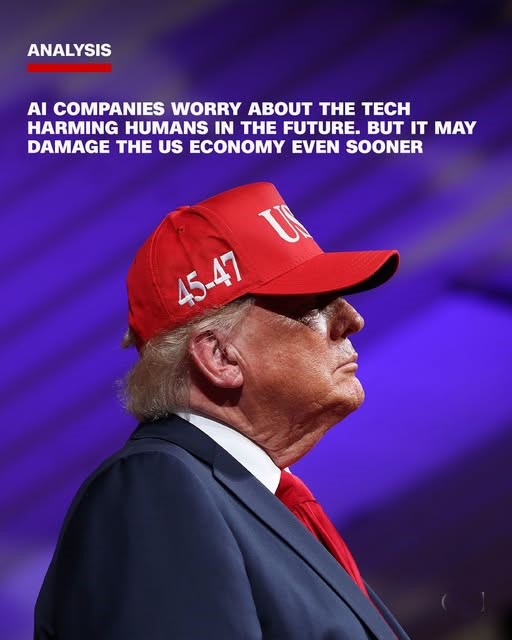
Trump’s AI Push Raises a Bigger Economic Question: What Happens If the AI Fever Breaks?
Artificial intelligence has become one of the defining economic stories of the current decade. Companies are investing enormous sums in chips, data centers, software, electricity generation and infrastructure, while investors continue to watch the technology sector closely for signs of whether the boom can translate into lasting productivity and economic growth.
For President Donald Trump, artificial intelligence has also become a major part of his economic and national-security agenda. His administration has repeatedly emphasized the importance of keeping the United States ahead of China in AI and reducing regulatory barriers to the technology.
The White House says the administration’s policies have helped attract trillions of dollars in announced investment into American technology, manufacturing and AI infrastructure. Its investment list includes large commitments from companies including Meta, OpenAI, Oracle, NVIDIA, Micron and others. Those figures are company announcements and administration claims about investment commitments, rather than money already spent or guaranteed economic output.
That distinction becomes important when considering the possibility of an AI slowdown.
The central question is not necessarily whether artificial intelligence will disappear. It is whether the enormous amount of money currently being committed to AI infrastructure will generate enough economic returns to justify the investment.
That question has become more prominent in September 2026.
Reuters reported that technology stocks recently declined after Anthropic CEO Dario Amodei called for a slower pace of AI development amid concerns about the risks associated with increasingly powerful systems. The report noted that the market reaction reflected uncertainty about future AI investment and whether the rapid infrastructure expansion can continue at its current pace.
At the same time, other analysts cited by Reuters have offered different interpretations. Some have warned that slower AI spending could affect technology valuations and other parts of the economy, while others have characterized recent weakness as a normal adjustment rather than evidence of a collapse.
That disagreement is important.
An “AI bubble” can mean different things. It could refer to technology stocks becoming excessively valued, companies spending more on infrastructure than they can ultimately monetize, or expectations about AI productivity becoming disconnected from actual economic results.
Those are different risks.
A decline in AI stock prices would not necessarily mean that artificial intelligence itself had failed. Similarly, slower construction of data centers would not mean that AI technology had disappeared.
But because the current boom involves such enormous investment, a significant slowdown could affect businesses far beyond software companies.
Consider data centers.
AI models require enormous computing resources. Those resources require specialized chips, servers, buildings, cooling systems and electricity. As data centers expand, they also require connections to power grids and other infrastructure.
The economic consequences are already becoming visible.
On September 16, the U.S. House of Representatives overwhelmingly passed the Ratepayer Protection Act, legislation addressing concerns about the economic impact of the rapidly expanding data-center industry. Reuters reported that the measure passed 417-3 and would require state utility regulators to consider whether large electricity consumers such as data centers should bear additional infrastructure costs.
That debate illustrates the complicated relationship between AI investment and the wider economy.
AI development can create demand for construction, electricity, semiconductor manufacturing, engineering and other services. But rapidly increasing electricity consumption can also create costs for utilities and households.
The Trump administration has acknowledged that issue while continuing to support AI expansion. A March 2026 White House proclamation said that data centers and AI infrastructure were important to American technological and economic leadership but also recognized concerns about increased electricity demand and household energy costs.
Meanwhile, the Federal Reserve is watching the broader economy from a different perspective.
On September 16, 2026, the Federal Reserve raised its benchmark interest-rate target by a quarter percentage point to between 3.75% and 4.00%. Reuters reported that the central bank cited persistent inflation, including pressures associated with energy costs, tariffs and strong investment connected to the AI boom.
That creates another complication.
AI investment can contribute to economic growth, but a powerful investment cycle can also increase demand for labor, energy and capital. If those pressures contribute to inflation, higher interest rates can make borrowing more expensive for businesses.
That matters because AI infrastructure is extremely capital-intensive.
A company building a massive data center may require billions of dollars in financing and equipment. If financing costs rise while expected future returns decline, companies could reconsider the pace of expansion.
That does not automatically produce an economic crisis.
The United States has a large and diversified economy. AI is one part of it, alongside manufacturing, healthcare, financial services, construction, agriculture, energy, transportation and countless other industries.
But the AI boom has become important enough that a major investment slowdown could have noticeable effects in technology and related industries.
The stock market provides another channel.
Technology companies represent a substantial portion of major U.S. stock indexes. If investors suddenly concluded that AI-related earnings would be much lower than expected, valuations could fall.
That could affect household wealth, retirement accounts and business investment even if the underlying technology continued improving.
The opposite scenario is also possible.
AI could produce productivity improvements that justify today’s enormous investment. Companies could discover profitable uses for AI, workers could become more productive, and new industries could emerge.
The White House’s economic strategy explicitly emphasizes this possibility. Its AI policy framework describes AI as a major source of innovation, economic competitiveness and national security.
Trump has also publicly rejected calls to slow American AI development, arguing that maintaining U.S. leadership is strategically important, particularly in competition with China. Reuters reported on September 14 that Trump dismissed growing concerns about AI safety and argued that the United States already has mechanisms capable of addressing risks.
That policy approach places the administration firmly behind continued AI expansion.
The economic question raised by critics is therefore not simply whether AI is useful. It is whether investment expectations have become too high.
If the AI boom slows gradually, the consequences could be manageable. Companies might reduce spending, investors could shift money toward other sectors, and the industry could move from rapid infrastructure construction toward a more mature phase focused on generating returns.
A much sharper correction would be different.
Companies that depend heavily on AI spending could face declining revenues. Data-center projects could be delayed. Semiconductor orders could weaken. Technology valuations could fall. Contractors and suppliers could experience reduced demand.
The effects would depend heavily on the size and speed of any adjustment.
There is another possibility: AI investment could continue while expectations become more realistic.
That would mean the industry does not necessarily experience a dramatic collapse. Instead, investors and companies could gradually distinguish between technologies that generate measurable economic value and projects that depend mainly on expectations of future growth.
That process is already part of the current market discussion.
Reuters reported that some analysts see recent weakness in AI-related stocks as a potential plateau in infrastructure expansion rather than an industry collapse.
The difference between those scenarios cannot be known with certainty today.
What is clear is that the AI economy has become significant enough to influence investment, electricity demand, technology markets and government policy.
Trump’s administration has chosen to encourage rapid development and reduce barriers to AI innovation. The White House says this strategy is intended to strengthen American competitiveness and attract investment.
Whether those investments ultimately generate the expected economic returns will take years to determine.
For now, the phrase “AI fever breaks” describes a possibility, not an established outcome.
The more useful question is what happens if enthusiasm becomes more cautious.
In that situation, the United States would still have an enormous technology sector, a large economy and substantial AI capabilities. But companies, investors and policymakers would have to adjust to a world in which growth expectations are lower and every new data center, chip factory and AI model must demonstrate clearer economic value.
That would not necessarily mark the end of the AI revolution.
It could instead mark the transition from an era of extraordinary expectations to one in which results matter more than promises.
And for the U.S. economy, that distinction could ultimately matter more than whether the AI boom continues at its current extraordinary pace.