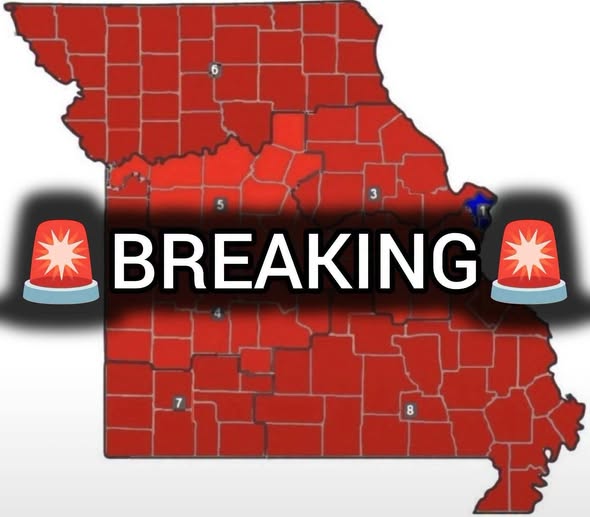
BREAKING: The 8th Circuit’s Missouri Map Battle—What the Court Actually Decided
MISSOURI — September 19, 2026
A major legal dispute over Missouri’s congressional district boundaries has drawn national attention after a series of conflicting court decisions left election officials facing uncertainty ahead of the November midterm elections.
A social-media headline claims that the 8th U.S. Circuit Court of Appeals has blocked Democrats from restoring Missouri’s previous congressional map. However, that description does not accurately capture the latest developments. The appeals court previously declined to block a federal judge’s order requiring the state to use a new map, but the U.S. Supreme Court subsequently intervened, temporarily preventing that map from being used in November.
The legal dispute continued this week, when the appeals court heard arguments about whether Missouri could revive the new congressional districts.
The case illustrates how redistricting disputes can become complicated when state constitutional rules, federal court orders, election deadlines, and competing interpretations of the law collide.
How Missouri’s Redistricting Dispute Began
The controversy centers on a congressional map adopted by Missouri’s Republican-controlled legislature in 2025.
Republican lawmakers supported changing the boundaries of the state’s eight congressional districts. The new arrangement was designed to improve Republican candidates’ opportunities in future elections.
One of its most significant effects involved Kansas City and the district represented by Democratic Congressman Emanuel Cleaver.
Under the 2022 map, Cleaver represented a district centered on Kansas City. The 2025 plan redrew the boundaries in a way that would significantly alter that district and potentially make another seat more favorable to Republicans.
Supporters argued that the new map should be implemented. Opponents challenged the plan through Missouri’s legal and referendum procedures.
The dispute eventually reached the Missouri Supreme Court, which ruled that the referendum challenging the map was valid and that the new boundaries could not take effect unless approved by voters.
That decision set the stage for the subsequent federal court proceedings.
The State Supreme Court’s Decision
On September 3, 2026, the Missouri Supreme Court issued a decision concerning the referendum petition.
The court concluded that the petition was legally sufficient and timely. It ruled that the 2025 congressional map had not taken effect because it was subject to the referendum process.
Consequently, the court held that the 2022 congressional districts remained in force for the November 2026 general election unless voters approved the new plan.
The ruling also directed Missouri officials to take the necessary steps to place the referendum before voters.
This decision became a central part of the legal dispute because it addressed whether the legislature’s redistricting plan could be implemented before the public had voted on the referendum.
Republican officials and supporters of the new map continued to pursue legal avenues to have the 2025 boundaries used in November.
The disagreement then moved into federal court, creating a complicated sequence of competing orders.
A Federal Judge Issues a Conflicting Order
On September 8, U.S. District Judge Stephen R. Clark issued a temporary restraining order in a separate lawsuit involving Missouri’s congressional districts.
The order temporarily prevented the state from returning to the 2022 map and required the use of the 2025 boundaries.
The ruling came shortly after the U.S. Supreme Court declined an emergency request to intervene in the state court dispute.
The competing orders created immediate uncertainty. Missouri officials were confronted with conflicting instructions concerning which congressional districts should be used for the November election.
The situation also raised practical questions about election administration, including ballot preparation, voter registration records, and the deadlines for changing district assignments.
The federal order did not finally determine every legal question surrounding the map. Instead, it became the subject of additional appeals.
What the 8th Circuit Actually Did
On September 9, the 8th U.S. Circuit Court of Appeals declined to block Judge Clark’s temporary order.
That decision allowed the federal order to remain in place temporarily. It did not amount to a final ruling that the 2025 map was lawful, nor did it establish that Democrats had permanently lost their challenge.
The appeals court’s action was procedural. It concerned whether the temporary order should be paused while the legal dispute continued.
The challengers subsequently sought intervention from the U.S. Supreme Court.
This distinction is important because an emergency decision about whether to suspend an order is not necessarily the same as a final judgment on the underlying constitutional questions.
The viral headline’s suggestion that the appeals court had issued a decisive ruling against Democrats therefore leaves out the larger sequence of events.
The Supreme Court Steps In Again
On September 10, the U.S. Supreme Court temporarily blocked Missouri from using the 2025 congressional map in the November election.
The order suspended Judge Clark’s conflicting directive and left the 2022 congressional map in place for the time being.
The intervention was significant because it changed the immediate legal situation after the 8th Circuit had declined to block the federal judge’s order.
The Supreme Court’s action did not necessarily resolve every issue in the underlying litigation. Instead, it addressed which map could be used while the dispute proceeded through the courts.
The result was that Missouri returned to the 2022 district boundaries for the November election, subject to further developments in the litigation.
The Latest Appeals Court Hearing
On September 17, a three-judge panel of the 8th Circuit heard arguments concerning efforts to revive the 2025 map.
Attorneys representing supporters of the new districts argued that the map should be reinstated. The dispute included questions about election administration, the timing of the litigation, and whether changing district boundaries at this stage would create serious practical difficulties.
Election officials have warned that switching maps late in the process could require substantial administrative work.
The arguments also came against the background of Missouri’s August primary, which had been conducted using the disputed 2025 boundaries.
The hearing did not itself establish that the court had issued a final ruling blocking Democrats from restoring the previous map.
Instead, the panel was considering the competing legal arguments surrounding the attempt to revive the new districts.
Why the Dispute Matters to Voters
Congressional district boundaries determine which voters are grouped together when electing representatives to the U.S. House.
Changing those boundaries can affect which communities share a representative and how candidates organize their campaigns.
In Missouri, the dispute has created uncertainty for voters who participated in the August primary under the 2025 map but may vote in November under the 2022 boundaries.
Election officials must provide accurate information about district assignments, polling locations, ballot contents, and the candidates appearing in each race.
Late changes can also create additional administrative costs and complicate communication with voters.
These practical concerns have become part of the arguments presented in court, alongside the constitutional and statutory questions.
What Happens Next?
The legal proceedings remain important because the courts must determine how the competing orders and challenges should be resolved.
The 8th Circuit’s September 17 hearing was another step in that process, but it should not be confused with a final determination that Democrats have been permanently barred from seeking restoration of the 2022 map.
The Supreme Court’s September 10 intervention remains a crucial part of the current procedural history.
Further decisions could address the arguments surrounding the federal order and the state’s authority to implement the 2025 boundaries.
Until the courts issue additional rulings, readers should be cautious about social-media posts that describe temporary procedural decisions as final victories for either political party.
The Bottom Line
Missouri’s congressional map dispute involves a series of state and federal court decisions, not one simple ruling.
The Missouri Supreme Court held that the 2025 map could not take effect unless approved by voters. A federal judge subsequently ordered the state to use the new boundaries, and the 8th Circuit declined to block that temporary order.
The U.S. Supreme Court then intervened on September 10, preventing use of the 2025 map for November while the litigation continued.
The 8th Circuit heard further arguments on September 17, but the available reporting does not establish that it issued the decisive ruling described in the viral headline.
For voters, the key issue is which congressional map will legally govern the November election. For now, the 2022 map remains in place under the Supreme Court’s intervention, while the broader legal dispute continues.