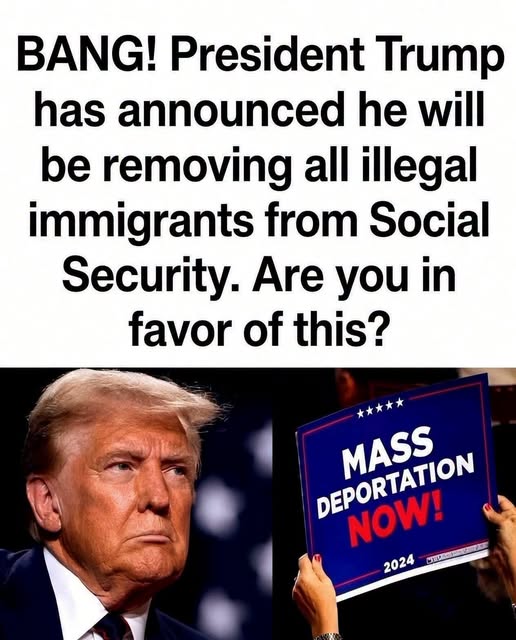
Trump’s Social Security Move: What His Latest Announcement Means for Undocumented Immigrants
President Donald Trump’s administration has continued to tighten rules surrounding federal benefits and immigration, bringing renewed attention to Social Security, Supplemental Security Income, and the question of whether undocumented immigrants can receive government assistance. The issue has generated headlines and political debate, but the details matter because Social Security programs have different eligibility rules, and undocumented immigrants are not generally eligible for Social Security retirement benefits simply because they have worked or paid taxes.
A major step came in April 2025, when Trump issued a presidential memorandum directing federal agencies to take additional measures to prevent people who are ineligible from receiving benefits under the Social Security Act. The memorandum instructed the Social Security Administration, the Department of Labor, the Department of Health and Human Services, and other agencies to strengthen eligibility verification and enforcement.
The Social Security Administration subsequently said it supported the memorandum and would work to ensure that benefits were paid only to eligible recipients. The agency specifically highlighted efforts involving potentially fraudulent records, including mismatched records involving people reported as being 100 years old or older. The administration also directed the agency to consider renewed use of certain civil monetary penalties.
Importantly, the policy does not mean that every noncitizen is barred from Social Security. The Social Security Administration states that lawfully present noncitizens who meet all eligibility requirements can qualify for Social Security benefits. Some noncitizens who are authorized to work and obtained Social Security numbers can also qualify when they satisfy the applicable requirements.
The situation is different for undocumented immigrants. Federal law generally restricts access to Social Security Act benefits for people who are not lawfully present and otherwise fail to meet eligibility requirements. In practice, this means that having a Social Security number, working in the United States, or paying payroll taxes does not by itself guarantee eligibility for retirement or disability benefits.
This distinction is especially important because undocumented workers may still have payroll taxes withheld from their wages. Employers generally withhold Social Security and Medicare taxes from covered wages, even when an employee’s immigration status creates complications involving identification or authorization to work. Those payments can contribute to the Social Security system, but paying into the system is not the same as establishing legal eligibility for future benefits.
The administration has continued taking related steps in 2026. In September, the Justice Department issued a legal opinion concerning reporting requirements involving people known to be unlawfully present in the United States. The opinion said that states participating in Temporary Assistance for Needy Families and Supplemental Security Income programs have broader responsibilities to report known unlawful presence to federal immigration authorities. The Justice Department described the action as a clarification of existing federal law rather than the creation of a completely new reporting requirement.
That development is related to the wider immigration-enforcement agenda but should not be confused with a new rule giving undocumented immigrants Social Security retirement benefits. SSI is a separate program from Social Security retirement insurance. SSI provides needs-based assistance to certain elderly, blind, or disabled people with limited income and resources, and its eligibility rules for noncitizens are different from those governing Social Security retirement and disability insurance.
Trump’s administration has also pursued other restrictions affecting noncitizens and public benefits. In September 2026, a new immigration policy took effect allowing immigration officers greater discretion when considering an applicant’s use or potential use of certain public benefits in green-card and visa decisions. States and local governments have challenged the policy in court, arguing that it could discourage eligible immigrant families from seeking assistance.
These developments have made Social Security and immigration benefits a recurring part of the policy debate. However, several different categories should remain separate. Social Security retirement and disability benefits are generally based on work history and eligibility requirements. SSI is a separate needs-based program. Medicaid, food assistance, housing assistance, and tax credits are governed by other laws and agencies. A change involving one program does not automatically change eligibility for another.
For Americans, the central issue is not simply whether undocumented immigrants are being “cut off” from Social Security. In most cases, undocumented immigrants were already not eligible for Social Security retirement benefits. The administration’s actions have focused more heavily on verification, enforcement, information sharing, and preventing people who are legally ineligible from receiving federal benefits.
The Social Security Administration itself emphasizes that eligibility depends on the law and the individual’s circumstances. Lawfully present immigrants can qualify under certain conditions, while undocumented immigrants generally cannot receive Social Security benefits merely because they worked in the country or paid payroll taxes.
The debate also has a wider financial dimension. Social Security’s trustees reported in 2026 that the retirement and survivors trust fund is projected to face depletion in the early 2030s under law. That long-term financing problem involves demographic changes, revenues, benefit levels, immigration, and federal policy decisions. It is separate from the narrower question of whether undocumented immigrants qualify for benefits.
As Trump’s administration continues changing immigration and public-benefit policies, additional regulations, court challenges, and agency guidance could alter how the rules are applied. For immigrants and families affected by these policies, the program involved and the person’s immigration category can make a significant difference.
The takeaway is that Trump’s Social Security-related actions are primarily about enforcing eligibility rules and increasing government verification rather than creating a new blanket prohibition against all noncitizens. Un