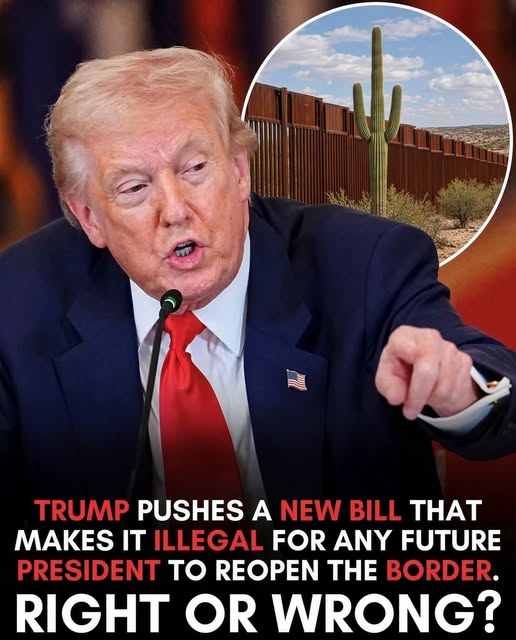
Trump’s New Border Bill: Could It Prevent Future Presidents From Reopening the Border?
President Donald Trump has announced plans to pursue new legislation designed to prevent future presidents from reopening the United States border under immigration policies that differ from his own. The proposal, which Trump has referred to as the “No Invasion of Our Country Act,” raises important questions about presidential authority, congressional power, immigration law, and whether one administration can establish lasting restrictions that successors would find difficult to reverse.
During a Republican midterm convention address in Dallas, Trump said the legislation would make it legally impossible for a future president to reopen the border. However, the proposal’s complete legislative text and precise legal mechanisms have not been publicly established in the available reporting. That distinction matters: announcing an objective is not the same as passing a law capable of achieving it.
What Is Trump Proposing?
Trump’s announcement reflects his administration’s broader approach to immigration enforcement. The president has emphasized border restrictions, immigration arrests, deportations, and tighter limits on access to asylum.
According to reporting on his speech, Trump argued that future administrations should not be able to reverse his border policies simply by changing executive priorities. His proposed legislation would seek to place stronger restrictions into federal law rather than leave the issue entirely to presidential discretion.
The administration’s position is that tighter enforcement is necessary to control unlawful crossings and protect national security. Supporters of restrictive immigration policies have also argued that consistent rules could discourage unauthorized entry and reduce pressure on border communities.
Nevertheless, the proposal’s actual consequences will depend on its language. Without a finalized bill, it is not possible to determine precisely which presidential powers would be restricted, what exceptions might remain, or how the legislation would interact with existing immigration statutes.
Can Congress Limit a Future President?
Congress has substantial authority over immigration. It can establish statutory requirements governing admission, removal, asylum, visas, and the responsibilities of federal agencies.
If lawmakers pass legislation establishing specific border procedures, a future president generally cannot simply disregard those requirements because of a policy disagreement. Federal agencies must operate within the law, and executive officials can face legal challenges when their actions exceed statutory authority.
However, Congress cannot necessarily make every aspect of immigration policy permanently unchangeable. The Constitution establishes separate branches of government, and future Congresses retain legislative authority.
A later Congress could amend or repeal a statute through the ordinary legislative process. Therefore, even a law described as permanent would not automatically become immune from future legislative revision.
The distinction is important: Congress may establish binding rules that constrain executive discretion, but one Congress generally cannot prevent another Congress from changing federal law.
A Separate Border Bill Already Introduced
The proposed announcement should also be distinguished from the Permanent Trump Secure Border Act, a separate measure introduced by Representative Chip Roy.
According to the U.S. Government Publishing Office, H.R. 9773 was introduced on July 20, 2026, and referred to congressional committees. The bill addresses multiple immigration and border-security matters. Its provisions include border barrier construction, enforcement requirements, restrictions involving asylum and immigration parole, and changes to penalties for certain immigration violations.
The legislation’s existence demonstrates that congressional efforts to codify restrictive immigration policies are not limited to presidential announcements. However, its introduction does not mean that it has become law.
The available legislative record identifies the measure as an introduced bill rather than an enacted statute. Its provisions would therefore need to proceed through the legislative process before becoming binding federal requirements.
The No Invasion of Our Country Act announcement and H.R. 9773 should not automatically be treated as the same legislation. Their relationship would need to be established through official legislative documents.
Why the Legal Details Matter
Immigration policy operates within a complicated framework of statutes, regulations, executive authority, and judicial interpretation.
A president has significant responsibilities in enforcing immigration law, but those responsibilities do not provide unlimited power to disregard congressional statutes.
That question has already appeared in litigation involving Trump’s border policies.
In April 2026, the U.S. Court of Appeals for the District of Columbia Circuit ruled against the administration’s effort to use an invasion proclamation to deny asylum access. The court concluded that the policy conflicted with federal immigration law.
The administration indicated that it would challenge the decision.
The ruling illustrates why the precise wording of new legislation matters. If Congress establishes explicit restrictions through a valid statute, those provisions may provide a different legal foundation from an executive proclamation. But legislation can still be challenged, and courts may be asked to determine whether particular provisions comply with the Constitution and other applicable laws.
What Would Happen to Asylum Seekers?
One major question concerns asylum.
Under existing federal law, people who meet the applicable requirements may seek asylum in the United States. The process includes legal standards governing eligibility and procedures for evaluating claims.
Trump’s immigration agenda has sought to restrict access to the system, arguing that it has been exploited and has contributed to unlawful migration.
Immigration advocates, meanwhile, argue that asylum protections are important for people fleeing persecution and that restrictions must comply with federal law and international obligations.
The consequences of a new statute would depend on whether it changed eligibility requirements, limited particular procedures, expanded enforcement authority, or established new exceptions.
Without the bill’s final text, claims that it would completely eliminate asylum access or permanently close every border crossing would go beyond what has been established.
Could a Future Democratic President Reverse the Policy?
A future president could face legal obstacles if Congress enacted clear statutory requirements governing border enforcement.
For example, if a law required federal agencies to follow particular procedures, an administration could not necessarily abandon those procedures through an executive order alone.
However, a future president could still exercise whatever discretion the law permits. Enforcement priorities, agency implementation, and responses to changing circumstances may remain areas where executive officials have authority.
A future administration could also ask Congress to amend the statute. Whether that effort succeeded would depend on the political and legislative circumstances at the time.
Consequently, the proposal could potentially make certain policy reversals more difficult without making them permanently impossible.
What Happens Next?
For Trump’s proposal to become law, lawmakers would need to consider its legislative language and move it through the required congressional procedures.
That process can involve committee review, amendments, negotiations, and votes in both chambers. The president would then need to sign the legislation, subject to the constitutional process governing enactment.
Even after enactment, legal challenges could arise over the scope of federal authority, the rights of affected individuals, or the interpretation of particular provisions.
The distinction between a political announcement, an introduced bill, and an enacted statute is therefore essential when assessing what the proposal would actually accomplish.
The Bottom Line
Trump’s proposal seeks to make his restrictive border approach more durable by placing additional requirements into federal law. Congress has significant authority to legislate on immigration, and properly enacted statutes can constrain how future presidents administer the system.
But no announcement alone can guarantee that a future administration will be unable to change immigration policy. A later Congress may amend existing law, executive discretion may remain in certain areas, and courts can review disputes over statutory and constitutional authority.
The decisive questions are what the final legislation says, whether Congress passes it, and how courts interpret its provisions.
Until those questions are resolved, the proposal represents an announced legislative objective—not proof that future presidents have already lost the ability to change border policy.