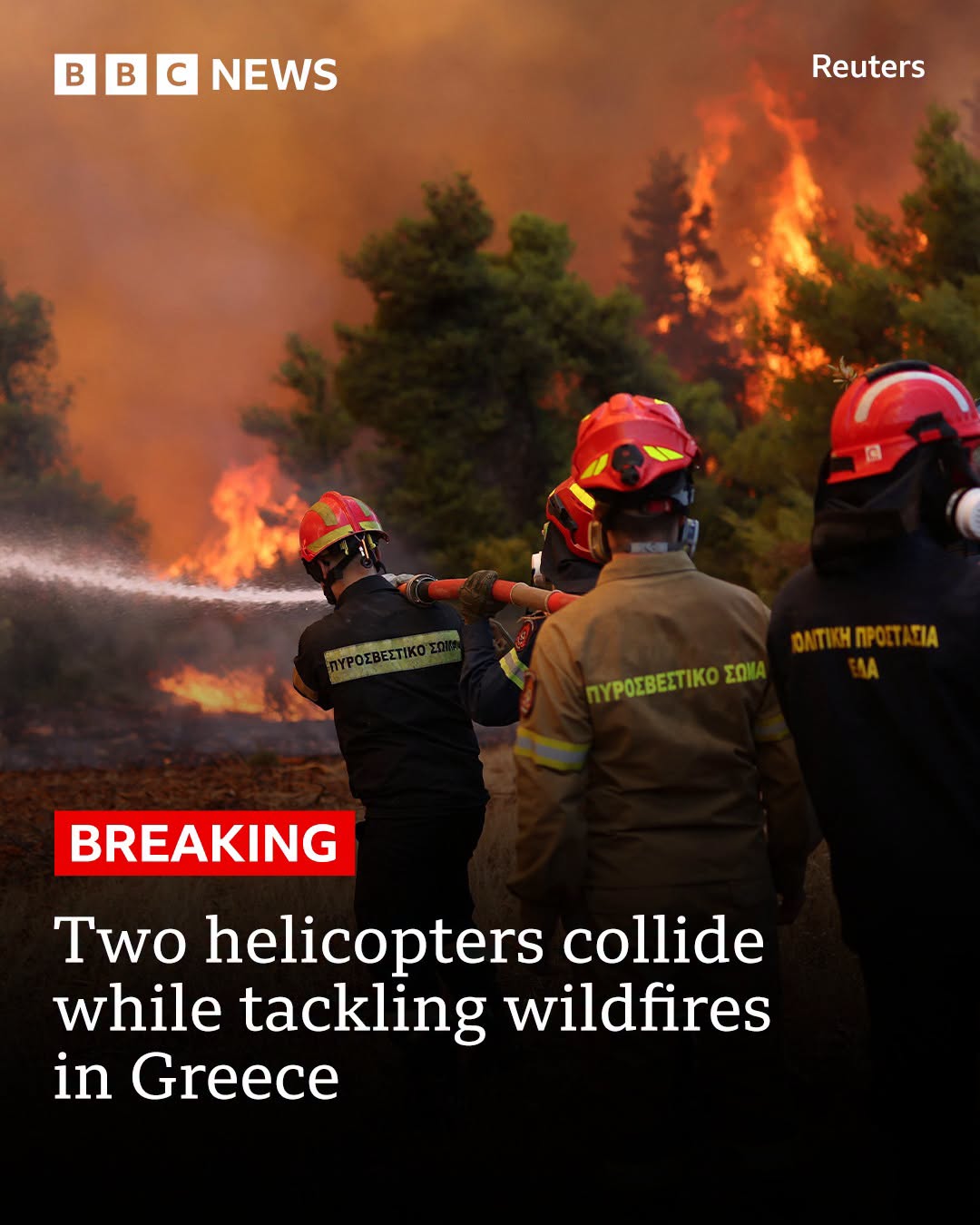
Search and Rescue Operation Under Way After Two Firefighting Helicopters Crash While Battling Greek Wildfires
A major search and rescue operation was launched in Greece after two firefighting helicopters collided while battling a rapidly spreading wildfire west of Athens, highlighting the dangerous conditions emergency crews face as devastating blazes continue to sweep across parts of the country.
The mid-air collision occurred near the coastal area of Psatha in the Attica region, where firefighters had been working tirelessly to contain a fast-moving wildfire fueled by strong winds, high temperatures, and extremely dry vegetation. The helicopters were part of a large aerial response aimed at slowing the advance of the flames and protecting nearby communities threatened by the fire.
Witnesses described seeing the two aircraft flying low over the fire zone as they collected and dropped water on the burning forest. Moments later, the helicopters appeared to converge before colliding in the air. One aircraft reportedly burst into flames and crashed to the ground, sending a thick plume of smoke into the sky. The second helicopter managed to remain airborne long enough to release its remaining water load before landing elsewhere, according to early reports.
Emergency services immediately launched a search and rescue operation involving firefighters, police, medical teams, and aviation authorities. Rescue helicopters and ground crews rushed to the crash site, navigating rugged terrain made even more hazardous by the ongoing wildfire.
Authorities later confirmed that the collision resulted in fatalities, while survivors from the second helicopter were rescued. Officials identified the victims as members of the firefighting crew, whose mission had been to help contain one of several major wildfires burning across Greece. An investigation into the cause of the collision has begun, although no official conclusions have yet been announced.
The tragedy has shocked the nation and drawn attention to the immense risks faced by aerial firefighting crews. Pilots often fly at very low altitudes through heavy smoke, strong winds, and turbulent air while coordinating closely with multiple aircraft operating over the same fire. Every mission demands exceptional precision and constant communication.
Experts note that aerial firefighting is among the most dangerous forms of aviation. Helicopters and water-bombing aircraft must repeatedly fly into hazardous environments, collecting water from nearby lakes or the sea before returning to active fire fronts. Reduced visibility, rapidly changing wind conditions, and the presence of multiple aircraft all increase the likelihood of accidents.
The wildfire near Psatha has already burned large areas of forest and scrubland, threatening homes and forcing evacuations in several communities. Hundreds of firefighters supported by aircraft have been deployed to contain the blaze, while emergency alerts urged residents in vulnerable areas to leave as a precaution.
Across Greece, firefighters continue to battle numerous wildfires as another period of extreme summer weather grips southern Europe. Meteorologists have warned that high temperatures, low humidity, and powerful winds create ideal conditions for fires to spread rapidly, making suppression efforts increasingly difficult.
Wildfires have become a recurring challenge for Greece during the summer months. Climate scientists say prolonged heatwaves and drought conditions increase the likelihood of large and destructive fires, placing enormous pressure on emergency services. Although wildfires are a natural part of many Mediterranean ecosystems, the frequency and intensity of recent fire seasons have raised growing concerns about the effects of climate change.
Greek authorities have mobilized extensive firefighting resources, including ground crews, volunteer firefighters, military assistance, helicopters, and fixed-wing firefighting aircraft. International cooperation through European emergency mechanisms has also helped strengthen firefighting efforts during particularly severe fire seasons.
Prime Minister Kyriakos Mitsotakis expressed condolences to the families of those who lost their lives and praised the courage of firefighters risking everything to protect communities. Officials emphasized that emergency personnel continue to work under exceptionally dangerous conditions to prevent additional loss of life and property.
Residents living near the affected areas described dramatic scenes as flames advanced toward homes. Thick smoke reduced visibility, while embers carried by strong winds ignited new fires hundreds of meters away from the main blaze. Many families evacuated with only essential belongings as emergency services went door to door advising people to leave.
Despite the tragic collision, firefighting operations have continued. Additional aircraft and ground crews remain engaged in efforts to slow the fire’s advance and protect residential areas. Emergency officials continue to monitor weather conditions closely, warning that changing winds could quickly alter the direction and intensity of the blaze.
Aviation investigators will examine flight records, communication logs, maintenance documentation, weather data, and eyewitness accounts to determine exactly how the helicopters collided. Investigators are expected to analyze whether visibility, operational procedures, or other factors contributed to the accident.
The incident serves as a stark reminder of the sacrifices made by emergency responders who confront life-threatening conditions to protect others. Firefighting pilots routinely operate in environments where every second matters, balancing the urgency of suppressing dangerous fires with the constant hazards of low-level flight.
As the investigation continues, rescue personnel, firefighters, and local authorities remain focused on containing the wildfires and ensuring the safety of affected communities. Meanwhile, tributes continue to pour in for the crew members who lost their lives while serving on the front lines of Greece’s ongoing wildfire emergency.
The collision underscores both the devastating impact of this year’s wildfire season and the extraordinary courage displayed by those who battle these disasters from the air and on the ground. While officials work to determine exactly what caused the crash, the incident has already become one of the most tragic moments of Greece’s current firefighting campaign, reminding the world of the risks emergency crews willingly face in their mission to save lives, homes, and natural landscapes.