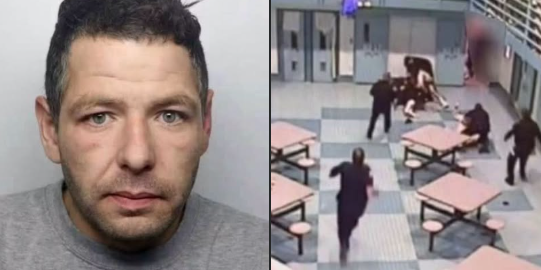
BREAKING: Kyle Bevan Killed in Five-Minute HMP Wakefield Prison Attack
The murder of convicted child killer Kyle Bevan inside HMP Wakefield has ended with three fellow prisoners receiving life sentences after a brutal attack that lasted less than five minutes.
Bevan, 33, was serving a life sentence for the 2020 murder of two-year-old Lola James, the young daughter of his partner. He was being held at the high-security prison in West Yorkshire when three inmates entered his cell on November 4, 2025.
The three prisoners — Lee Newell, Mark Fellows and David Taylor — were later convicted of his murder at Leeds Crown Court. On June 19, 2026, all three were sentenced to life imprisonment.
The case attracted significant attention because of the speed and apparent coordination of the attack.
Court proceedings heard that CCTV showed Bevan entering his cell shortly after 5:30 p.m. on the day of the killing. The three defendants subsequently followed him inside.
They remained there for approximately four minutes and 39 seconds before leaving together.
Bevan was never seen alive again.
Prosecutors told the court that the attackers used makeshift weapons, including a piece of metal taken from the back of a television and fashioned into a sharp weapon. Investigators later recovered an item containing Bevan’s blood.
The precise description of his injuries has also been clarified during the court proceedings. Reports initially referred to him being injured more than 30 times, while prosecutors told the jury that he suffered 25 stab wounds along with additional injuries believed to have been caused by another pointed weapon. The wounds included damage to major blood vessels and the heart.
Bevan was left in his bed after the attack.
According to prosecutors, the circumstances were arranged so that he appeared to be asleep. His body was not discovered until the following morning during a prison roll call.
By then, he had died from blood loss.
The circumstances surrounding the killing became an important part of the prosecution’s case. CCTV showed the three men together before the attack and entering Bevan’s cell as a group. Taylor was also seen taking an item from his waistband before entering the cell, according to West Yorkshire Police.
The prosecution argued that the attack had been planned and that the three men acted together.
The court also heard about tensions within the prison between different groups of prisoners. Bevan was classified as a vulnerable prisoner and generally kept to himself. Prosecutors said he often remained in his cell and had asked to be locked inside.
The three men accused of killing him had extensive criminal histories of their own.
Newell was serving a life sentence for murder and had previously been involved in another killing of a prisoner who had been convicted of a crime against a child. Fellows was serving life sentences connected with two previous murders. Taylor was also serving a substantial sentence for murder and an attempted murder committed against a police officer while he was in custody.
The prosecution therefore presented the killing as an attack carried out by three experienced and dangerous prisoners against a fellow inmate.
The jury ultimately agreed that the men acted together and intended either to kill Bevan or cause him serious harm. All three were convicted of murder.
West Yorkshire Police described the killing as a premeditated attack inside a prison.
Following the convictions, Senior Investigating Officer Chief Inspector James Entwistle said the case demonstrated that serious violence inside prisons would be investigated and prosecuted.
The sentencing judge, Mrs Justice McGowan, also addressed the reason Bevan had been selected as the target.
According to the sentencing remarks published by the judiciary, the three defendants chose Bevan because he had been convicted of murdering a child. The judge confirmed that all three had been convicted of his murder at HMP Wakefield on November 4, 2025.
The case has raised difficult questions about safety inside high-security prisons and how vulnerable prisoners are protected.
During the trial, prosecutors discussed the prison’s arrangements for vulnerable prisoners and other inmates. The court heard that different categories of prisoners could interact during periods of association, creating tensions between groups.
The prosecution suggested that the system made it impossible for prison officers to observe every prisoner continuously.
That issue was part of the evidence heard by the jury, although the court’s central question was whether the three defendants were responsible for Bevan’s murder.
The answer was ultimately yes.
The CCTV evidence became particularly significant because it provided a timeline for the events. It showed the defendants following Bevan into his cell and leaving together less than five minutes later.
The police investigation subsequently recovered evidence connecting the defendants and their cells to the killing.
The discovery of Bevan’s body the following morning triggered a prison lockdown while investigators began examining what had happened.
The attack also had an unusual historical element. One of the defendants, Lee Newell, had previously killed another prisoner who had been convicted of a child-related murder. According to court reporting, the circumstances of that earlier killing had similarities to Bevan’s death.
For Bevan’s case, however, the court ultimately focused on the evidence surrounding November 4, 2025.
Three men entered his cell.
They remained there for several minutes.
They emerged together.
Bevan was left behind.
The next morning, he was found dead.
The final legal outcome came in June 2026, when Newell, Fellows and Taylor received life sentences for the killing.
The story is disturbing not simply because a prisoner was murdered, but because the attack occurred inside an institution specifically designed to keep dangerous offenders contained and under supervision.
The case demonstrates how violence can still occur behind prison walls despite security procedures and surveillance.
It also highlights the complex challenge of managing different categories of prisoners, particularly where inmates have histories of violence against vulnerable people.
Kyle Bevan’s death brought an end to a case that began with his conviction for the murder of a two-year-old child and ended with his own killing inside prison.
The three men responsible will now spend the remainder of their lives subject to the sentences imposed for his murder.
For investigators, the CCTV footage, forensic evidence and testimony provided the foundation for the prosecution.
For the court, those pieces of evidence established that the attack was not an accident or spontaneous confrontation.
It was a coordinated killing.
And after months of investigation and a lengthy trial, the three prisoners involved were held legally responsible.