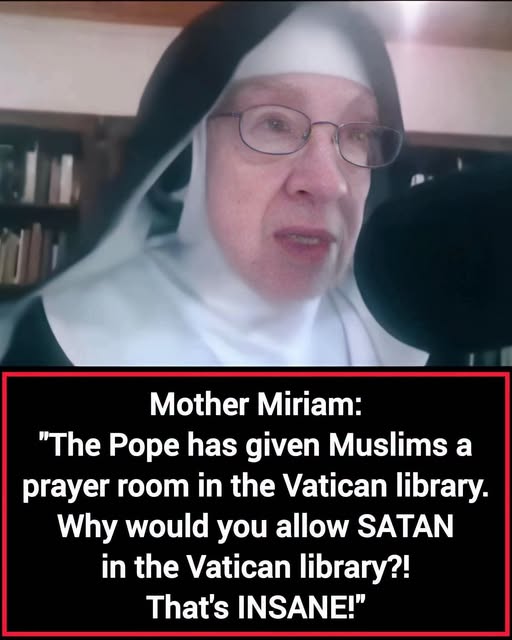
Mother Miriam Calls Out Pope Leo XIV: What Is Behind the Controversy?
Mother Miriam Ruth has become one of the more outspoken Catholic voices criticizing Pope Leo XIV, and her recent comments have reopened a difficult question inside the Catholic Church: How should Catholics respond when they believe a pope is teaching or supporting something that conflicts with Church tradition?
The controversy touches on authority, doctrine, tradition, conscience, and the limits of criticism within Catholicism. Mother Miriam, a Catholic religious sister and host of Mother Miriam Live, has challenged positions associated with Pope Leo, including statements concerning the death penalty and broader questions surrounding modern Catholic teaching. Reports published earlier this year described her as accusing Leo of doctrinal error, while her public discussions have emphasized remaining faithful to what she understands as the Church’s perennial teaching.
One of the clearest recent examples concerns the Society of St. Pius X, commonly known as the SSPX. In May 2026, Mother Miriam published an urgent appeal concerning Pope Leo XIV and the SSPX. She discussed a petition asking the pope to support the society’s planned episcopal consecrations and argued that Catholics should carefully consider questions surrounding traditional Catholic worship and Church authority. Her position placed her within a much larger debate over how the Church should handle divisions between traditionalist Catholics and Vatican authorities.
The debate became intense because critics and supporters do not agree on what constitutes legitimate disagreement with a pope. Mother Miriam’s position is that Catholics owe obedience to legitimate Church authority but are not required to follow commands that would involve sin or contradict divine law. Supporters see that distinction as a safeguard for conscience. Critics argue that applying such reasoning to papal teaching can create confusion about what Catholics are required to believe.
That disagreement is important because Catholic teaching on papal authority is more complicated than the idea that the pope is either always right or never wrong. Catholic doctrine gives the pope special teaching authority, but papal infallibility is narrowly defined. It does not mean every statement made by a pope, every interview comment, or every observation is automatically infallible.
That distinction is central to understanding the controversy surrounding Mother Miriam’s criticisms. A person can challenge a pope’s particular statement without necessarily rejecting the Catholic Church itself. At the same time, claiming that a pope has formally taught heresy is a much more serious theological accusation, and determining whether such a claim is justified requires careful examination of the exact statement, its context, its authority, and the Church’s established teaching.
Some commentators defend Mother Miriam. They argue that Catholics should not remain silent when they believe important traditions are being weakened or misunderstood. Others have disputed her conclusions and warned that accusations of heresy or illegitimate papal authority require stronger theological and canonical arguments than social-media discussions often provide.
The disagreement also reflects a broader division among Catholics over tradition. For some, the Traditional Latin Mass and pre-Vatican II practices are essential expressions of faith. Others believe liturgical development after the Second Vatican Council can coexist with continuity in Catholic doctrine. The disagreement becomes difficult when either side believes the other is abandoning something fundamental.
Pope Leo XIV has also made statements that have become part of this debate. In remarks discussed by Mother Miriam and her critics, Leo connected pro-life concerns with broader questions about the treatment of migrants and the death penalty. Supporters of his approach can interpret those comments as emphasizing the consistency of Catholic teaching on human dignity. Critics can interpret them differently, particularly when they believe newer formulations conflict with earlier Catholic teaching.
That is why the question, “Do you agree with Mother Miriam?” does not have to be reduced to a simple yes-or-no argument. A more useful question is: What specific statement is being criticized, what does Catholic doctrine actually say about it, and what authority does that statement carry?
Those questions matter because headlines can make theological disagreements appear settled than they really are. A headline saying that someone “called out the pope” may accurately describe a confrontation, but it does not by itself establish whether the criticism is theologically correct. Likewise, saying that someone defended the pope does not prove that every argument supporting the pope is correct.
Mother Miriam’s public criticism is therefore best understood as part of a continuing Catholic debate rather than as a simple personal dispute. Her supporters see her willingness to challenge powerful Church figures as an example of conscience and fidelity. Her critics see some of her conclusions as theologically problematic and believe disagreement with a pope must remain within the boundaries of Catholic teaching and ecclesial authority.
For Catholics watching the controversy, an important distinction is between disagreement and certainty. It is possible to recognize that Mother Miriam has raised serious questions without accepting every conclusion. It is also possible to respect papal authority while acknowledging that Catholics have historically debated difficult theological questions.
The controversy is unlikely to disappear quickly. Questions about tradition, papal authority, the death penalty, the Traditional Latin Mass, and the interpretation of modern Catholic teaching have been developing for years. Pope Leo’s pontificate has brought some of those disagreements into renewed public focus, while voices such as Mother Miriam continue to challenge Catholics to examine what they believe.
So, do you agree with her? That depends on which specific claim you mean and which sources you consider authoritative. The strongest way to form a view is to examine Mother Miriam’s actual words, compare them with official Catholic teaching, and distinguish established doctrine from commentary, interpretation, and opinion. The debate deserves attention because questions of faith and authority cannot be settled by a headline alone.
In the end, the controversy surrounding Mother Miriam and Pope Leo XIV is bigger than either individual. It reflects an ongoing struggle within Catholicism over how tradition, conscience, authority, and doctrinal development should relate to one another. Those questions are likely to remain central to Catholic discussion for years to come.