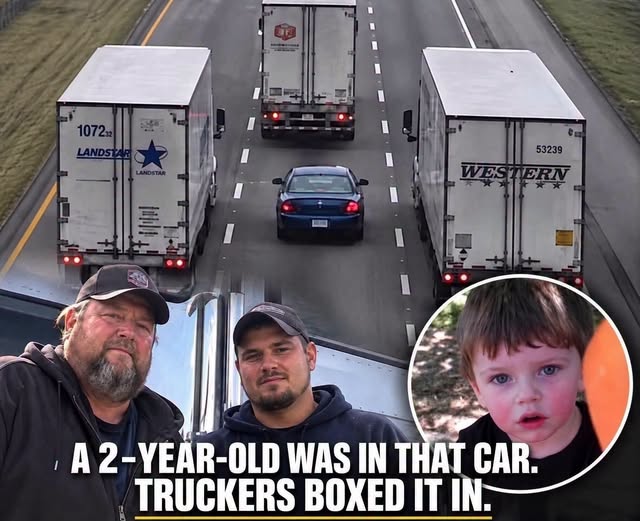
A 2-Year-Old Was in That Car. Truckers Boxed It In — and Helped Bring Him Home
Sometimes, the most powerful acts of courage happen without uniforms, official titles, or elaborate plans. They happen on ordinary roads, during ordinary workdays, when people suddenly realize that a child may be in danger and decide they cannot simply keep driving.
That is what happened on Interstate 24 in Tennessee in January 2013, when truck drivers heard an AMBER Alert and soon recognized the vehicle described in the emergency notification. Inside that car was a two-year-old boy, Cael Whitehead. The truckers understood that every minute mattered.
According to reports from the time, truck driver Jim Lowe and his co-driver, Austin Morris, were traveling on Interstate 24 when the AMBER Alert was broadcast. The alert described a missing two-year-old, the vehicle involved, and its license plate information. Shortly afterward, Lowe noticed a car traveling nearby that appeared to match the description.
The drivers did not simply assume it was a coincidence. They checked the license plate against the information from the alert. When they realized the vehicle matched, they immediately communicated with other truckers using their radios.
What happened next became a remarkable example of coordinated action on a busy highway.
The truckers moved their large tractor-trailers into positions around the car and created what authorities described as a rolling roadblock. Trucks ahead slowed down and occupied lanes, while others helped prevent the suspect vehicle from escaping. Instead of chasing the car at dangerous speeds, they used their size and positioning to gradually restrict its movement.
The scene must have been extraordinary: a small passenger vehicle surrounded by massive eighteen-wheelers, moving slowly along the interstate while truck drivers communicated with one another and waited for law enforcement to arrive.
The goal was not to punish the driver themselves. It was to keep the vehicle contained long enough for police to take over.
Reports said the car was eventually slowed to roughly 30 miles per hour. The driver apparently realized there was no easy way through the blockade and pulled over. A state trooper then arrived and took control of the situation.
The two-year-old boy was found safe and unharmed.
The circumstances surrounding the alert were serious. Authorities said the child’s father, Austin Whitehead, had taken the boy after a domestic disturbance involving the child’s mother. Reports at the time said Whitehead had traveled a considerable distance and was believed to be heading toward Georgia. The truckers encountered the vehicle close to the state line, making their quick recognition especially important.
Tennessee Bureau of Investigation spokesperson Kristin Kern credited the truck drivers with helping save the child, according to contemporaneous reports. Their actions also demonstrated something important about AMBER Alerts: the system depends not only on authorities broadcasting information, but also on ordinary people paying attention.
An alert can be received by thousands of drivers, but only someone who notices the details can connect a passing vehicle to the description. In this case, the truckers were listening, looking, and willing to communicate.
That combination made a difference.
It is easy to imagine how frightening the situation could have become. A vehicle connected to an active child-abduction alert was traveling down an interstate. The people who recognized it had no way of knowing exactly what the driver might do next. They also had to consider the safety of other motorists.
Rather than attempting a reckless confrontation, the truckers used a controlled approach. They slowed traffic around the suspect vehicle and waited for police assistance. Their trucks effectively became a moving barrier, buying valuable time without turning the highway into a high-speed pursuit.
There is also something deeply human about the fact that these drivers did not personally know the child. Cael was not their relative or friend. They were strangers who happened to be in the right place at the right time. Yet once they understood that a toddler was inside the vehicle, the situation became personal enough to act.
For the family, the most important detail was simple: the child was found alive and unharmed.
Stories like this can also remind people why paying attention to emergency alerts matters. AMBER Alerts are designed to quickly spread information about certain child-abduction cases, giving the public an opportunity to recognize a suspect, vehicle, or location. Most people who receive an alert will never encounter the vehicle involved. But when someone does, knowing what to look for can become critically important.
The Interstate 24 incident is now more than a decade old, but its central lesson remains relevant. Help does not always come from the first responder wearing a badge. Sometimes it comes from a person behind the wheel of a commercial truck, listening to a radio and realizing that the car beside them may contain a child who desperately needs to be found.
They did not know how the story would end. They simply knew their information could matter. They shared it and created time for police to intervene.
That is what makes the story memorable.
A highway can feel anonymous. Thousands of vehicles pass each other every day, with drivers focused on destinations, schedules, traffic, and the road ahead. But occasionally, strangers become connected by a moment that demands attention.
For one little boy, a group of truck drivers noticed.
They listened to an alert. They recognized a vehicle. They called on other drivers. They surrounded the car without turning the situation into a dangerous chase. And they stayed with it until police could take over.
The result was simple: a missing two-year-old was located safely at last.
The story is a reminder that courage can look surprisingly ordinary. It can look like checking a license plate, picking up a radio, slowing down, and telling another driver to move into position.
Sometimes, helping someone means simply refusing to look away.
And on that Tennessee highway, several truckers chose to do exactly that.