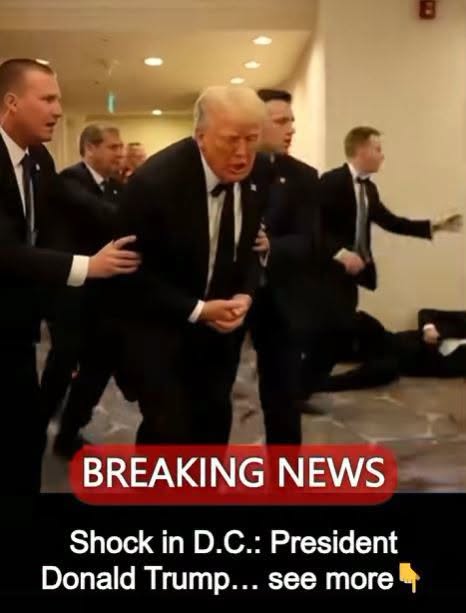
FICTION: Shock in the Capital
This story is entirely fictional and does not describe real events or real people.
Washington, D.C., awoke to what seemed like an ordinary morning. Government employees streamed into office buildings, tourists gathered around the National Mall, and journalists prepared for another day covering politics. Shortly after noon, however, social media erupted with sensational posts claiming that a major incident involving the nation’s leader had occurred just blocks from a scheduled public event.
Within minutes, the hashtag climbed to the top of trending lists. Videos showing police vehicles, ambulances, and flashing emergency lights spread rapidly across multiple platforms. Some users insisted they had witnessed the event firsthand, while others reposted dramatic claims without knowing whether they were accurate.
Television stations interrupted regular programming to acknowledge the growing rumors. Anchors carefully reminded viewers that no official confirmation had been issued and urged patience while reporters worked to verify information. Veteran journalists understood that during fast-moving situations, accuracy mattered far more than speed.
At the center of the city, law enforcement officers established temporary security perimeters around several government buildings. The increased police presence immediately fueled speculation among bystanders. Tourists pulled out their phones to record videos, while office workers paused on sidewalks trying to determine what was happening.
Inside newsrooms, editors instructed reporters to contact multiple independent sources before publishing any updates. Producers rejected several dramatic claims because they could not be verified. Although this cautious approach delayed reporting, it prevented misinformation from appearing on trusted broadcasts.
Meanwhile, cybersecurity specialists noticed something unusual. Hundreds of anonymous social media accounts were posting nearly identical messages at exactly the same time. Many of the accounts had been created only recently, suggesting that automated systems rather than ordinary users were helping spread the rumors.
Emergency management officials held a brief press conference during the afternoon. A spokesperson confirmed that security procedures had been activated following a potential concern but emphasized there was no verified evidence supporting the alarming stories circulating online.
“We encourage everyone to rely on official updates rather than speculation,” the spokesperson said. “Please avoid sharing unconfirmed information while our agencies complete their assessment.”
Despite the statement, misinformation continued spreading at extraordinary speed. Edited videos from unrelated events appeared alongside fabricated photographs that seemed convincing at first glance. Millions of people viewed the misleading posts before fact-checkers could identify their true origins.
Digital investigators worked around the clock comparing timestamps, analyzing video metadata, and tracing the earliest uploads. They soon discovered that several of the most widely shared clips had actually been recorded years earlier in entirely different cities. Others had been digitally altered to create the illusion of a breaking emergency.
As evening approached, authorities released a detailed timeline explaining what had actually occurred. A routine security response to an unrelated matter had been dramatically exaggerated online until it evolved into a nationwide rumor. No evidence supported the sensational claims dominating social media throughout the day.
The following morning, communications experts discussed the incident during interviews and university lectures. They explained how emotionally charged headlines encourage immediate reactions before readers stop to verify facts. The event became a textbook example of how quickly misinformation can spread in an era of instant communication.
Journalism organizations praised reporters who resisted pressure to publish unverified claims. Editors noted that waiting for reliable confirmation protected public trust even though it meant being slower than viral social media posts.
Technology researchers also highlighted the role of artificial intelligence and automated accounts in amplifying false information. They recommended stronger media literacy education, encouraging people to question extraordinary claims and seek confirmation from multiple credible sources.
By week’s end, life in the capital had returned to normal. Government offices resumed routine operations, tourists once again filled museums and monuments, and the dramatic rumors faded from public attention. Yet the fictional episode left behind an important lesson: in moments of uncertainty, careful verification is more valuable than sensational speculation.
The greatest challenge facing modern society is no longer simply accessing information—it is determining which information deserves trust. Whether a story appears in a headline, a video, or a social media post, responsible readers benefit from asking simple questions: Who is reporting this? What evidence supports it? Has it been independently confirmed?
Those habits may not make headlines, but they remain the strongest defense against confusion in an age when rumors can circle the world in minutes. In the end, truth is built patiently through evidence, not through dramatic claims or viral posts.