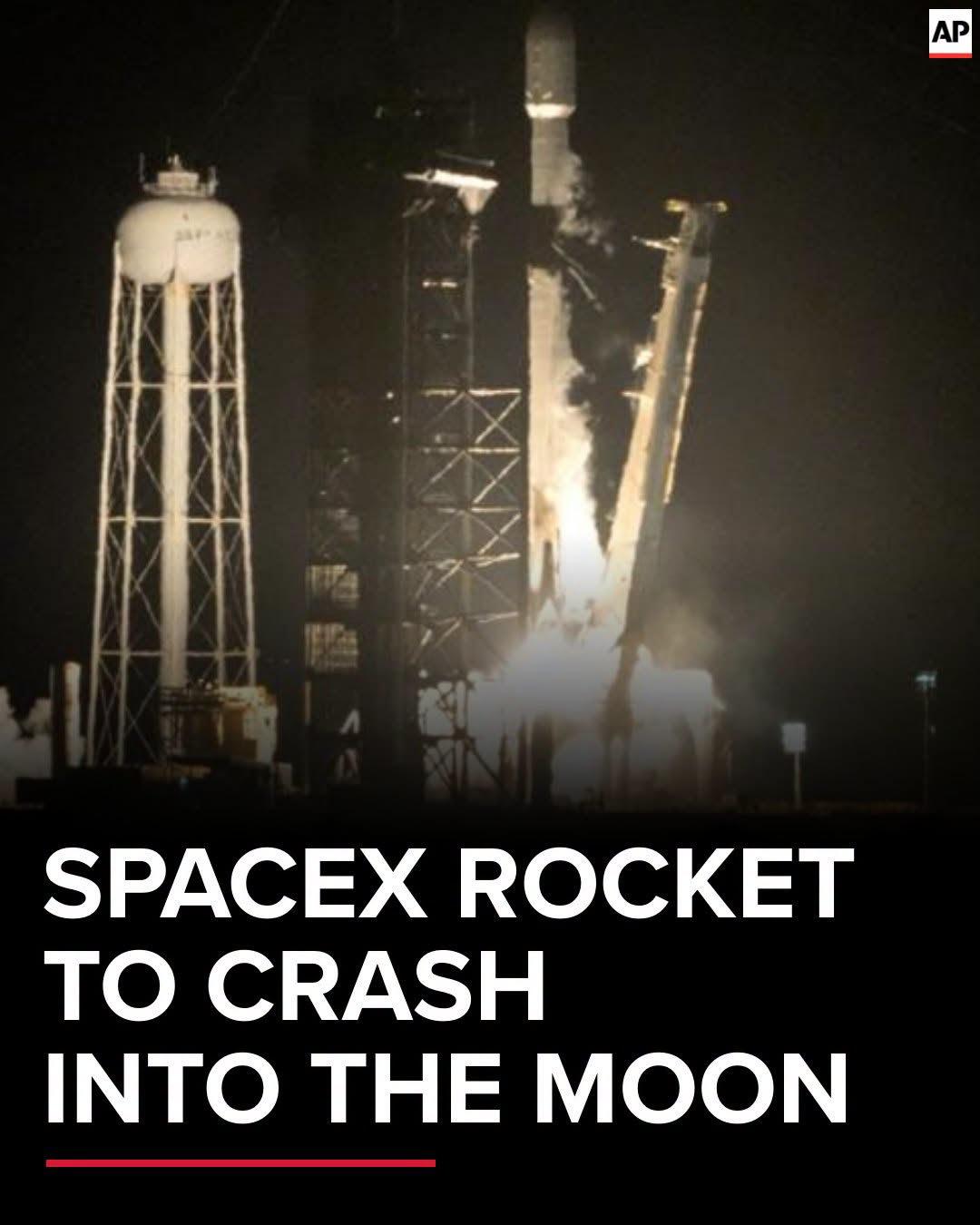
A SpaceX Rocket Will Crash Into the Moon Early Wednesday
The countdown had captured the attention of millions around the world. News headlines buzzed with speculation as astronomers, space enthusiasts, and curious onlookers prepared for an unusual event. According to tracking data, the upper stage of a SpaceX rocket, which had spent years drifting through space after completing its original mission, was expected to collide with the Moon early Wednesday morning.
Although the headline sounded dramatic, experts explained that there was no danger to people on Earth. The Moon, already marked by countless impact craters formed over billions of years, has experienced collisions with asteroids, comets, and other objects throughout its history. This event was simply another impact—one made by a piece of human technology rather than a naturally occurring rock.
The rocket stage had long since completed its job. After launching its payload into space years earlier, it continued traveling through a complicated path influenced by the gravity of the Earth, the Moon, and the Sun. Without engines firing or a controlled mission to guide it, the empty booster slowly wandered through space until scientists calculated that its orbit would eventually intersect with the Moon.
For weeks before the expected impact, observatories around the world monitored the object’s path. Every new observation refined the prediction by just a little, allowing astronomers to estimate the time and location of the collision with increasing precision.
Social media exploded with questions.
Would people be able to see the impact from Earth?
Would the Moon change its orbit?
Could the collision cause pieces of the Moon to fly toward Earth?
The answer to each question was reassuring. The impact would almost certainly be invisible to the naked eye, the Moon’s orbit would remain essentially unchanged, and no dangerous debris would threaten Earth. Compared to the Moon’s enormous mass, the empty rocket stage was tiny.
Still, the event fascinated scientists.
Unlike a natural asteroid, engineers already knew a great deal about the rocket’s size, approximate mass, and construction materials. That made the collision an unusual opportunity to study how a known object behaves when striking the lunar surface at tremendous speed.
Researchers hoped that orbiting spacecraft around the Moon might later photograph the newly formed crater. By comparing before-and-after images, scientists could learn more about the lunar soil, known as regolith, and how impacts scatter material across the surface.
Early Wednesday finally arrived.
Around the world, observatories pointed their instruments toward the Moon. Amateur astronomers gathered in backyards and observatory domes, eager to witness history—even if they knew they probably wouldn’t actually see the moment of impact.
Inside mission control centers, researchers watched streams of orbital calculations updating on their screens.
The predicted time approached.
The rocket stage raced toward the Moon at thousands of kilometers per hour. With no fuel, no guidance system, and no communication equipment still operating, it silently crossed the final stretch of space.
Then, according to the calculations, it reached the surface.
There was no fiery explosion visible from Earth.
No giant flash lit up the night sky.
The collision occurred on the far side of the Moon, hidden from direct view, leaving only computer models and later observations to confirm exactly where it struck.
Hours later, scientists began reviewing fresh tracking data.
Everything suggested the impact had occurred as expected.
Now came the next phase of the investigation.
Lunar orbiters operated by various space agencies would eventually pass over the region. High-resolution cameras would search for a fresh crater among the countless existing ones.
Finding it would not necessarily be easy.
The Moon’s surface is covered with impact marks of every size, from tiny pits only centimeters wide to enormous basins hundreds of kilometers across. Detecting one newly formed crater requires careful comparison with older photographs.
Weeks later, researchers announced exciting news.
Images appeared to reveal a fresh impact site matching the predicted location.
The crater measured several meters across and displayed bright rays of newly exposed material spreading outward from the point of impact.
Scientists carefully analyzed the photographs.
Because the rocket stage was relatively lightweight compared to a natural asteroid of similar size, the crater’s characteristics offered valuable information about both the impact itself and the properties of the lunar surface.
The event also sparked broader discussions about humanity’s growing presence in space.
As more countries and private companies launch missions beyond Earth, experts increasingly emphasize the importance of tracking spacecraft long after their primary missions end. While abandoned rocket stages usually pose little risk, understanding their future paths helps avoid surprises and contributes to responsible space operations.
Space agencies continue improving methods for monitoring inactive spacecraft, predicting future orbits, and, when practical, designing missions that minimize long-term space debris.
The Moon itself remains an important destination for future exploration. Several nations and commercial organizations are planning robotic missions, scientific experiments, and eventually human expeditions aimed at expanding our understanding of Earth’s closest celestial neighbor.
Every mission contributes another chapter to humanity’s growing relationship with space.
Events like an old rocket stage impacting the Moon remind us that even after a spacecraft’s primary mission ends, its journey may continue for years before finally reaching an unexpected conclusion.
For many people, the headline inspired wonder rather than concern. It highlighted just how far space exploration has advanced in only a few decades. What once seemed impossible—launching reusable rockets, sending probes across the solar system, and planning permanent lunar exploration—has become part of modern scientific achievement.
Children watching documentaries about the event imagined becoming the next generation of engineers, astronauts, or astronomers. Teachers used the story to explain gravity, orbital mechanics, and the history of lunar exploration. Planetariums hosted public lectures discussing why objects in space sometimes follow unpredictable paths over many years.
Perhaps the greatest lesson from the event was that space is not empty or static. It is a dynamic environment where gravity continuously shapes the motion of planets, moons, spacecraft, and countless natural objects. Even an abandoned rocket stage can travel millions of kilometers before ending its journey in a scientifically valuable way.
Although the impact itself lasted only an instant, the knowledge gained from observing and studying it may contribute to future lunar missions, improved spacecraft design, and a better understanding of how impacts shape planetary surfaces throughout our solar system.
The Moon has silently recorded billions of years of cosmic history through its countless craters. One more small crater, created by a piece of human engineering rather than a wandering asteroid, serves as a reminder of humanity’s expanding reach into space. As exploration continues, each mission—successful or long completed—becomes part of that larger story, connecting scientific curiosity, technological innovation, and our enduring desire to explore what lies beyond Earth.