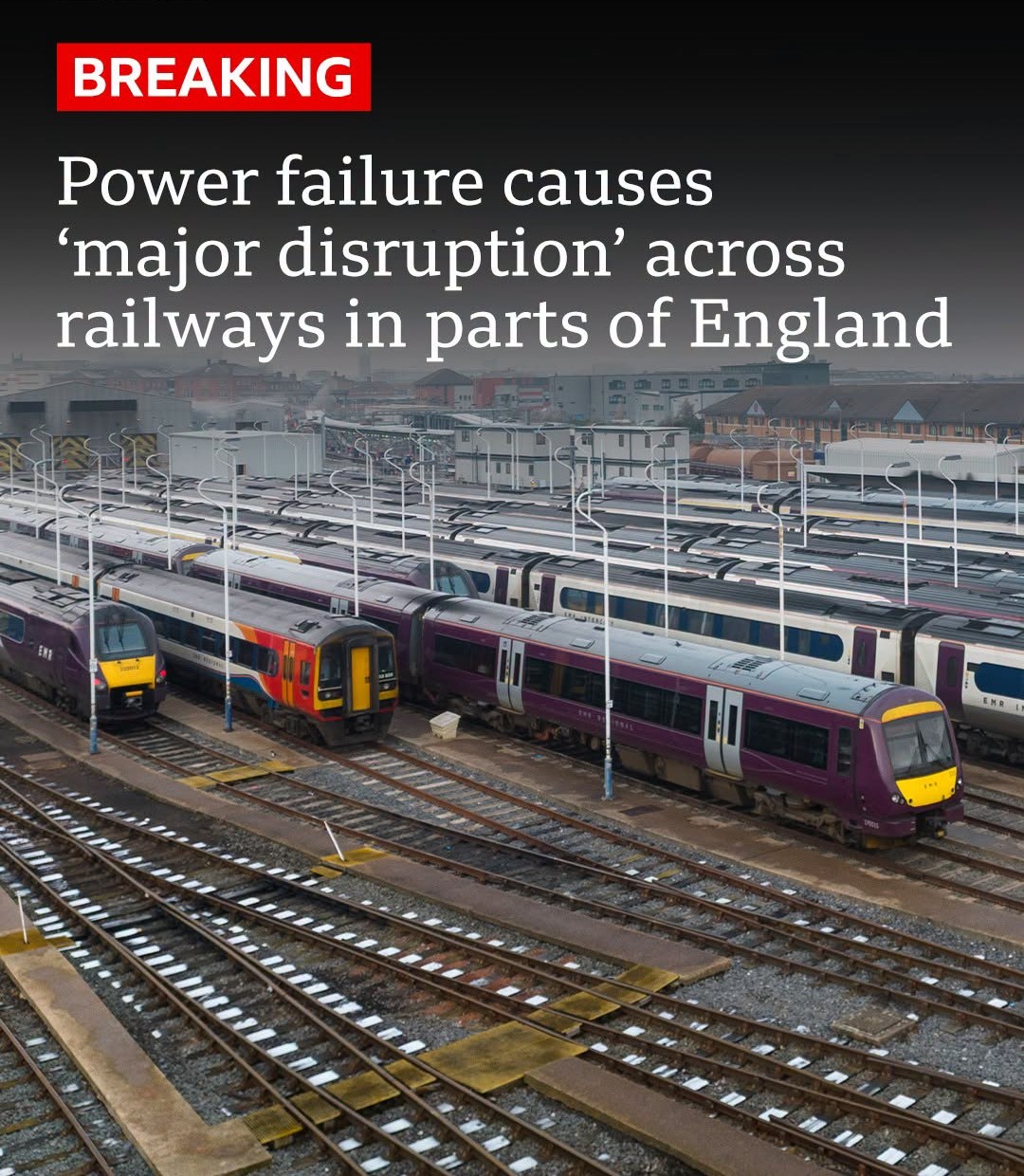
Major Rail Disruption Across the Midlands and Northern England Following Electrical Failure
Thousands of passengers faced significant travel disruption after a widespread electrical failure affected rail services across the Midlands and the north of England. The unexpected fault, which occurred during one of the busiest travel periods of the day, caused delays, cancellations, and confusion for commuters, business travelers, and holidaymakers alike.
According to National Rail, the electrical failure disrupted power supplies used by railway signaling and overhead line equipment, forcing train operators to reduce or suspend services on several major routes. Engineers were immediately dispatched to investigate the cause and restore normal operations, but officials warned that disruption could continue for several hours while repairs were carried out.
Stations that are usually bustling with activity quickly became crowded as passengers waited for updates. Long queues formed at ticket offices and customer service desks as travelers sought alternative routes or information about replacement services. Electronic departure boards displayed a growing list of delayed and canceled trains, while station announcements urged passengers to check before traveling.
Many commuters expressed frustration over the lack of certainty surrounding their journeys. Some reported waiting for more than an hour without receiving a confirmed departure time, while others decided to abandon their rail journeys altogether in favor of buses, taxis, or private vehicles.
The disruption affected several major cities across England, impacting routes connecting Birmingham, Manchester, Leeds, Sheffield, Nottingham, Liverpool, and surrounding areas. Services linking these cities with London also experienced knock-on delays as trains and crews were left out of position.
Rail operators worked closely with Network Rail to assess the situation. Engineers inspected substations, overhead electrical equipment, and signaling systems to identify the source of the failure. Safety remained the highest priority throughout the response, with officials emphasizing that services could not resume until infrastructure had been thoroughly checked.
Passengers were advised to avoid unnecessary travel where possible and to check live departure information before leaving home. Many train companies accepted tickets on alternative routes or coordinated with local bus operators to provide replacement transport for affected customers.
Businesses also felt the effects of the disruption. Employees traveling between regional offices found themselves stranded, while meetings and appointments were postponed as delays mounted throughout the day. Some employers encouraged staff to work remotely after realizing they would be unable to reach their destinations on time.
The disruption also affected students returning from universities, tourists visiting popular attractions, and families traveling during school holidays. Hotels near major railway stations reported increased inquiries from passengers who decided to stay overnight rather than continue uncertain journeys.
Transport experts noted that Britain’s rail network is highly interconnected, meaning that even a single infrastructure failure can quickly spread delays across hundreds of miles. When trains cannot reach their scheduled destinations, rolling stock and train crews become unavailable for later services, creating a domino effect that may last well beyond the original incident.
Network Rail engineers continued working throughout the afternoon, using specialist equipment to inspect damaged electrical components and safely restore power to affected sections of the railway. Control centers monitored progress in real time while coordinating with train operators to determine when services could gradually resume.
Throughout the incident, officials stressed the importance of accurate communication. Social media accounts, station announcements, and online journey planners were updated regularly as new information became available. Passengers were reminded that estimated departure times could change while repairs remained underway.
Rail passenger groups acknowledged the frustration experienced by travelers but praised frontline station staff who assisted customers under challenging circumstances. Many employees worked extended shifts to answer questions, distribute travel advice, and help vulnerable passengers find alternative arrangements.
Industry specialists explained that electrical failures can result from a variety of causes, including equipment faults, damaged cables, power supply interruptions, or external factors affecting railway infrastructure. Determining the precise cause often requires detailed technical inspections after services have been stabilized.
As repairs progressed, some routes gradually reopened with reduced timetables. Train operators warned, however, that delays could continue into the evening as the network recovered and displaced trains returned to their normal positions.
Passengers whose journeys were delayed or canceled were encouraged to retain their tickets and consult their train operator regarding compensation under existing delay repayment schemes.
By late evening, engineers had restored power to much of the affected network, allowing more trains to operate. Although services remained less frequent than usual, officials expressed confidence that a full timetable would return once final safety inspections had been completed.
The incident served as another reminder of the importance of maintaining resilient transport infrastructure. While modern railway systems are designed with multiple layers of safety and redundancy, unexpected technical failures can still have widespread consequences when they affect critical parts of the network.
For many travelers, the day ended later than planned. Yet despite the inconvenience, railway staff, engineers, emergency planners, and customer service teams worked together to restore operations as safely and efficiently as possible. Investigations into the exact cause of the electrical failure were expected to continue after normal services resumed, with lessons learned helping to strengthen the reliability of the railway network in the future.