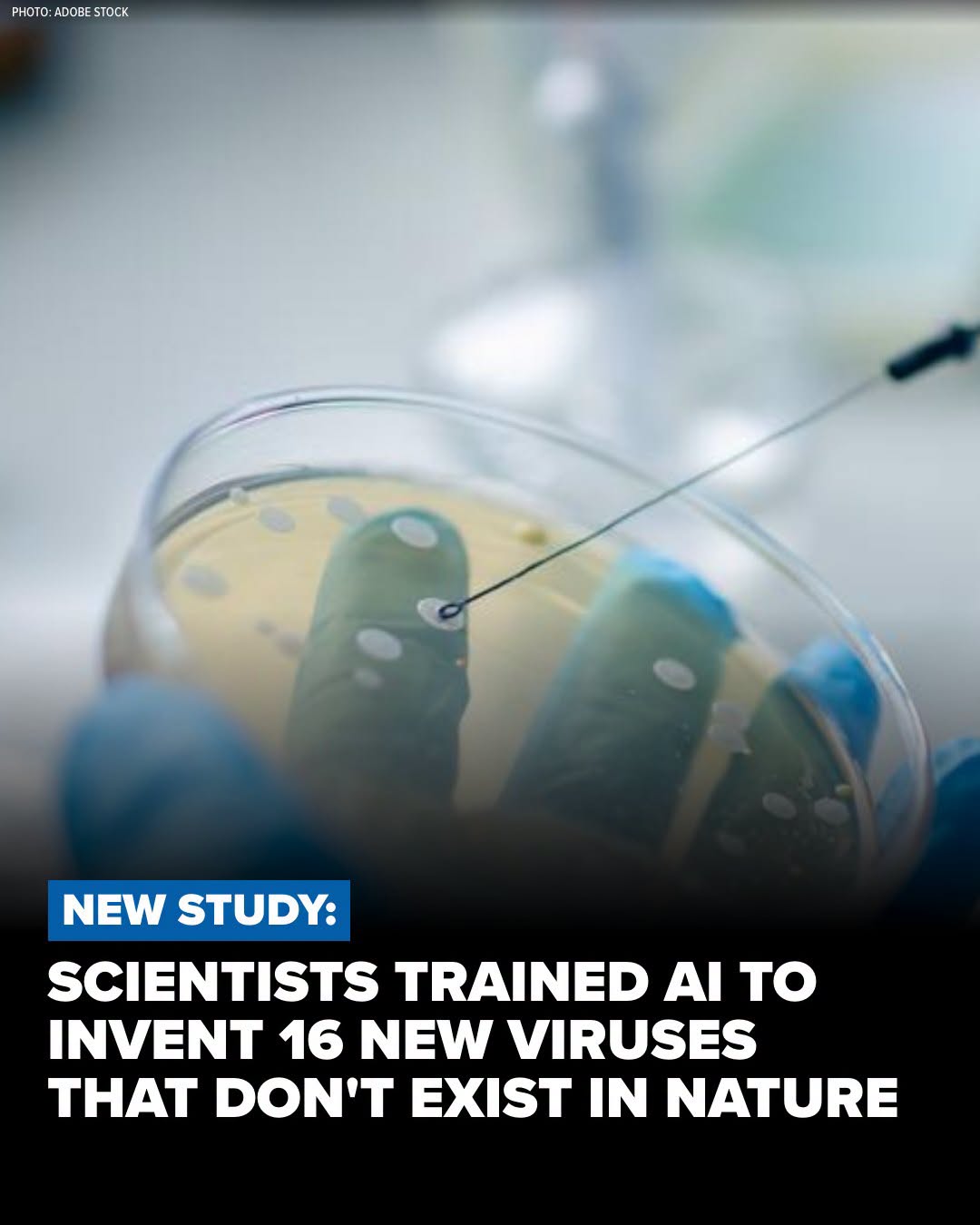
Scientists Used AI to Design 16 Entirely New Viruses That Don’t Exist in Nature — What It Could Mean for Medicine
Artificial intelligence is rapidly changing the way scientists approach biology.
Researchers can now use computational systems to analyze enormous amounts of biological information, identify patterns that would be difficult for humans to detect, and explore possibilities that might otherwise take years to investigate.
But a recent development has raised a difficult question: What happens when AI is used not only to study biological systems, but also to design biological entities that have never existed in nature?
Reports that scientists used artificial intelligence to design 16 entirely new viruses have attracted significant attention because of the potential medical benefits—and the serious biosecurity questions surrounding the technology.
The idea is both fascinating and unsettling.
On one hand, artificial intelligence could help researchers understand viruses in ways that were previously impossible. On the other, powerful computational tools could potentially lower barriers to biological experimentation, creating challenges for regulators, laboratories, and security experts.
The important point is that designing something computationally is not necessarily the same as producing a functioning biological agent.
A computer model can generate theoretical biological sequences or structures, but translating a computational design into a real-world biological system involves additional scientific and technical steps.
That distinction matters when evaluating claims about AI-designed viruses.
Nevertheless, researchers are increasingly interested in using AI to explore biological possibilities.
Traditional biological research can be slow.
Scientists may need to examine large databases, compare genetic information, test hypotheses, and conduct carefully controlled experiments.
AI can accelerate parts of this process by analyzing huge datasets and identifying relationships that might otherwise remain hidden.
This capability could eventually contribute to new approaches for treating disease.
Viruses themselves are not always purely harmful from a medical perspective.
Researchers have been studying viral systems for decades because certain viruses can interact with cells in highly specific ways.
Scientists have explored modified viral platforms for applications including gene delivery and other medical technologies.
The challenge is controlling those biological systems safely and reliably.
AI could potentially help researchers identify promising candidates before laboratory testing begins.
Instead of examining every possible biological possibility experimentally, researchers can use computational models to narrow the field.
That could save time and resources.
It could also help scientists better understand how biological systems behave.
But the same power that makes AI useful for medicine can create risks.
Biosecurity experts are concerned that increasingly sophisticated AI systems could eventually make it easier for inexperienced individuals—or malicious actors—to obtain dangerous biological information.
That concern is part of a much larger debate about the responsible development of artificial intelligence.
AI models are becoming capable of reasoning about increasingly complicated scientific problems.
They can summarize research, analyze data, generate hypotheses, and assist with experimental planning.
When these capabilities are applied to biology, the potential consequences are significant.
A technology that can accelerate beneficial research might also accelerate harmful research.
This is why scientists and policymakers increasingly emphasize the need for safeguards.
The goal is not necessarily to stop AI-assisted biological research.
Doing so could prevent important medical discoveries.
Instead, researchers are looking for ways to ensure that powerful systems are used responsibly.
One major area of concern is screening.
AI developers and biological laboratories can use safeguards designed to detect requests involving dangerous pathogens or other high-risk biological information.
The principle is similar to security screening in other sensitive technologies: potentially dangerous capabilities require additional controls.
Another concern is access.
Not every biological experiment should be equally accessible to everyone.
Research involving potentially dangerous organisms or biological systems may require specialized laboratories, trained personnel, institutional oversight, and regulatory approval.
AI does not eliminate those responsibilities.
In fact, the emergence of powerful biological AI tools may make them even more important.
There is also a communication challenge.
Sensational headlines can make scientific developments sound more immediately dangerous—or more immediately revolutionary—than they actually are.
The phrase “16 entirely new viruses” naturally sounds alarming.
But readers should ask what exactly “designed” means in the specific study being discussed.
Were the entities theoretical computational designs?
Were they experimentally evaluated?
Did they demonstrate biological activity?
What was the purpose of the research?
What safeguards were in place?
These questions are essential because the word “virus” can describe very different things depending on the scientific context.
Another important distinction concerns natural evolution.
Nature has produced an enormous diversity of viruses over billions of years.
Scientists have long studied how viral systems change, adapt, and interact with hosts.
AI-designed biological systems introduce a different possibility: computational exploration of biological configurations that may not have arisen naturally.
That is scientifically intriguing because researchers can potentially explore parts of biological design space that evolution has not sampled—or that scientists have not yet recognized.
But it also creates uncertainty.
If a biological system has no natural counterpart, researchers may have less historical information about how it behaves.
That is one reason safety evaluation is so important.
Scientists need to understand not only whether a system performs a desired function, but also whether it creates unexpected effects.
Biology is complicated.
Small changes can sometimes produce outcomes that are difficult to predict from computer models alone.
This is why responsible research generally involves multiple layers of testing and oversight.
Computational predictions can provide useful information, but they do not replace experimental evidence.
The potential medical applications remain one of the most exciting aspects of the technology.
AI could help researchers discover new biological tools, identify potential therapeutic strategies, and understand diseases at a deeper level.
It could eventually contribute to treatments that are more targeted and personalized.
The technology could also help scientists explore rare biological phenomena that would otherwise be difficult to study.
However, none of these possibilities should be interpreted as proof that revolutionary treatments are already available.
Scientific breakthroughs often begin with promising experiments.
Moving from an experimental result to a safe, effective treatment can take years.
Researchers must demonstrate reproducibility, understand risks, conduct appropriate testing, and satisfy regulatory requirements.
That process cannot simply be skipped because AI makes discovery faster.
The biosecurity debate therefore involves a difficult balancing act.
Scientists want enough freedom to explore potentially life-saving ideas.
Governments and institutions want to prevent dangerous misuse.
AI developers want their systems to be useful for legitimate scientific research while avoiding assistance that could meaningfully enable biological harm.
Achieving that balance will require cooperation among scientists, technology companies, governments, ethicists, security experts, and the broader public.
Transparency will also matter.
People need to understand what researchers are doing and why.
At the same time, transparency must be balanced against the possibility that publishing certain technical details could make dangerous biological capabilities easier to misuse.
That is a difficult ethical problem with no simple answer.
The emergence of AI-designed biological systems therefore represents more than a single scientific experiment.
It is a preview of a future in which artificial intelligence and biotechnology become increasingly interconnected.
That future could bring extraordinary benefits.
It could also create extraordinary responsibilities.
The central question is no longer simply whether AI can help scientists design new biological systems.
The question is whether society can develop the safeguards necessary to ensure that those capabilities remain focused on legitimate scientific and medical goals.
The reported 16 AI-designed viruses are therefore significant not only because of what they represent scientifically, but because they highlight the growing importance of biosecurity.
AI may help humanity understand biology faster than ever before.
But speed must be accompanied by caution.
Innovation without responsibility can create risks that are difficult to reverse.
The most promising future is one in which researchers can use AI to accelerate medicine while strong safeguards prevent dangerous applications.
If scientists, policymakers, and technology developers succeed in achieving that balance, AI-assisted biology could become an extraordinarily powerful tool for understanding disease and developing new treatments.
The breakthrough, in other words, may not simply be about creating something new.
It may be about learning how to explore the possibilities of biology while making sure that scientific progress remains safe.
That is the challenge now facing the scientific community—and it is one that will become increasingly important as artificial intelligence continues to transform what researchers can imagine, test, and ultimately discover.