RWE’s $1.2 Billion Offshore Wind Exit Raises Bigger Questions About America’s Energy Future
A major shift is taking place in the American energy landscape, and it involves a decision that would have seemed surprising only a few years ago.
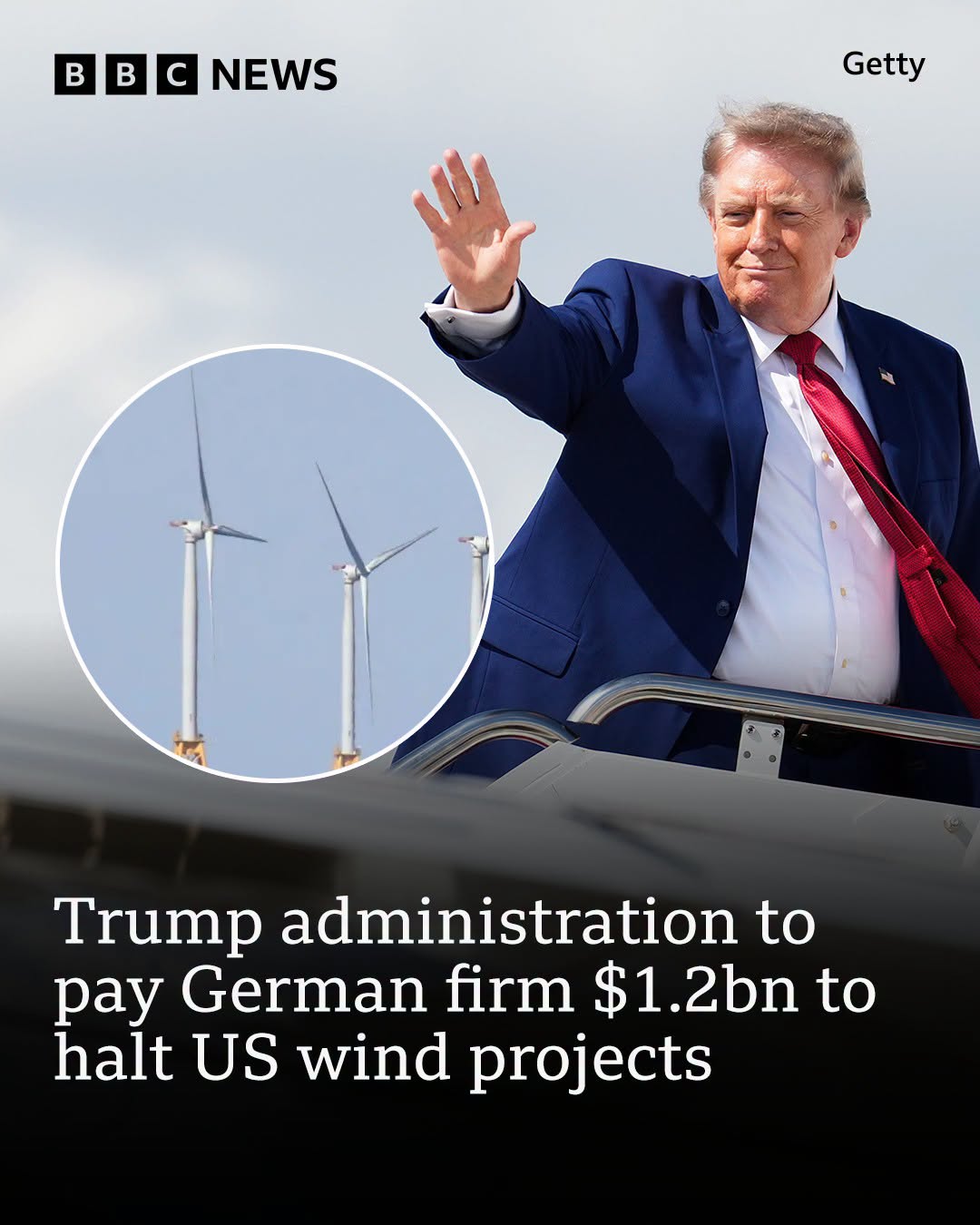
German energy company RWE has agreed to abandon three offshore wind leases in the United States after reaching a settlement worth roughly $1.2 billion with the U.S. Department of the Interior. The agreement concerns projects off the coasts of New York, California and Louisiana, and represents another major retreat from offshore wind development under President Donald Trump’s administration.
The announcement is significant not simply because one company is leaving several projects behind. It highlights a much larger debate about what kind of energy future the United States wants—and how government policy can influence billions of dollars in private investment.
RWE had been pursuing offshore wind opportunities in the United States as part of a broader international renewable-energy strategy. Offshore wind has attracted interest because coastal areas can provide strong and relatively consistent winds, while large turbines positioned far offshore can generate substantial amounts of electricity.
But developing an offshore wind farm is an enormous undertaking.
Projects require years of planning, environmental reviews, permits, financing, specialized vessels, manufacturing capacity and extensive infrastructure. Developers also have to navigate changing regulations and political priorities.
That last factor has become especially important in the United States.
The Trump administration has taken a much more skeptical approach to offshore wind than the previous administration. The president has repeatedly criticized wind energy, while his administration has pursued policies that have slowed or halted a number of offshore wind projects.
For companies investing billions of dollars in projects that may take years to complete, uncertainty can be almost as significant as cost.
RWE’s agreement therefore illustrates a difficult reality facing developers: an energy project can be technically possible and financially attractive on paper, yet become difficult to pursue when government policy changes dramatically.
According to reports, RWE determined that there was no realistic path to obtaining the necessary permits for its U.S. offshore wind projects in the foreseeable future. Rather than continuing to spend money on projects facing prolonged uncertainty, the company agreed to surrender its leases as part of the settlement.
The amount involved is enormous.
Approximately $1.2 billion is enough to attract attention under almost any circumstances. It also raises an obvious question: why would the U.S. government pay a company to stop developing renewable-energy projects?
The answer lies partly in the history of the leases and the legal and financial commitments surrounding them. The settlement is not simply a reward for abandoning an idea. Reports indicate that the agreement resolves disputes connected with the leases and compensates RWE as it gives them up.
Still, the broader political symbolism is difficult to ignore.
For years, governments around the world have encouraged investment in renewable energy. Wind and solar projects have been promoted as ways to diversify electricity supplies and reduce dependence on fossil fuels.
Now, in the United States, the direction is shifting.
RWE has said it plans to redirect investment toward conventional energy projects. Reports indicate that this includes a major investment in a liquefied natural gas export terminal project in Louisiana.
That does not mean RWE is abandoning renewable energy altogether.
The company continues to develop offshore wind projects in other parts of the world. In Europe, for example, RWE remains heavily involved in offshore wind development. Earlier this year, the company and Masdar received planning approval for two large Dogger Bank South projects in the United Kingdom with a combined planned capacity of 3 gigawatts.
That distinction is important.
The story is not simply “RWE gives up on wind.”
It is more accurately a story about RWE changing its investment strategy in response to conditions in the American market.
And that is where the issue becomes much larger than one company.
Energy infrastructure is built over decades. Power plants, pipelines, transmission lines, ports, wind farms and gas facilities can operate for many years after the politicians who approved them have left office.
When energy policy changes sharply from one administration to another, companies have to decide whether they can justify making investments that may take decades to recover.
That creates a difficult balancing act.
Supporters of the administration’s approach argue that the United States should prioritize reliable and affordable energy, reduce dependence on government subsidies, and avoid forcing consumers to pay for technologies that they believe remain too expensive or unreliable.
Critics argue that canceling offshore wind development could cause the United States to lose investment, manufacturing opportunities, jobs and technological expertise in a sector that other countries are aggressively developing.
Both sides are ultimately debating the same question:
What should America’s energy system look like in twenty or thirty years?
That question cannot be answered simply by looking at one project.
Offshore wind has advantages, but it also has challenges. Construction costs can be high. Supply chains can be complicated. Projects require major infrastructure and careful environmental assessment. Financing can become difficult when interest rates rise or regulations change.
At the same time, fossil fuels have their own costs and challenges, including emissions, price volatility and environmental impacts.
There is no energy source without trade-offs.
The real question is which combination of technologies provides the United States with the reliability, affordability, security and environmental outcomes it wants.
The RWE settlement demonstrates how strongly government policy can influence that answer.
It also sends a message to investors.
A company considering a multibillion-dollar American energy project has to think not only about today’s economics but also about tomorrow’s political environment.
Will permits still be available?
Will regulations remain stable?
Will demand exist?
Will the government support the project—or attempt to stop it?
Those questions can determine whether an investment moves forward.
For RWE, the answer appears to have been that continuing with its U.S. offshore wind leases was no longer commercially or practically sensible under the current conditions.
For supporters of the administration, the agreement may represent a victory: projects they believe are unnecessary or uneconomical will not move forward, while investment can be directed toward conventional energy infrastructure.
For opponents, however, the $1.2 billion price tag raises a very different concern.
They see government spending being used to unwind renewable-energy investments at a time when other countries are racing to develop their own clean-energy industries.
The debate is therefore likely to continue long after the headlines disappear.
One thing is clear: energy policy is never just about electricity.
It is about jobs.
It is about investment.
It is about national security.
It is about industrial competitiveness.
It is about environmental policy.
And ultimately, it is about deciding what kind of country the United States wants to build for the next generation.
RWE’s withdrawal from these offshore wind projects is only one chapter in that much larger story.
The turbines may never rise above the waters where these projects were planned. The construction contracts may never be signed. The expected electricity may never reach American homes and businesses.
But the decision itself will leave a mark.
It demonstrates how quickly an industry’s prospects can change when political priorities shift.
And it offers a powerful reminder that the energy transition is not simply a technological challenge. It is also a political, economic and financial one.
For RWE, the immediate future lies elsewhere.
For the United States, the bigger question remains unanswered: whether the country will ultimately pursue a diverse energy system that includes offshore wind alongside natural gas and other sources, or whether today’s policy shift will become the foundation of a much longer-term retreat from offshore wind.
Whatever happens next, the $1.2 billion agreement is more than a corporate transaction.
It is a symbol of an American energy debate that is far from over.