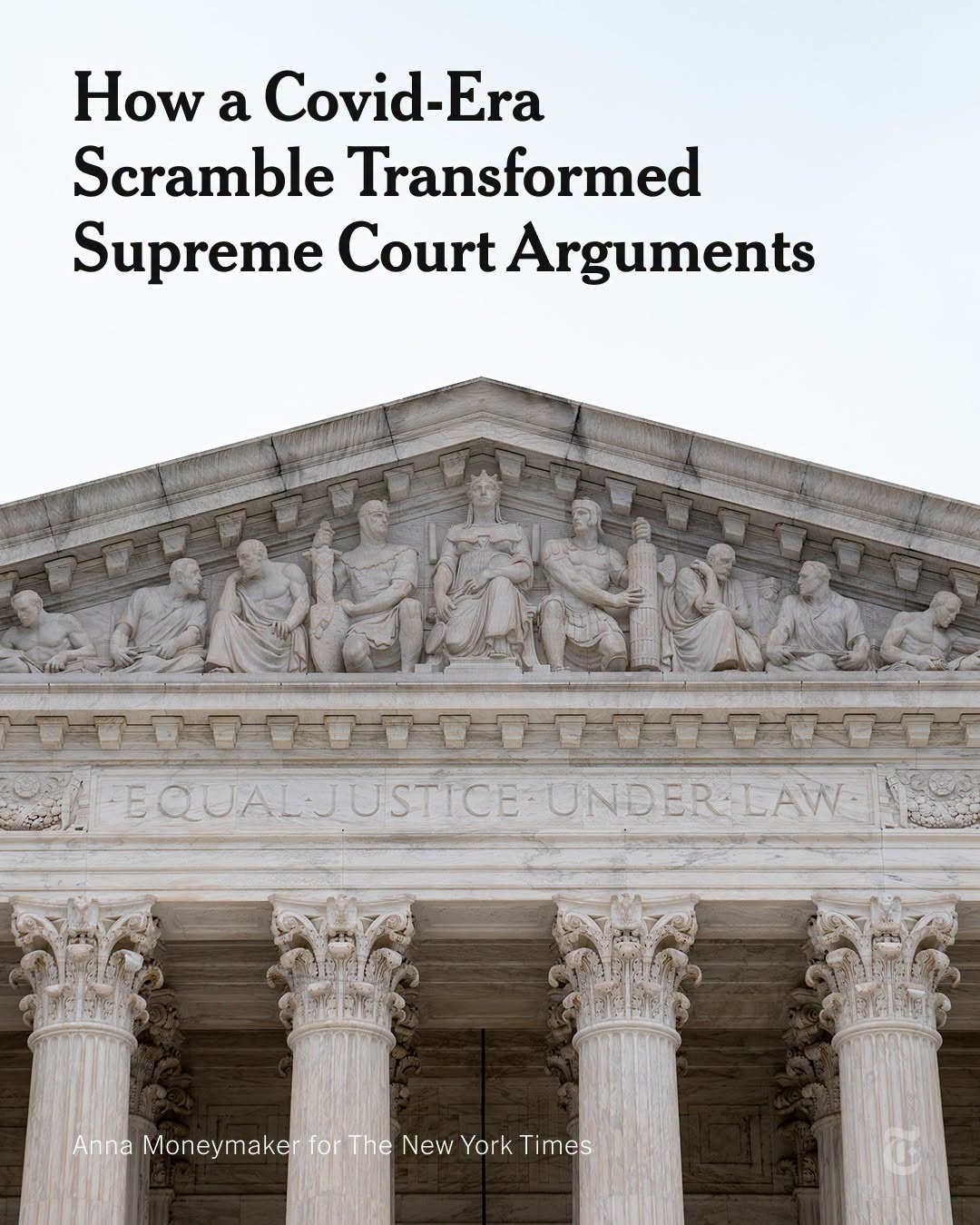
When the COVID-19 pandemic forced the United States into an unprecedented period of uncertainty, almost every major institution had to rethink how it operated. Schools moved online, businesses closed their doors, workplaces adopted remote meetings, and public gatherings were restricted. Even one of the country’s most traditional institutions—the Supreme Court—was forced to change the way it conducted its work.
The Supreme Court has long been associated with ceremony and tradition. The justices sit together in their courtroom, lawyers stand before them, and oral arguments unfold through a carefully structured exchange of questions and answers. For generations, the courtroom itself had remained remarkably consistent.
Then the pandemic arrived.
Suddenly, the justices could no longer safely gather in their courtroom.
Instead of allowing the judicial process to stop completely, the court adopted an approach that would have seemed extraordinary only months earlier: oral arguments would be conducted by telephone.
The change was practical, but it was also historic.
For the first time in its modern history, the Supreme Court had to reconsider how one of its most recognizable public rituals could function when the justices could not physically sit together.
The pandemic created an immediate problem.
The court still had cases to decide.
Lawyers still needed opportunities to present arguments.
The justices still needed to ask questions.
And the American public still had an interest in understanding how the nation’s highest court was considering important legal disputes.
Telephone arguments provided a solution.
But they also changed the character of the proceedings.
In the traditional courtroom, the justices could see one another. They could observe attorneys standing before them. They could read body language and facial expressions. The interaction had a physical rhythm that had developed over many years.
Telephone arguments removed much of that.
The justices were voices rather than people sitting together in the same room.
That meant the court had to develop new procedures.
One major adjustment involved the way justices asked questions.
Normally, Supreme Court oral arguments can be fast-paced. A justice may interrupt an attorney and begin asking a series of questions. Another justice may follow immediately. The exchange can become intense and unpredictable.
By telephone, that approach created obvious difficulties.
Several people speaking at once could make it difficult to hear.
A justice could unintentionally interrupt another justice.
Attorneys might not know who was about to speak.
The court therefore experimented with a more structured system.
Instead of allowing the justices to jump into the conversation whenever they wished, the court gave them opportunities to ask questions in sequence.
This change may sound small, but it affected the rhythm of oral arguments.
The traditional Supreme Court courtroom had always been partly defined by spontaneity. Justices could challenge attorneys immediately and react to one another in real time.
The telephone format imposed greater order.
For some observers, that made the proceedings easier to follow.
For others, it made them feel less like the Supreme Court people had known for generations.
Another important change involved public access.
Because the arguments were being conducted by telephone, the court allowed the public to listen to live audio of the proceedings.
That was significant.
For much of its history, the Supreme Court had maintained a level of distance from the public that distinguished it from other branches of government.
Unlike Congress, the court did not routinely provide live television coverage of its proceedings.
Its courtroom was open to the public, but physical attendance was limited by space and security.
The pandemic changed that dynamic.
Suddenly, people who could never have found a seat inside the courtroom could listen to the justices debate major constitutional questions from their own homes.
The change was partly a practical response to the emergency.
But it also created a new expectation.
If the public could listen to Supreme Court arguments remotely, some began asking why such access should disappear once the pandemic ended.
The issue raised an important question about transparency.
How much access should citizens have to the country’s highest court?
The Supreme Court has enormous influence over American life. Its decisions can affect elections, civil rights, presidential power, criminal law, business regulation, privacy, education, and many other areas.
Yet the court is also designed to operate differently from the political branches.
Justices are appointed rather than elected.
They serve during good behavior, generally meaning they have lifetime tenure.
Their role is to interpret the Constitution and federal law rather than respond directly to public opinion.
That independence is considered essential to the judicial system.
But independence does not necessarily mean isolation.
The pandemic experience demonstrated that the public could gain greater access without turning the court into a political institution.
Listening to arguments does not mean controlling the outcome.
It simply allows citizens to hear the reasoning.
The experiment therefore generated a broader discussion about what the Supreme Court should look like in the modern era.
Should the court return completely to its traditional procedures?
Should some of the pandemic-era changes remain?
Should oral arguments continue to be available through modern technology?
These questions are complicated because traditions can serve important purposes.
The Supreme Court’s rituals are not accidental.
The robes, courtroom, formal language, seating arrangements, and procedures communicate the seriousness of the institution.
They remind participants that the court is not simply another political meeting.
It is a constitutional tribunal with a unique role.
Yet traditions can also become barriers when circumstances change.
The pandemic demonstrated that even the Supreme Court could adapt quickly when necessary.
That realization itself was important.
For decades, many institutions had assumed that certain procedures could not easily be changed.
Then COVID-19 forced them to change.
The justices adapted.
Lawyers adapted.
Court staff adapted.
And the public adapted.
The result was not perfect.
Telephone arguments created technical challenges and occasionally made the proceedings feel less natural. The lack of visual interaction removed some of the human elements of courtroom debate.
But the system worked.
The court continued hearing cases.
It continued issuing decisions.
And the legal system did not collapse simply because the justices were no longer sitting together in their traditional courtroom.
That experience may ultimately prove to be one of the pandemic’s lasting institutional lessons.
Organizations can preserve their essential functions while changing the methods they use.
The Supreme Court’s experience also demonstrated that technology can alter public expectations.
Once people have experienced easier access to government proceedings, they may question why that access should disappear.
The pandemic therefore did more than temporarily move Supreme Court arguments onto telephones.
It challenged assumptions about what a modern court should look like.
It raised questions about transparency, tradition, technology, and public participation.
Most importantly, it showed that institutions built around centuries of tradition are not necessarily frozen in time.
They can adapt when circumstances demand it.
The courtroom may remain a powerful symbol of the Supreme Court, but the pandemic revealed that the institution’s work does not depend entirely on the physical space.
Judicial decisions depend on legal reasoning, constitutional interpretation, evidence, advocacy, and deliberation.
Those things can continue even when the justices are separated.
The experience also offered a rare glimpse into how quickly tradition can change.
What once seemed unimaginable—Supreme Court justices conducting arguments remotely—became reality almost overnight.
And once it happened, it became difficult to pretend that the old system was the only possible system.
The pandemic forced the Supreme Court to experiment.
That experiment unsettled some observers, while others saw an opportunity for greater transparency.
Either way, the change became part of the court’s history.
The COVID-19 pandemic eventually receded, but its impact on institutions did not disappear with it.
For the Supreme Court, one of the most important questions left behind was not simply how to conduct oral arguments during an emergency.
It was whether some of the changes introduced during that emergency could improve the relationship between the court and the public.
The answer remains part of an ongoing conversation about technology, transparency, and judicial tradition.
What began as a temporary response to a global health crisis ultimately became something much larger: a reminder that even America’s most traditional institutions can be transformed by extraordinary circumstances.
And sometimes, once an institution discovers a different way of doing things, it can never completely return to the way it was before.