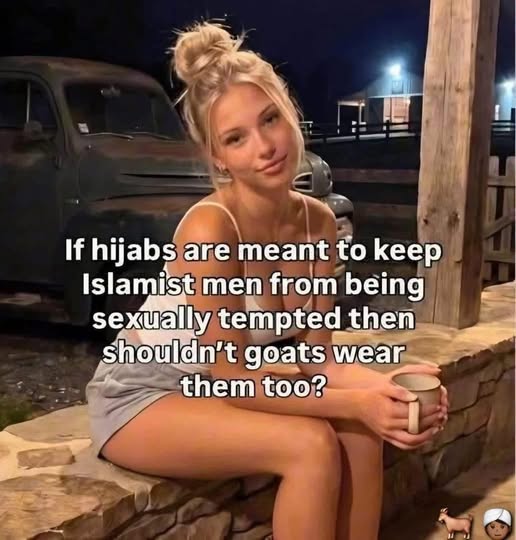
The Hijab Debate: A Viral Meme Raises Questions About Modesty, Choice, and Responsibility… See More
A single image can sometimes start a conversation far bigger than anyone expected.
That is exactly what happens when a viral meme touches on the subject of hijab. What may begin as a joke, a provocative comparison, or a simple social-media post can quickly become a debate about religion, modesty, personal freedom, cultural expectations, and responsibility.
For some viewers, the hijab represents faith, dignity, devotion, and a deeply personal relationship with God. For others, the discussion raises questions about whether women should have complete freedom to decide how they dress. Still others see the subject through the lens of culture, family expectations, or government policy.
The disagreement is complicated because there is no single experience shared by every Muslim woman.
For some women, wearing a hijab is an important religious commitment. Egypt’s Dar Al-Ifta, for example, describes hijab as part of Islamic dress intended to promote modesty and says that covering the hair is obligatory for adult Muslim women according to its interpretation of Islamic law.
But religious belief and personal choice can exist within the same conversation.
A woman may choose to wear a hijab because she believes it strengthens her faith. Another may wear it because it connects her to her family or community. Another may choose not to wear one. The reasons can be deeply personal.
That is why simplistic memes can be misleading.
A picture cannot explain an individual’s beliefs, circumstances, or relationship with religion.
The debate over hijab has existed for generations, but social media has made it much louder. Memes can compress complicated questions into a few words or a striking image. Their simplicity makes them easy to share, but that same simplicity can erase important context.
A complicated question becomes a binary argument.
“Is hijab oppression?”
“Is refusing hijab disrespectful?”
“Should women be required to cover?”
“Should women be prohibited from covering?”
These questions may sound straightforward, but the answers depend heavily on religious interpretation, individual beliefs, culture, and the legal environment in which a person lives.
One of the most important principles in the debate is consent.
A woman who chooses to wear hijab should not be mocked or treated as less intelligent because of her clothing. Likewise, a woman who chooses not to wear hijab should not automatically be treated as immoral or assumed to lack respect for Islam.
Respecting personal dignity requires recognizing that women can make decisions about their own lives for different reasons.
Interestingly, research has shown that Muslims themselves hold varied views about whether women should decide for themselves whether to wear a veil. Pew Research Center found major differences between countries and regions, with substantial majorities in many surveyed countries supporting a woman’s right to decide.
That diversity is important.
It challenges the idea that there is one universal Muslim perspective on the social meaning of hijab.
At the same time, it would also be inaccurate to suggest that religious teachings have nothing to do with the practice. Many Muslims sincerely understand hijab as a religious obligation rather than merely a cultural fashion choice.
For those women, wearing it can be an expression of devotion.
The meaning may be invisible to an outsider, but that does not make it less real.
This is where the viral meme debate can become uncomfortable.
When people see a woman wearing a hijab, they may immediately attach assumptions to her. Some may assume she is oppressed. Others may assume she is exceptionally religious. Neither assumption necessarily tells us anything about the individual person.
Clothing does not reveal an entire personality.
A hijab can be religious.
It can also be cultural.
It can be both.
And the person wearing it may have a completely different explanation.
The same principle applies to modesty.
Modesty is not limited to one religion or one type of clothing. Different cultures have different ideas about what constitutes appropriate dress. What one society considers revealing may be considered ordinary somewhere else.
Even within the Muslim world, clothing traditions vary enormously.
There is no single universal Muslim style.
This diversity becomes particularly important when memes portray hijab as though it has only one meaning.
They can unintentionally reinforce stereotypes rather than encouraging understanding.
Another major question concerns responsibility.
Some arguments about modesty place responsibility primarily on women and what they wear. But Islamic teachings about modesty also address men. Dar Al-Ifta’s explanation, for example, discusses expectations concerning men’s behavior and lowering the gaze alongside women’s dress.
That point matters because modesty is not simply about controlling women’s bodies.
It can also involve behavior, respect, self-discipline, and how people treat one another.
A society that talks about modesty only in terms of women’s clothing is having an incomplete conversation.
At the same time, women should not be forced to accept someone else’s definition of modesty simply because it is culturally dominant.
That brings the discussion back to choice.
Freedom becomes complicated when governments become involved.
Some governments have attempted to restrict religious clothing, while others have mandated particular forms of religious dress. The U.S. Commission on International Religious Freedom has argued that both prohibitions and mandates involving religious clothing can conflict with freedom of religion or belief under international human-rights principles.
This creates an important distinction.
There is a difference between a person choosing religious clothing because of personal belief and a government forcing that person to wear it.
There is also a difference between personal choice and a government preventing someone from wearing it.
In both situations, the woman’s autonomy can become secondary to someone else’s authority.
That is why the hijab debate should not simply be framed as “traditional versus modern.”
A woman can be religious and independent.
She can wear a hijab and pursue a professional career.
She can remove a hijab and remain deeply connected to her faith.
She can change her decision over time.
People’s relationships with religion can evolve.
The internet often struggles with that complexity.
Social media encourages quick judgments. Users see an image, decide what it means, and immediately share their opinion. The person at the center of the image may have no opportunity to explain her perspective.
A viral meme can therefore become a mirror of the viewer’s assumptions rather than a reflection of reality.
That does not mean controversial conversations should be avoided.
Quite the opposite.
The hijab debate deserves thoughtful discussion because it touches fundamental questions about religion, gender, identity, freedom, and cultural expectations.
But the discussion should begin with respect.
A Muslim woman should not be reduced to a piece of clothing.
A non-Muslim woman should not be judged for choosing different clothing.
And neither should be treated as incapable of making decisions simply because someone else disagrees with those decisions.
Perhaps the most useful question is not, “What does the hijab mean?”
It is:
“What does it mean to the woman wearing it?”
For one person, the answer may be faith.
For another, identity.
For another, family.
For another, culture.
And for someone else, there may be no connection to hijab at all.
Those differences do not have to prevent respectful conversation.
A viral meme may create the argument, but it does not have to determine the conclusion.
The strongest conversations happen when people move beyond stereotypes and ask questions instead of assuming they already know the answer.
Hijab is not simply fabric.
It can carry religious meaning, cultural history, personal identity, and emotional significance.
That is precisely why the debate deserves more than a meme.
It deserves context.
It deserves empathy.
And most importantly, it deserves recognition that behind every photograph is a person with her own beliefs, experiences, and choices.
See More — and think twice before judging someone by what she wears.