Jake Lang’s Controversial EPIC Mosque Protest Sparks Outrage and Questions About Free Speech — See More
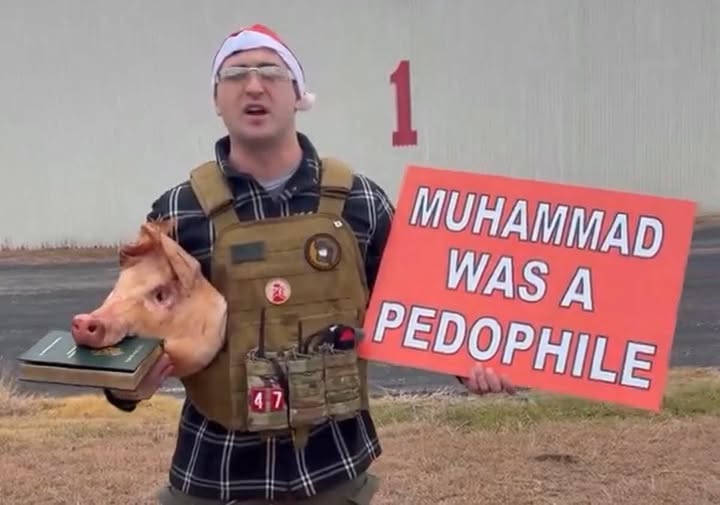
A deeply provocative protest outside a Texas mosque drew widespread attention after political activist Jake Lang appeared carrying a pig’s head with a Quran placed inside its mouth.
The demonstration took place outside the East Plano Islamic Center, commonly known as EPIC, in Plano, Texas, in December 2025. Lang organized an anti-Islam protest that included other highly provocative imagery and rhetoric. PBS later reported on the incident as part of broader tensions surrounding the EPIC community and political controversy over the proposed EPIC City development.
The images were disturbing to many Muslims because pigs are considered unclean in Islam and the Quran is Islam’s sacred scripture. Combining the two in a deliberately provocative display was therefore interpreted by many observers as an intentional attempt to offend and intimidate.
The incident immediately raised a difficult question:
Where does protected political expression end and religious harassment begin?
That question has no simple answer.
The United States has exceptionally strong constitutional protections for speech and religious expression. People are generally permitted to express even deeply offensive political or religious opinions. But those freedoms exist alongside laws addressing threats, violence, trespassing, harassment, and other unlawful conduct.
That distinction is important when discussing controversial protests.
A person may have a constitutional right to express hatred toward an idea or religion. That does not automatically give that person the right to threaten individuals, damage property, assault someone, or commit another crime.
In the case of the EPIC protest, reporting indicates that police were present as tensions increased between demonstrators and counter-protesters. TPUSA reported that the demonstration included a severed pig’s head, live pigs, and other provocative displays.
For members of the Muslim community, the demonstration was about more than politics.
A mosque is a place of worship.
People arrive there to pray, study, meet friends, and participate in their religious community. Seeing a protest featuring deliberately offensive religious imagery outside that environment can naturally feel threatening, even if the protesters claim they are exercising free speech.
Yasir Qadhi, a scholar associated with EPIC, later described the incident in an interview with PBS. He questioned the purpose of bringing such an offensive display to a mosque and characterized it as a media spectacle.
That observation touches on a larger feature of modern political activism.
Provocation attracts attention.
A conventional political speech might receive limited coverage. A shocking image, however, can spread across social media almost instantly. Once photographed or recorded, it can reach audiences far beyond the original protest.
For activists seeking publicity, controversy can therefore become part of the strategy.
But publicity comes with consequences.
The more extreme the imagery becomes, the more likely it is to deepen divisions between communities. Instead of encouraging a discussion about immigration, religious freedom, development, or constitutional principles, the conversation can become dominated by outrage over the protest itself.
That appears to have happened here.
The EPIC controversy was already part of a larger political dispute surrounding EPIC City, a proposed Muslim-oriented residential development in Texas. The project generated intense debate, with opponents raising concerns about its religious character and supporters arguing that Muslims have the same rights as other communities to build homes, schools, businesses, and places of worship. PBS reported that the controversy had become intertwined with broader political rhetoric about Islam in Texas.
Lang’s protest therefore did not occur in isolation.
It was part of a larger political environment in which questions about immigration, Islam, religious freedom, and American identity were already generating intense disagreement.
For some supporters of the demonstration, the protest represented resistance to what they viewed as increasing Islamic influence in America.
For critics, however, the language and imagery crossed a line from political disagreement into religious hatred.
This disagreement illustrates one of the central challenges of free speech.
Freedom of expression is most important when people say things we dislike.
If the government could simply prohibit every offensive opinion, freedom of speech would become meaningless. But protecting speech does not require society to approve of what is being said.
A person can defend someone’s legal right to make an offensive statement while simultaneously condemning the statement itself.
That distinction is essential.
The response from the Muslim community also deserves attention.
People living around EPIC have continued to face protests and public controversy surrounding the mosque and proposed development. Dallas Morning News reported in February 2026 that volunteers at the mosque had continued outreach efforts despite heckling protesters, emphasizing a strategy of responding to hostility with community engagement.
That approach represents an alternative to escalation.
Instead of responding to provocation with more provocation, community leaders can attempt to explain their beliefs, welcome neighbors, and demonstrate that religious differences do not automatically require hostility.
Of course, that does not mean people should simply ignore genuine threats.
Anyone who feels endangered has a legitimate reason to seek assistance from law enforcement and community organizations. Peaceful protest and intimidation are not the same thing, and determining which category applies depends on the specific facts and applicable law.
That is why claims that someone “must be arrested” should be treated carefully.
Being offensive is not automatically a criminal offense in the United States.
An arrest requires a legal basis.
The fact that many people find an act disgusting, insulting, or hateful does not by itself establish that a crime occurred.
At the same time, the First Amendment does not provide unlimited protection for every action performed during a protest. Threats, physical violence, vandalism, and certain forms of unlawful conduct can have legal consequences.
Those questions must be determined from evidence rather than social-media outrage.
The EPIC incident also demonstrates how quickly religious controversy can become a national story.
A protest in one Texas community can be photographed, uploaded, reposted, debated, and transformed into an international conversation within hours.
That speed can be useful when exposing genuine wrongdoing.
But it can also make misinformation spread rapidly.
One particularly important lesson is to distinguish the original event from later headlines.
The protest involving Lang occurred in December 2025. It should not be presented as though it happened “minutes ago” or “today” without evidence supporting such a claim. The underlying incident is real, but sensational descriptions can make an older event appear newly occurring.
That matters because people deserve accurate information.
The debate over Islam, religious freedom, immigration, and American identity will undoubtedly continue. Americans have different beliefs about all of these subjects, and disagreement is part of democratic society.
But disagreement does not require dehumanization.
People can criticize a religion without attacking individual believers.
They can oppose a development project without insulting an entire faith community.
They can defend free speech without celebrating hateful imagery.
And they can condemn offensive behavior without demanding punishment that the law does not authorize.
Those distinctions are difficult in an era of viral politics.
Social media rewards outrage.
The most shocking photograph often receives the most attention.
The loudest argument can overpower the most thoughtful one.
Yet the answer to controversial speech should not automatically be more outrage.
It should be facts, lawful conduct, and serious discussion.
The images from the EPIC protest are undeniably provocative. They were designed to provoke a reaction, and they succeeded.
But perhaps the more important question is what happens afterward.
Does the controversy push communities further apart?
Or can it encourage people to understand why the imagery was so offensive while still defending the principle of lawful expression?
That is the difficult balance.
Free speech protects the right to express unpopular ideas.
Religious freedom protects the right to practice one’s faith.
Equal protection means Muslims should have the same legal rights as everyone else.
And the rule of law requires that actual crimes be investigated based on evidence rather than political pressure.
The EPIC controversy sits at the intersection of all four principles.
That is why it continues to generate debate.
The strongest response to a provocative political spectacle may ultimately be refusing to let the spectacle become the entire story.
Behind the viral image are real people, real communities, constitutional rights, and difficult questions about how Americans with profoundly different beliefs can share the same country.
Those questions deserve better than a headline.
They deserve facts.
They deserve context.
And they deserve a conversation that is passionate without becoming hateful.
See More — and remember to separate the verified facts from the sensational claims surrounding them.